


Adolescents' depressive moods and parents' family-work interaction
- PMID: 36684857
- PMCID: PMC9852992
- DOI: 10.3389/fpubh.2022.975935
Adolescents' depressive moods and parents' family-work interaction
Abstract
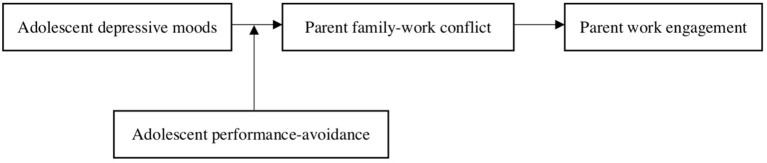
Introduction: For working parents with dependent children, parenthood is essential to their "life" component, which could profoundly influence their work experiences. Since depressive moods rise sharply in adolescence, this study aims to investigate the relationship between children's depressive moods and parental family-work interaction. Integrating the literature on emotions and family-work interaction, I propose that adolescents' depressive moods (over the past 2 weeks) decrease parents' work engagement via increased parents' family-work conflict. Further, I hypothesize that adolescent performance-avoidance, a key trait related to adolescents' long-term emotional experiences, moderates the indirect relationship.
Methods: Using a multiple-source, time-lagged design, I tested hypotheses using data collected from 468 adolescent-parent dyadic from China.
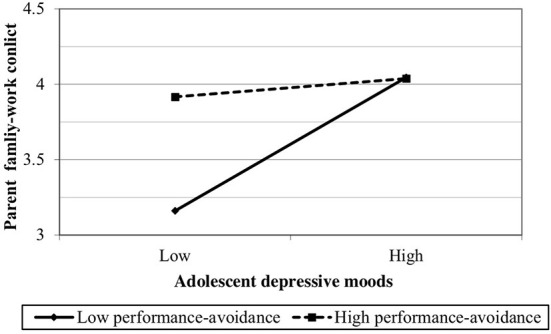
Results: I found that adolescents' depressive moods relate negatively to their parents' work engagement via increased parents' family-work conflict when adolescents have low levels of performance-avoidance. When an adolescent has a high level of performance-avoidance, parents show a relatively higher degree of family-work conflict and lower work engagement regardless of adolescents' depressive moods.
Discussion: I discuss the theoretical and practical implications for employee family-work interaction and work engagement.
Keywords: adolescent depressive moods; child-parent level; family-work conflict; performance-avoidance; work engagement.
Copyright © 2023 Lu.
Conflict of interest statement
The author declares that the research was conducted in the absence of any commercial or financial relationships that could be construed as a potential conflict of interest.
Figures
References
-
- Kessler RC, Avenevoli S, Costello EJ, Georgiades K, Green JG, Gruber MJ, et al. Prevalence, persistence, and sociodemographic correlates of dsm-iv disorders in the national comorbidity survey replication adolescent supplement. Arch General Psychiatry. (2012) 69:372–80. 10.1001/archgenpsychiatry.2011.160 - DOI - PMC - PubMed
-
- Niu GF, Sun XJ, Tian Y, Fan CY, Zhou ZK. Resilience moderates the relationship between ostracism and depression among Chinese adolescents. Person Individual Differ. (2016) 99:77–80. 10.1016/j.paid.2016.04.059 - DOI
-
- National Institute of Mental Health. Major Depression Among Adolescents. (2017). Available online at: https://www.nimh.nih.gov/health/statistics/prevalence/major-depression-a... (accessed March 6, 2018).
-
- Garrison A, Maselko J, Saurel-Cubizolles M, Courtin D, Zoumenou R, Boivin MJ, et al. The impact of maternal depression and parent–child interactions on risk of parasitic infections in early childhood: a prospective cohort in benin. Matern Child Health J. (2022) 26:1049–58. 10.1007/s10995-021-03317-x - DOI - PMC - PubMed
Publication types
MeSH terms
LinkOut - more resources
Full Text Sources
Medical
Miscellaneous
