


CRISPR/Cas9-editing of KISS1 to generate pigs with hypogonadotropic hypogonadism as a castration free trait
- PMID: 36685939
- PMCID: PMC9854396
- DOI: 10.3389/fgene.2022.1078991
CRISPR/Cas9-editing of KISS1 to generate pigs with hypogonadotropic hypogonadism as a castration free trait
Abstract
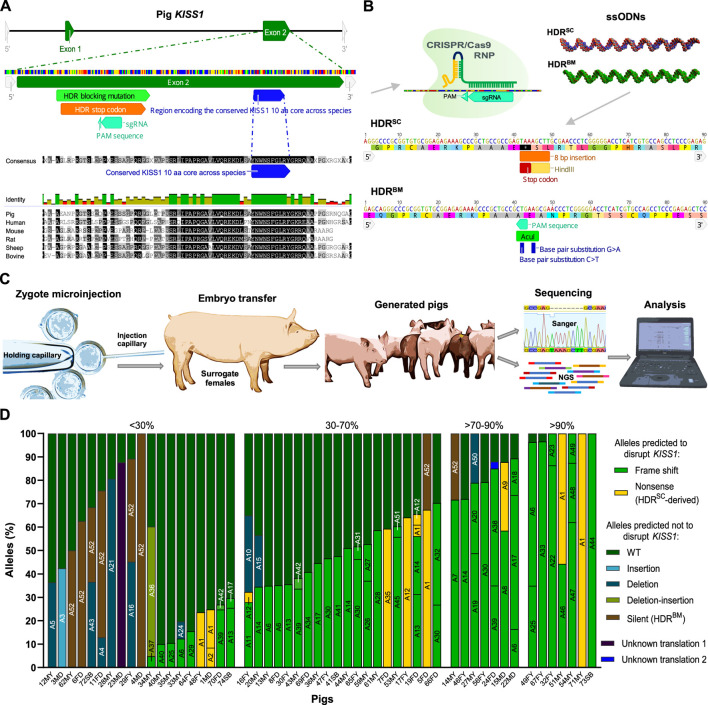
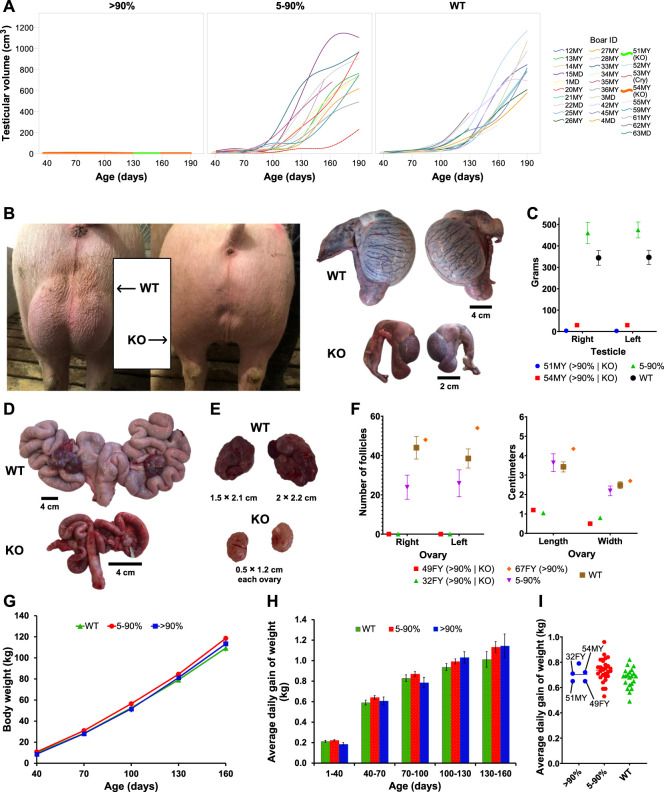
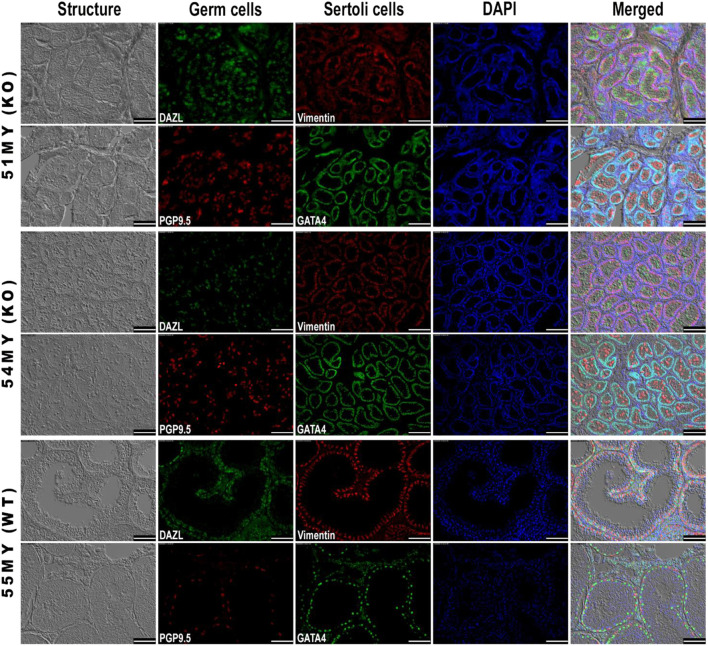
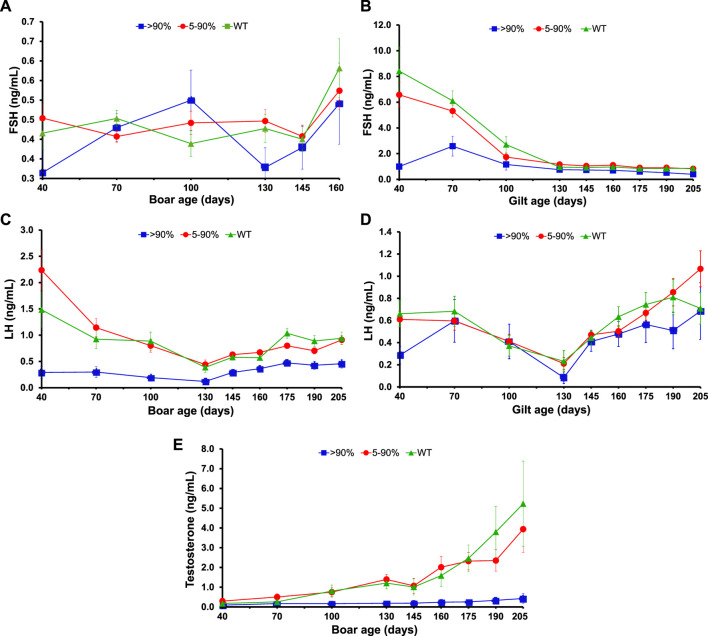
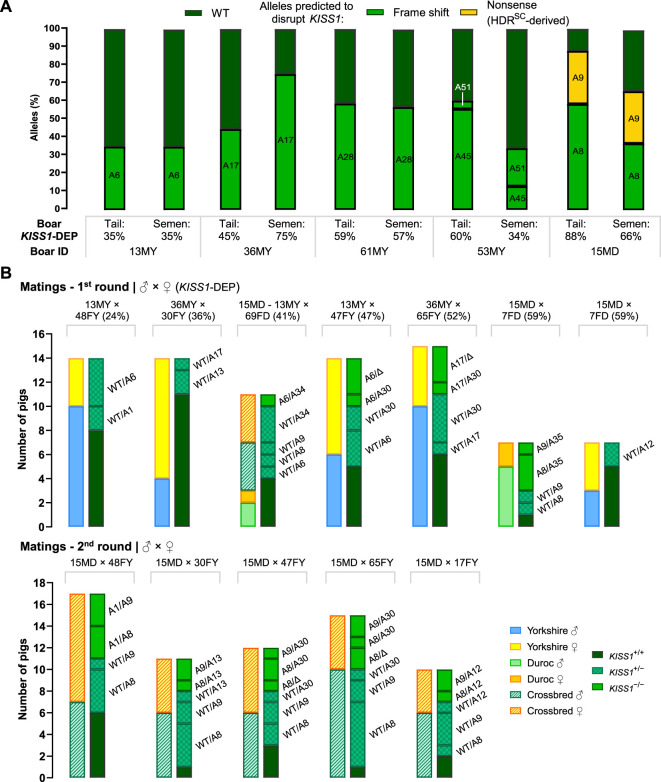
Introduction: Most male pigs are surgically castrated to avoid puberty-derived boar taint and aggressiveness. However, this surgical intervention represents a welfare concern in swine production. Disrupting porcine KISS1 is hypothesized to delay or abolish puberty by inducing variable hypogonadotropism and thus preventing the need for castration. Methods: To test this hypothesis, we generated the first KISS1-edited large animal using CRISPR/Cas9-ribonucleoproteins and single-stranded donor oligonucleotides. The targeted region preceded the sequence encoding a conserved core motif of kisspeptin. Genome editors were intracytoplasmically injected into 684 swine zygotes and transferred to 19 hormonally synchronized surrogate sows. In nine litters, 49 American Yorkshire and 20 Duroc liveborn piglets were naturally farrowed. Results: Thirty-five of these pigs bore KISS1-disruptive alleles ranging in frequency from 5% to 97% and did not phenotypically differ from their wild-type counterparts. In contrast, four KISS1-edited pigs (two boars and two gilts) with disruptive allele frequencies of 96% and 100% demonstrated full hypogonadotropism, infantile reproductive tracts, and failed to reach sexual maturity. Change in body weight during development was unaffected by editing KISS1. Founder pigs partially carrying KISS1-disruptive alleles were bred resulting in a total of 53 KISS1 +/+, 60 KISS1 +/-, and 34 KISS1 -/- F1 liveborn piglets, confirming germline transmission. Discussion: Results demonstrate that a high proportion of KISS1 alleles in pigs must be disrupted before variation in gonadotropin secretion is observed, suggesting that even a small amount of kisspeptin ligand is sufficient to confer proper sexual development and puberty in pigs. Follow-on studies will evaluate fertility restoration in KISS1 KO breeding stock to fully realize the potential of KISS1 gene edits to eliminate the need for surgical castration.
Keywords: animal welfare; boar taint; embryo editing; homology-directed repair; kisspeptin; knockout; pig puberty.
Copyright © 2023 Flórez, Martins, Solin, Bostrom, Rodríguez-Villamil, Ongaratto, Larson, Ganbaatar, Coutts, Kern, Murphy, Kim, Carlson, Huisman, Sonstegard and Lents.
Conflict of interest statement
The authors JF, KM, JB, PR-V, FO, SL, E-SK, and TS are employed by Acceligen Inc., a wholly owned subsidiary of Recombinetics Inc.; SS, UG, AC, and DC are employed by Recombinetics Inc. AH is an employee of Hendrix Genetics. These companies contributed supplemental funding for this study. The remaining authors declare that the research was conducted in the absence of any commercial or financial relationships that could be construed as a potential conflict of interest.
Figures
References
-
- American Veterinary Medical Association (2020). AVMA guidelines for the euthanasia of animals: 2020 edition. Available at: https://www.avma.org/sites/default/files/2020-02/Guidelines-on-Euthanasi... (Accessed February 24, 2022).
-
- Backus G., Higuera M., Juul N., Nalon E., de Briyne N. (2018). Second progress report 2015 – 2017 on the European declaration on alternatives to surgical castration of pigs. Brussels: Available at: https://www.boarsontheway.com/wp-content/uploads/2018/08/Second-progress... (Accessed December 12, 2022).
LinkOut - more resources
Full Text Sources
Research Materials
