


Depiction of immune heterogeneity of peripheral blood from patients with type II diabetic nephropathy based on mass cytometry
- PMID: 36686486
- PMCID: PMC9853014
- DOI: 10.3389/fendo.2022.1018608
Depiction of immune heterogeneity of peripheral blood from patients with type II diabetic nephropathy based on mass cytometry
Erratum in
-
Corrigendum: Depiction of immune heterogeneity of peripheral blood from patients with type II diabetic nephropathy based on mass cytometry.Front Endocrinol (Lausanne). 2023 Mar 7;14:1168889. doi: 10.3389/fendo.2023.1168889. eCollection 2023. Front Endocrinol (Lausanne). 2023. PMID: 36967806 Free PMC article.
Abstract
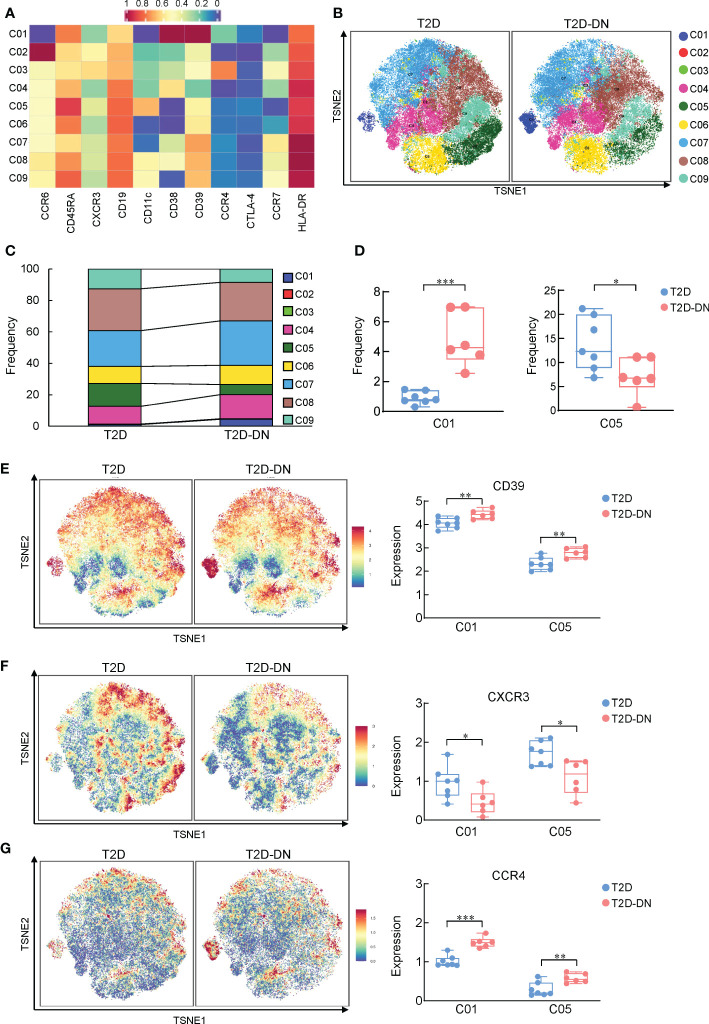
Diabetic nephropathy (DN) is the most prominent cause of chronic kidney disease and end-stage renal failure. However, the pathophysiology of DN, especially the risk factors for early onset remains elusive. Increasing evidence has revealed the role of the innate immune system in developing DN, but relatively little is known about early immunological change that proceeds from overt DN. Herein, this work aims to investigate the immune-driven pathogenesis of DN using mass cytometry (CyTOF). The peripheral blood mononuclear lymphocytes (PBMC) from 6 patients with early-stage nephropathy and 7 type II diabetes patients without nephropathy were employed in the CyTOF test. A panel that contains 38 lineage markers was designed to monitor immune protein levels in PBMC. The unsupervised clustering analysis was performed to profile the proportion of individual cells. t-Distributed Stochastic Neighbor Embedding (t-SNE) was used to visualize the differences in DN patients' immune phenotypes. Comprehensive immune profiling revealed substantial immune system alterations in the early onset of DN, including the significant decline of B cells and the marked increase of monocytes. The level of CXCR3 was dramatically reduced in the different immune cellular subsets. The CyTOF data classified the fine-grained differential immune cell subsets in the early stage of DN. Innovatively, we identified several significant changed T cells, B cell, and monocyte subgroups in the early-stage DN associated with several potential biomarkers for developing DN, such as CTLA-4, CXCR3, PD-1, CD39, CCR4, and HLA-DR. Correlation analysis further demonstrated the robust relationship between above immune cell biomarkers and clinical parameters in the DN patients. Therefore, we provided a convincible view of understanding the immune-driven early pathogenesis of DN. Our findings exhibited that patients with DN are more susceptible to immune system disorders. The classification of fine-grained immune cell subsets in this present research might provide novel targets for the immunotherapy of DN.
Keywords: diabetic nephropathy; high-dimensional mass cytometry; immune disorder; peripheral blood mononuclear cell (PBMC); type II diabetes mellitus.
Copyright © 2023 Jin, Wang, Liu, He, Zheng, Ni and He.
Conflict of interest statement
The authors declare that the research was conducted in the absence of any commercial or financial relationships that could be construed as a potential conflict of interest.
Figures




References
Publication types
MeSH terms
Substances
LinkOut - more resources
Full Text Sources
Medical
Research Materials
