Review
. 2023 Mar;4(1):011301.
doi: 10.1063/5.0109400. Epub 2023 Jan 13.

Beyond CFD: Emerging methodologies for predictive simulation in cardiovascular health and disease

Affiliations
Review

Beyond CFD: Emerging methodologies for predictive simulation in cardiovascular health and disease

Erica L Schwarz et al. Biophys Rev (Melville). 2023 Mar.

Abstract

Physics-based computational models of the cardiovascular system are increasingly used to simulate hemodynamics, tissue mechanics, and physiology in evolving healthy and diseased states. While predictive models using computational fluid dynamics (CFD) originated primarily for use in surgical planning, their application now extends well beyond this purpose. In this review, we describe an increasingly wide range of modeling applications aimed at uncovering fundamental mechanisms of disease progression and development, performing model-guided design, and generating testable hypotheses to drive targeted experiments. Increasingly, models are incorporating multiple physical processes spanning a wide range of time and length scales in the heart and vasculature. With these expanded capabilities, clinical adoption of patient-specific modeling in congenital and acquired cardiovascular disease is also increasing, impacting clinical care and treatment decisions in complex congenital heart disease, coronary artery disease, vascular surgery, pulmonary artery disease, and medical device design. In support of these efforts, we discuss recent advances in modeling methodology, which are most impactful when driven by clinical needs. We describe pivotal recent developments in image processing, fluid-structure interaction, modeling under uncertainty, and reduced order modeling to enable simulations in clinically relevant timeframes. In all these areas, we argue that traditional CFD alone is insufficient to tackle increasingly complex clinical and biological problems across scales and systems. Rather, CFD should be coupled with appropriate multiscale biological, physical, and physiological models needed to produce comprehensive, impactful models of mechanobiological systems and complex clinical scenarios. With this perspective, we finally outline open problems and future challenges in the field.


Conflict of interest statement

The authors have no conflicts to disclose.

Figures
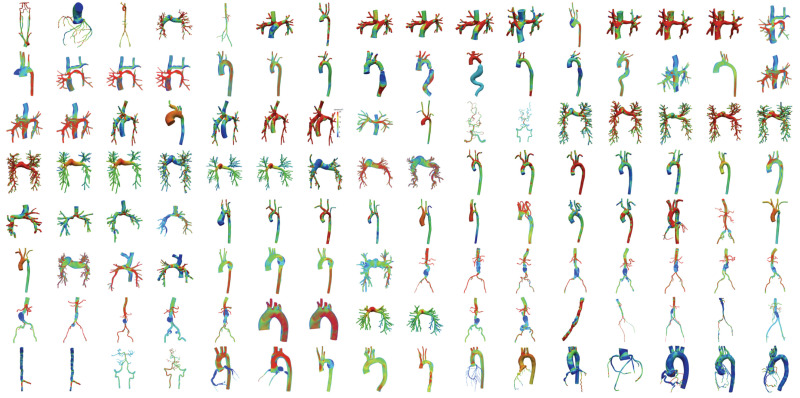
FIG. 1.
FIG. 1.
Subset of vascular models available in the vascular model repository.
FIG. 2.
FIG. 2.
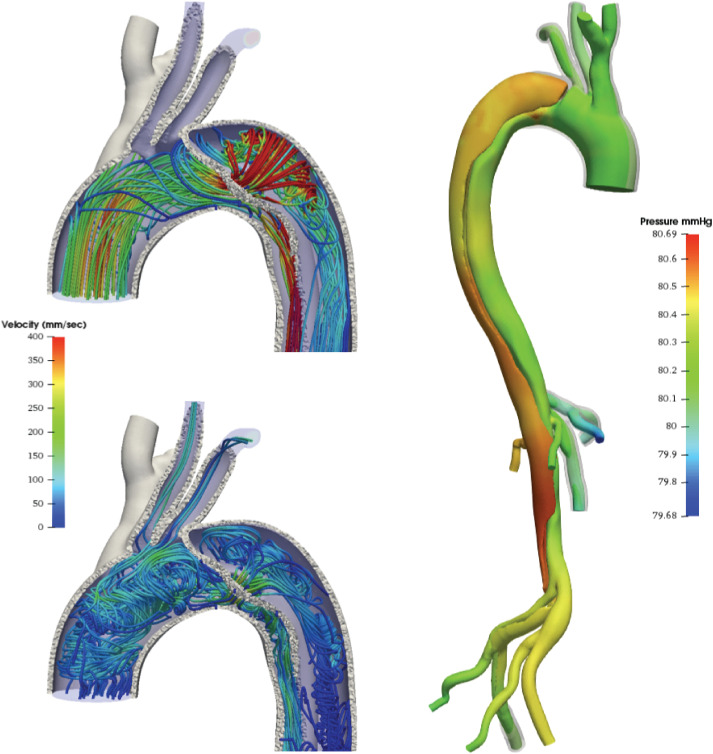
FSI model of aortic dissection with vessel wall prestress and external tissue support. Streamlines (left) in systole (top) and diastole bottom and pressure (right). True and false lumen are clearly visible with streamlines entering the false lumen at the focal entry tear. Adapted from Ref. .
FIG. 3.
FIG. 3.
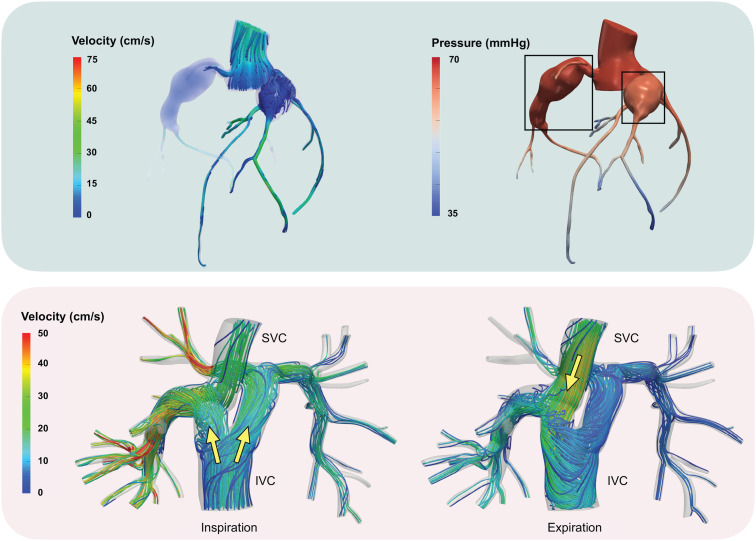
Examples of clinical applications. Top: Numerical approximation of FFR in coronary arteries with aneurysms caused by Kawasaki disease: streamlines of velocity field (left) and pressure distribution (averaged over time) in hyperemia (right). The aneurysms are marked with boxes on the right. Bottom: Y-graft Fontan model. During inspiration, the inferior vena cava (IVC) flow is bifurcated by the Y-graft and channeled to the pulmonary arteries. During expiration, retrograde flow in the IVC allows the superior vena cava (SVC) flow to enter the right limb of the Y-graft.
FIG. 4.
FIG. 4.
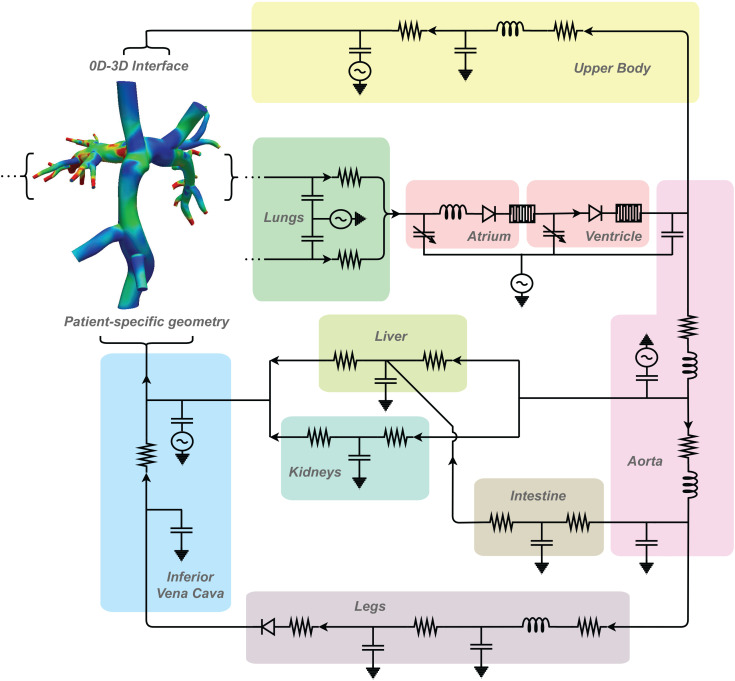
An example of multiscale modeling in a Fontan patient which allows for quantification of local hemodynamics and estimation of whole-body behavior in response to cavopulmonary changes. Adapted from Refs. and .
FIG. 5.
FIG. 5.
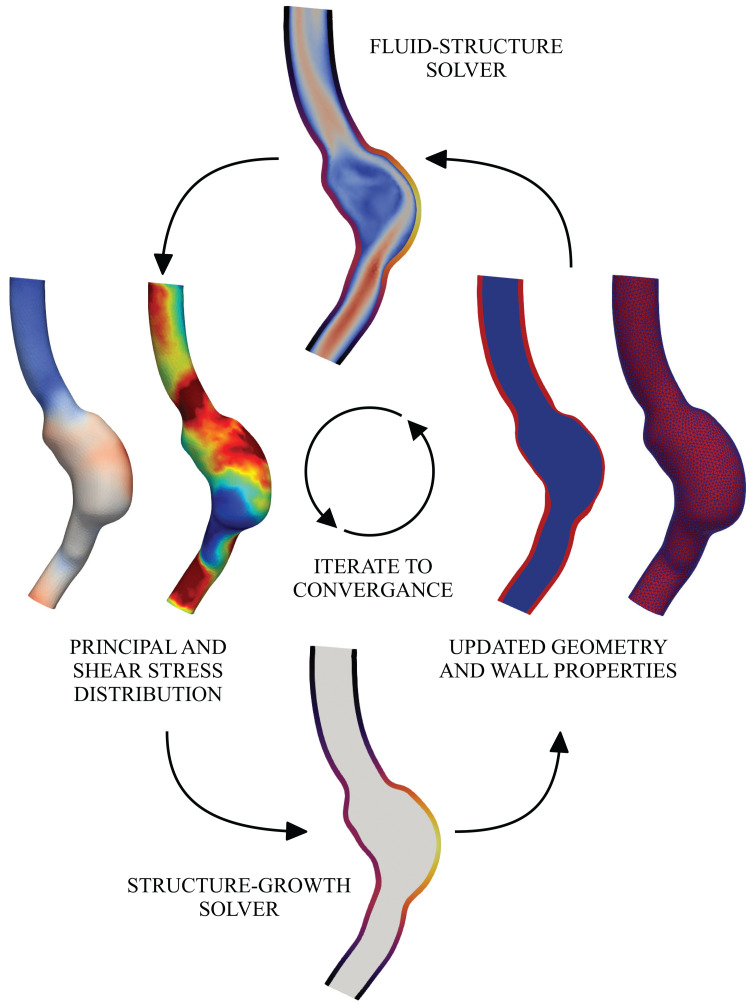
A fluidsolid-growth interaction framework, bridging different physics (fluid dynamics and solid growth) and time scales (milliseconds in fluid dynamics and days in solid growth).

References

    1. Migliavacca F., de Leval M. R., Dubini G., Pietrabissa R., and Fumero R., “ Computational fluid dynamic simulations of cavopulmonary connections with an extracardiac lateral conduit,” Med. Eng. Phys. 21, 187–193 (1999). 10.1016/S1350-4533(99)00042-9 - DOI - PubMed
    1. Dubini G., De Leval M., Pietrabissa R., Montevecchi F. M., and Fumero R., “ A numerical fluid mechanical study of repaired congenital heart defects. Application to the total cavopulmonary connection,” J. Biomech. 29, 111–121 (1996). 10.1016/0021-9290(95)00021-6 - DOI - PubMed
    1. Qiu Y. and Tarbell J. M., “ Numerical simulation of pulsatile flow in a compliant curved tube model of a coronary artery,” J. Biomech. Eng. 122, 77–85 (2000). 10.1115/1.429629 - DOI - PubMed
    1. Milner J., Moore J., Rutt B., and Steinman D., “ Hemodynamics of human carotid artery bifurcations: Computational studies with models reconstructed from magnetic resonance imaging of normal subjects,” J. Vasc. Surg. 28, 143–156 (1998). 10.1016/S0741-5214(98)70210-1 - DOI - PubMed
    1. Yushkevich P. A. and Gerig G., “ ITK-SNAP: An intractive medical image segmentation tool to meet the need for expert-guided segmentation of complex medical images,” IEEE Pulse 8, 54–57 (2017). 10.1109/MPUL.2017.2701493 - DOI - PubMed

LinkOut - more resources