


Outcomes of total pancreatectomy with islet autotransplantation: A systematic review and meta-analysis
- PMID: 36687559
- PMCID: PMC9850868
- DOI: 10.5500/wjt.v13.i1.10
Outcomes of total pancreatectomy with islet autotransplantation: A systematic review and meta-analysis
Abstract
Background: Despite the increased use of total pancreatectomy with islet autotransplantation (TPIAT), systematic evidence of its outcomes remains limited.
Aim: To evaluate the outcomes of TPIAT.
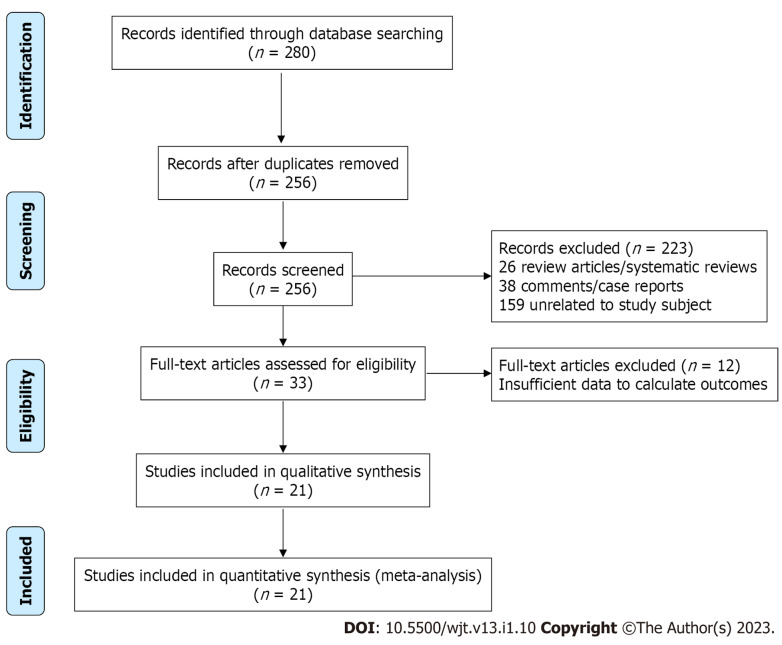
Methods: We searched PubMed, EMBASE, and Cochrane databases from inception through March 2019 for studies on TPIAT outcomes. Data were extracted and analyzed using comprehensive meta-analysis software. The random-effects model was used for all variables. Heterogeneity was assessed using the I2 measure and Cochrane Q-statistic. Publication bias was assessed using Egger's test.
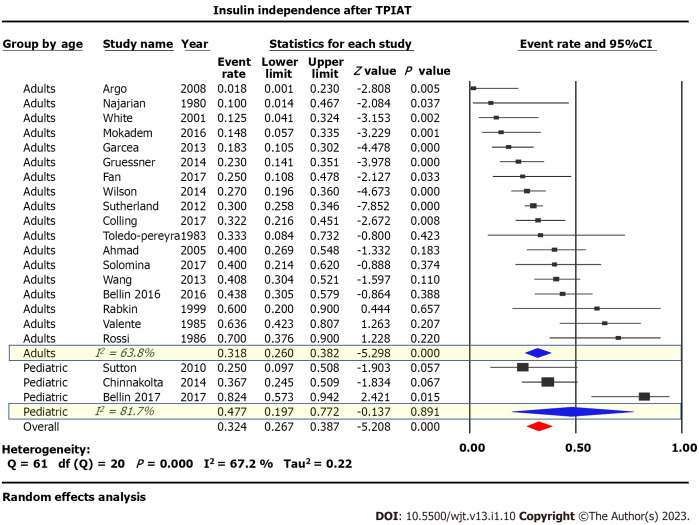
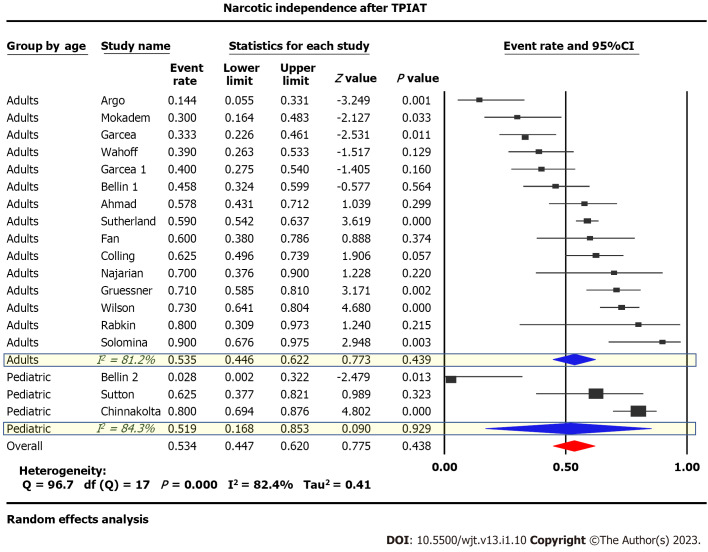
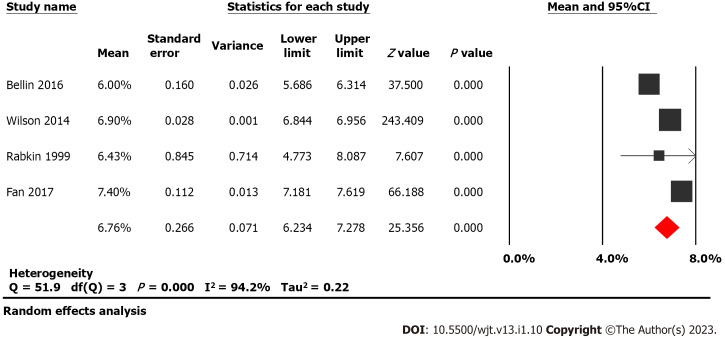
Results: Twenty-one studies published between 1980 and 2017 examining 1011 patients were included. Eighteen studies were of adults, while three studied pediatric populations. Narcotic independence was achieved in 53.5% [95% Confidence Interval (CI): 45-62, P < 0.05, I2 = 81%] of adults compared to 51.9% (95%CI: 17-85, P < 0.05, I2 = 84%) of children. Insulin-independence post-procedure was achieved in 31.8% (95%CI: 26-38, P < 0.05, I2 = 64%) of adults with considerable heterogeneity compared to 47.7% (95%CI: 20-77, P < 0.05, I2 = 82%) in children. Glycated hemoglobin (HbA1C) 12 mo post-surgery was reported in four studies with a pooled value of 6.76% (P = 0.27). Neither stratification by age of the studied population nor meta-regression analysis considering both the study publication date and the islet-cell-equivalent/kg weight explained the marked heterogeneity between studies.
Conclusion: These results indicate acceptable success for TPIAT. Future studies should evaluate the discussed measures before and after surgery for comparison.
Keywords: Islet autotransplantation; Narcotics; Pancreatectomy; Pancreatitis.
©The Author(s) 2023. Published by Baishideng Publishing Group Inc. All rights reserved.
Conflict of interest statement
Conflict-of-interest statement: The authors declare that the research was conducted in the absence of any commercial or financial relationships that could be construed as a potential conflict of interest.
Figures
References
-
- Lankisch PG, Löhr-Happe A, Otto J, Creutzfeldt W. Natural course in chronic pancreatitis. Pain, exocrine and endocrine pancreatic insufficiency and prognosis of the disease. Digestion. 1993;54:148–155. - PubMed
-
- Ammann RW, Akovbiantz A, Largiader F, Schueler G. Course and outcome of chronic pancreatitis. Longitudinal study of a mixed medical-surgical series of 245 patients. Gastroenterology. 1984;86:820–828. - PubMed
-
- Olesen SS, Büyükuslu A, Køhler M, Rasmussen HH, Drewes AM. Sarcopenia associates with increased hospitalization rates and reduced survival in patients with chronic pancreatitis. Pancreatology. 2019;19:245–251. - PubMed
-
- Malka D, Hammel P, Sauvanet A, Rufat P, O'Toole D, Bardet P, Belghiti J, Bernades P, Ruszniewski P, Lévy P. Risk factors for diabetes mellitus in chronic pancreatitis. Gastroenterology. 2000;119:1324–1332. - PubMed
-
- Löhr JM, Dominguez-Munoz E, Rosendahl J, Besselink M, Mayerle J, Lerch MM, Haas S, Akisik F, Kartalis N, Iglesias-Garcia J, Keller J, Boermeester M, Werner J, Dumonceau JM, Fockens P, Drewes A, Ceyhan G, Lindkvist B, Drenth J, Ewald N, Hardt P, de Madaria E, Witt H, Schneider A, Manfredi R, Brøndum FJ, Rudolf S, Bollen T, Bruno M HaPanEU/UEG Working Group. United European Gastroenterology evidence-based guidelines for the diagnosis and therapy of chronic pancreatitis (HaPanEU) United European Gastroenterol J. 2017;5:153–199. - PMC - PubMed
LinkOut - more resources
Full Text Sources
Miscellaneous
