Adherence to Oral Anticancer Medications Among Women With Breast Cancer in Africa: A Scoping Review
- PMID: 36689700
- PMCID: PMC10166491
- DOI: 10.1200/GO.21.00289
Adherence to Oral Anticancer Medications Among Women With Breast Cancer in Africa: A Scoping Review
Abstract
Purpose: Oral anticancer medications (OAMs) improve treatment outcomes and survival in women with breast cancer (BC). However, adherence to OAM therapy remains suboptimal. This scoping review provides evidence of adherence to OAMs among African women with BC.
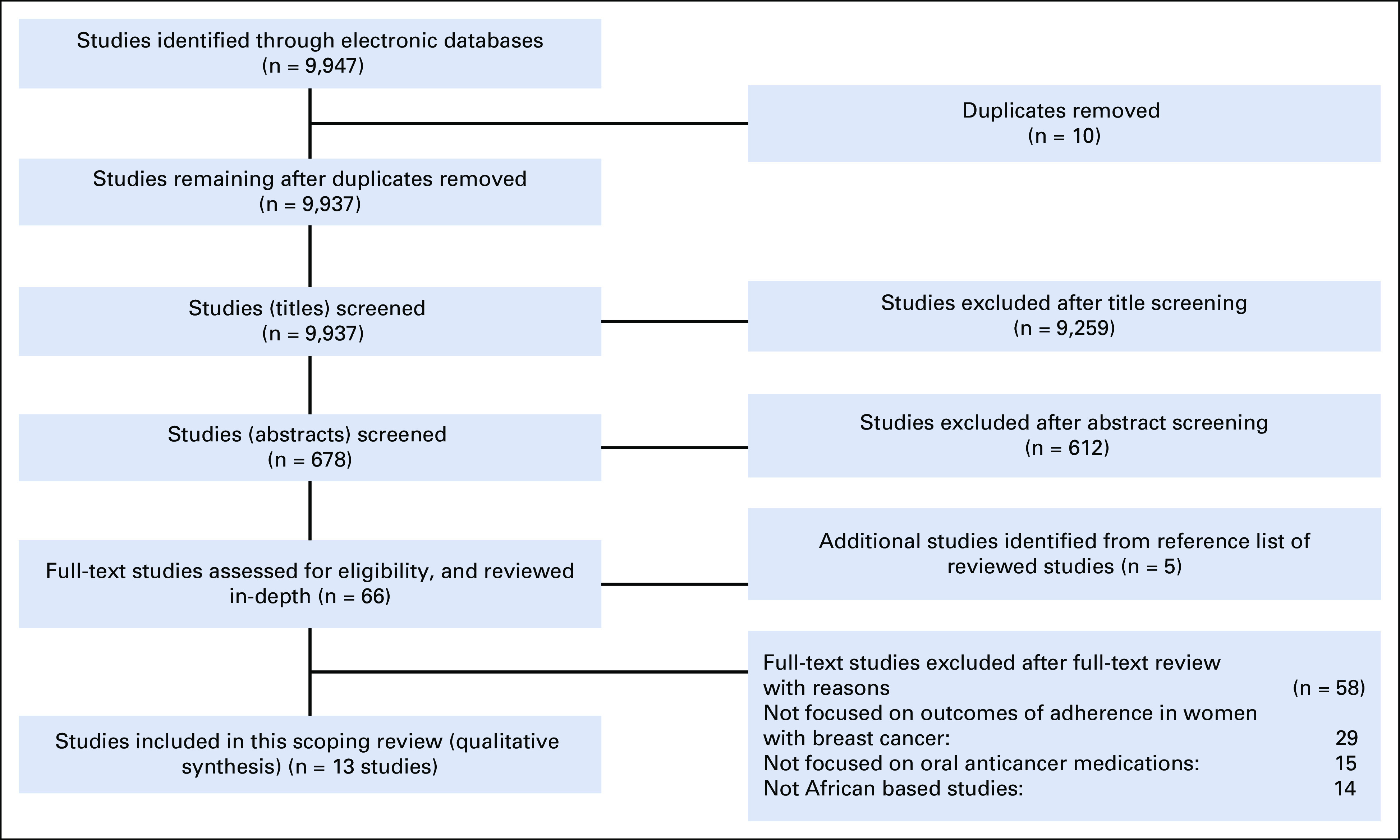
Methods: We searched four databases and gray literature, using guidance from the Joanna Briggs Institute. Thirteen studies on adherence rates, determinants, and interventions were included. NVivo 12 software was used to perform thematic analysis of the included studies. The determinants (barriers and facilitators) associated with adherence were analyzed according to the five dimensions of the WHO multidimensional adherence model.
Results: Most studies (n = 11, 85%) focused on endocrine medication. Depending on the definition, measurements, and assessment period, the nonadherence rates ranged from 4.3% to 65.4% for endocrine medications, 80.9% for cytotoxic chemotherapies, and 32.7% for combined medications. The significant barriers associated with adherence include Islamic religion, concurrent comorbidities, mastectomy, anastrozole treatment, side effects, unawareness of treatment insurance coverage, and seeking treatment from traditional healers. Thorough therapeutic communication regarding treatment, neoadjuvant chemotherapy, and adequate social support significantly facilitate adherence. A randomized controlled trial of breast nursing interventions reported improved patient adherence.
Conclusion: The evidence mapped from studies that evaluated OAM adherence in women with BC indicates that nonadherence to OAMs is common. Applying context-specific standardized measures to assess adherence and facilitators or strategies targeting the identified barriers can optimize adherence and treatment outcomes. Effective interventions to improve adherence are limited. Therefore, further empirical and interventional studies in Africa are required to enhance the evidence.
Conflict of interest statement
The following represents disclosure information provided by authors of this manuscript. All relationships are considered compensated unless otherwise noted. Relationships are self-held unless noted. I = Immediate Family Member, Inst = My Institution. Relationships may not relate to the subject matter of this manuscript. For more information about ASCO's conflict of interest policy, please refer to
Open Payments is a public database containing information reported by companies about payments made to US-licensed physicians (
No potential conflicts of interest were reported.
Figures
References
-
- McDonald ES, Clark AS, Tchou J, et al. : Clinical diagnosis and management of breast cancer. J Nucl Med 57:9S-16S, 2016. (suppl 1) - PubMed
-
- Findlay M, von Minckwitz G, Wardley A: Effective oral chemotherapy for breast cancer: Pillars of strength. Ann Oncol 19:212-222, 2008 - PubMed
-
- Paranjpe R, Trivedi M, Abughosh S: Identifying adherence barriers to oral endocrine therapy (OET) among breast cancer patients. Value Health 21:S35, 2018 - PubMed
Publication types
MeSH terms
LinkOut - more resources
Full Text Sources
Medical