


Primary cemiplimab treatment for orbital squamous cell carcinoma is effective and may alleviate the need for orbital exenteration
- PMID: 36690728
- PMCID: PMC10397183
- DOI: 10.1038/s41433-022-02358-y
Primary cemiplimab treatment for orbital squamous cell carcinoma is effective and may alleviate the need for orbital exenteration
Abstract
Purpose: To evaluate the effectiveness of cemiplimab, a Programmed-cell-death-1(PD-1) protein inhibitor, for the treatment of cutaneous periocular-locally-advanced squamous-cell-carcinoma (POLA-SCC) with orbital-invasion.
Methods: Multicentre real-world retrospective study. Demographic and clinical data were collected and analysed for patients with biopsy-proven POLA-SCC(AJCC-T4) with orbital-invasion who were treated with cemiplimab at one of four tertiary medical centres in 2019-2022.
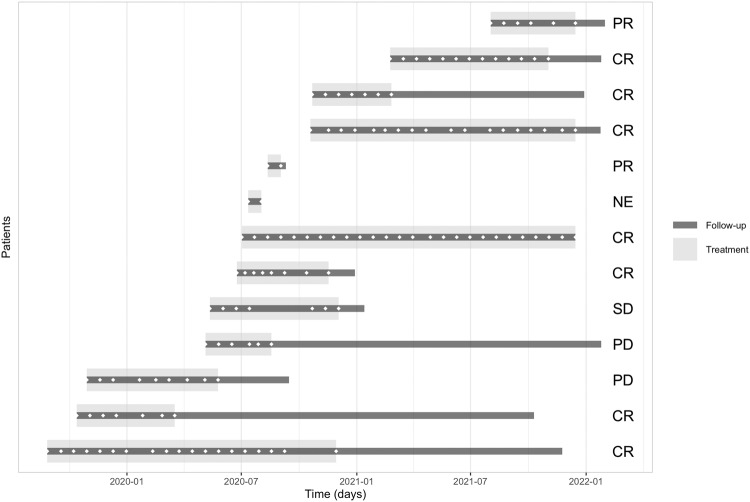
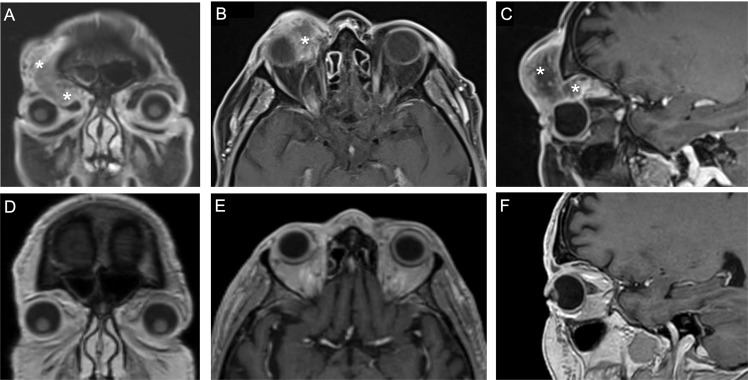
Results: The cohort included 13 patients, 8 males and 5 females, of median age 76 years (IQR65-86). The median duration of treatment was 5.0months (IQR3.5-10.5) and the median follow-up time, 15.0 months (IQR10.5-30). The overall response rate was 69.2%. Complete response was documented in seven patients (53.8%), partial response in two (15.4%), stable disease in one (7.7%), and progressive disease in two (15.4%); in one patient (7.7%), response was not evaluable. Six complete responders (46.1% of the cohort) received no further treatment and did not have a recurrence during an average follow-up of 6.14 (±6.9) months from treatment cessation. None of the patients underwent orbital-exenteration. The majority of adverse events were mild (grade-1), except for a moderate increase in creatinine level (grade-2), severe bullous dermatitis (grade-3), and myocarditis (grade-5) in one patient each. Four patients (30.7%) died during the follow-up period, all of whom had an Eastern-Cooperative-Oncology-Group score of 4 at presentation.
Conclusions: To our knowledge, this is the largest study to date on cemiplimab therapy for cutaneous POLA-SCC with orbital-invasion. Treatment was shown to be effective, with an overall response rate of 69.2%. Cemiplimab holds promise for the treatment of patients with tumours invading the orbit as it may alleviate the need for orbital exenteration.
© 2023. The Author(s), under exclusive licence to The Royal College of Ophthalmologists.
Conflict of interest statement
The authors declare no competing interests.
Figures
Comment on
-
PD-1 Blockade with Cemiplimab in Advanced Cutaneous Squamous-Cell Carcinoma.N Engl J Med. 2018 Jul 26;379(4):341-351. doi: 10.1056/NEJMoa1805131. Epub 2018 Jun 4. N Engl J Med. 2018. PMID: 29863979 Clinical Trial.
References
Publication types
MeSH terms
Substances
LinkOut - more resources
Full Text Sources
Research Materials
