


Leveraging microbiome rediversification for the ecological rescue of soil function
- PMID: 36691096
- PMCID: PMC9872425
- DOI: 10.1186/s40793-023-00462-4
Leveraging microbiome rediversification for the ecological rescue of soil function
Abstract
Background: Global biodiversity losses threaten ecosystem services and can impact important functional insurance in a changing world. Microbial diversity and function can become depleted in agricultural systems and attempts to rediversify agricultural soils rely on either targeted microbial introductions or retaining natural lands as biodiversity reservoirs. As many soil functions are provided by a combination of microbial taxa, rather than outsized impacts by single taxa, such functions may benefit more from diverse microbiome additions than additions of individual commercial strains. In this study, we measured the impact of soil microbial diversity loss and rediversification (i.e. rescue) on nitrification by quantifying ammonium and nitrate pools. We manipulated microbial assemblages in two distinct soil types, an agricultural and a forest soil, with a dilution-to-extinction approach and performed a microbiome rediversification experiment by re-introducing microorganisms lost from the dilution. A microbiome water control was included to act as a reference point. We assessed disruption and potential restoration of (1) nitrification, (2) bacterial and fungal composition through 16S rRNA gene and fungal ITS amplicon sequencing and (3) functional genes through shotgun metagenomic sequencing on a subset of samples.
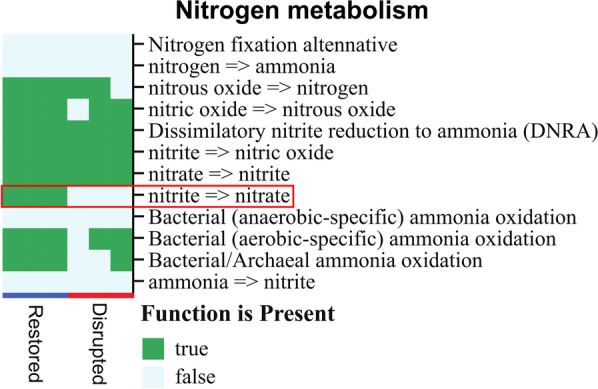
Results: Disruption of nitrification corresponded with diversity loss, but nitrification was successfully rescued in the rediversification experiment when high diversity inocula were introduced. Bacterial composition clustered into groups based on high and low diversity inocula. Metagenomic data showed that genes responsible for the conversion of nitrite to nitrate and taxa associated with nitrogen metabolism were absent in the low diversity inocula microcosms but were rescued with high diversity introductions.
Conclusions: In contrast to some previous work, our data suggest that soil functions can be rescued by diverse microbiome additions, but that the concentration of the microbial inoculum is important. By understanding how microbial rediversification impacts soil microbiome performance, we can further our toolkit for microbial management in human-controlled systems in order to restore depleted microbial functions.
Keywords: Biodiversity; Community inoculum; Microbial establishment; Microbial function; Nitrification.
© 2023. The Author(s).
Conflict of interest statement
The authors declare no conflicts of interest.
Figures

References
-
- Harrison PA, Berry PM, Simpson G, Haslett JR, Blicharska M, Bucur M, Dunford R, Egoh B, Garcia-Llorente M, Geamănă N, et al. Linkages between biodiversity attributes and ecosystem services: a systematic review. Ecosyst Serv. 2014;9:191–203. doi: 10.1016/j.ecoser.2014.05.006. - DOI
-
- Naeem S, Li S. Biodiversity enhances ecosystem reliability. Nature. 1997;390:507–509. doi: 10.1038/37348. - DOI
-
- Walker BH. Biodiversity and ecological redundancy. Conserv Biol. 1992;6:18–23. doi: 10.1046/j.1523-1739.1992.610018.x. - DOI
LinkOut - more resources
Full Text Sources
Research Materials