. 2023 Apr;30(4):1014-1024.
doi: 10.1111/ene.15706. Epub 2023 Feb 16.

Variability of the response to immunotherapy among subgroups of patients with multiple sclerosis

Ibrahima Diouf  1 Charles B Malpas  1   2 Sifat Sharmin  1 Izanne Roos  1   2 Dana Horakova  3 Eva Kubala Havrdova  3 Francesco Patti  4 Vahid Shaygannejad  5 Serkan Ozakbas  6 Guillermo Izquierdo  7 Sara Eichau  7 Marco Onofrj  8 Alessandra Lugaresi  9   10 Raed Alroughani  11 Alexandre Prat  12 Marc Girard  12 Pierre Duquette  12 Murat Terzi  13 Cavit Boz  14 Francois Grand'Maison  15 Sherif Hamdy  16 Patrizia Sola  17 Diana Ferraro  17 Pierre Grammond  18 Recai Turkoglu  19 Katherine Buzzard  20 Olga Skibina  20 Bassem Yamout  21 Ayse Altintas  22   23 Oliver Gerlach  24 Vincent van Pesch  25 Yolanda Blanco  26 Davide Maimone  27 Jeannette Lechner-Scott  28 Roberto Bergamaschi  29 Rana Karabudak  30 Gerardo Iuliano  31 Chris McGuigan  32 Elisabetta Cartechini  33 Michael Barnett  34 Stella Hughes  35 Maria José Sa  36 Claudio Solaro  37   38 Ludwig Kappos  39 Cristina Ramo-Tello  40 Edgardo Cristiano  41 Suzanne Hodgkinson  42 Daniele Spitaleri  43 Aysun Soysal  44 Thor Petersen  45 Mark Slee  46 Ernest Butler  47 Franco Granella  48 Koen de Gans  49 Pamela McCombe  50 Radek Ampapa  51 Bart Van Wijmeersch  52 Anneke van der Walt  20   53 Helmut Butzkueven  54 Julie Prevost  55 L G F Sinnige  56 Jose Luis Sanchez-Menoyo  57 Steve Vucic  58 Guy Laureys  59 Liesbeth Van Hijfte  59 Dheeraj Khurana  60 Richard Macdonell  54 Riadh Gouider  61 Tamara Castillo-Triviño  62 Orla Gray  63 Eduardo Aguera-Morales  64 Abdullah Al-Asmi  65 Cameron Shaw  66 Norma Deri  67 Talal Al-Harbi  68 Yara Fragoso  69 Tunde Csepany  70 Angel Perez Sempere  71 Irene Trevino-Frenk  72 Jan Schepel  73 Fraser Moore  74 Tomas Kalincik  1   2
Affiliations

Variability of the response to immunotherapy among subgroups of patients with multiple sclerosis

Ibrahima Diouf et al. Eur J Neurol. 2023 Apr.

Abstract

Background and purpose: This study assessed the effect of patient characteristics on the response to disease-modifying therapy (DMT) in multiple sclerosis (MS).

Methods: We extracted data from 61,810 patients from 135 centers across 35 countries from the MSBase registry. The selection criteria were: clinically isolated syndrome or definite MS, follow-up ≥ 1 year, and Expanded Disability Status Scale (EDSS) score ≥ 3, with ≥1 score recorded per year. Marginal structural models with interaction terms were used to compare the hazards of 12-month confirmed worsening and improvement of disability, and the incidence of relapses between treated and untreated patients stratified by their characteristics.

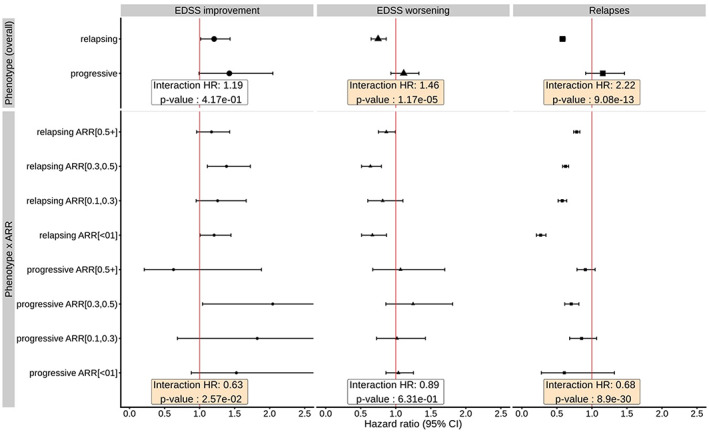
Results: Among 24,344 patients with relapsing MS, those on DMTs experienced 48% reduction in relapse incidence (hazard ratio [HR] = 0.52, 95% confidence interval [CI] = 0.45-0.60), 46% lower risk of disability worsening (HR = 0.54, 95% CI = 0.41-0.71), and 32% greater chance of disability improvement (HR = 1.32, 95% CI = 1.09-1.59). The effect of DMTs on EDSS worsening and improvement and the risk of relapses was attenuated with more severe disability. The magnitude of the effect of DMT on suppressing relapses declined with higher prior relapse rate and prior cerebral magnetic resonance imaging activity. We did not find any evidence for the effect of age on the effectiveness of DMT. After inclusion of 1985 participants with progressive MS, the effect of DMT on disability mostly depended on MS phenotype, whereas its effect on relapses was driven mainly by prior relapse activity.

Conclusions: DMT is generally most effective among patients with lower disability and in relapsing MS phenotypes. There is no evidence of attenuation of the effect of DMT with age.

Keywords: EDSS; immunotherapy; marginal structural model; multiple sclerosis; relapse.


Conflict of interest statement

The authors report the following relationships: speaker honoraria, advisory board or steering committee fees, research support, and/or conference travel support from Acthelion (E.K.H., R.Am.), Almirall (M.T., F.G., R.B., C.R.‐T., J.L.S.‐M.), Bayer (M.T., A.L., P.S., R.Am., C.B., J.L.‐S., V.v.P., R.B., D.S., R.Al., J.L.S.‐M., S.Ho., C.R.‐T., T.C‐T., M.S.), BioCSL (T.K.), Biogen (T.K., D.H., E.K.H., M.T., G.Iu., A.L., M.G., P.D., P.G., A.v.d.W., F.G'M., P.S., D.F., R.Am., C.B., J.L.‐S., V.v.P., F.G., R.B., R.Al., C.R.‐T., J.P., M.B., J.L.S.‐M., S.Ho., C.R.‐T., C.Sh., O.Gr., T.C‐T., M.S., H.B.), Biologix (R.Al.), Celgene (E.K.H.), Genpharm (R.Al.), Genzyme‐Sanofi (T.K., E.K.H., M.T., G.Iz., A.L., M.G., P.D., P.G., A.v.d.W., F.G'M., P.S., D.F., R.Al., M.T., C.B., J.L.‐S., V.v.P., F.G., R.B., D.S., C.R.‐T., J.P., M.B., J.L.S.‐M., S.Ho., O.Gr., H.B.), GSK (R.Al.), Merck/EMD (T.K., D.H., E.K.H., M.T., G.Iu., A.L., M.G., P.D., P.G., A.v.d.W., P.S., D.F., R.Am., M.T., C.B., J.L.‐S., V.v.P., F.G., R.B., D.S., R.Al., M.B., J.L.S.‐M., C.R.‐T., F.M., O.Gr., T.C‐T., M.S., H.B.), Mitsubishi (F.G'M.), Novartis (T.K., D.H., E.K.H., M.T., G.Iu., A.L., M.G., P.D., P.G., A.v.d.W., F.G'M., P.S., D.F., R.Am., M.T., C.B., J.L.‐S., V.v.P., F.G., R.B., D.S., R.Al., C.R.‐T., J.P., M.B., J.L.S.‐M., S.Ho., C.R.‐T., F.M., C.Sh., O.Gr., T.C‐T., M.S., H.B.), ONO Pharmaceuticals (F.G'M.), Roche (T.K., E.K.H., A.L., M.T., C.B., V.v.P.), Teva (T.K., D.H., E.K.H., M.T., G.Iz., A.L., M.G., P.D., P.G., F.G., P.S., D.F., M.T., C.B., J.L.‐S., V.v.P., R.B., D.S., R.Al., J.P., J.L.S.‐M., C.R.‐T., T.C‐T., M.S.), WebMD (T.K.).

Figures
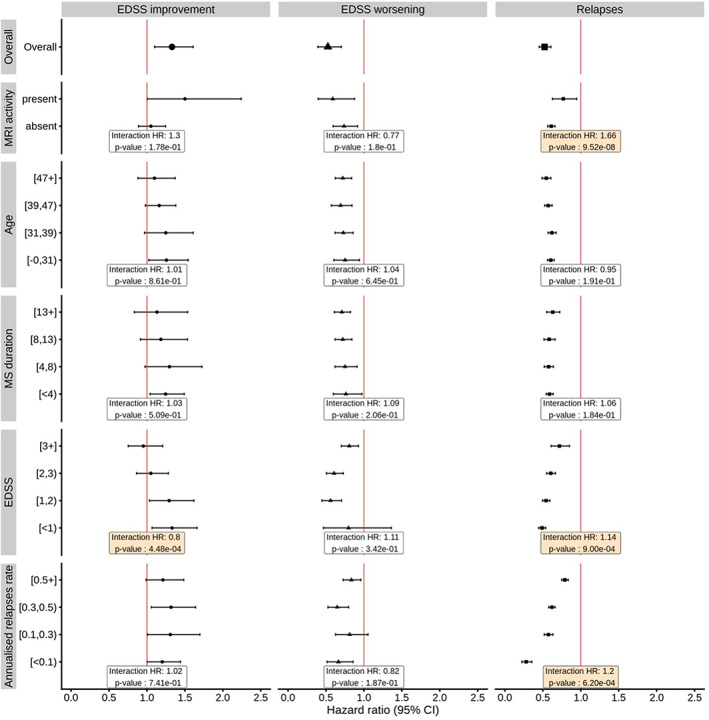
FIGURE 1
FIGURE 1
Weighted modifiers of the effects of disease‐modifying therapy (DMT) on disability improvement, disability worsening, and relapses. Results were estimated from stratified marginal structural Cox models using data from the relapsing multiple sclerosis (MS) cohort (clinically isolated syndrome and relapsing–remitting). Weights for the marginal structural model were calculated from a logistic model with treatment status as a dependent variable; independent variables included fixed covariates and the baseline stabilizing variables (sex, MS duration at first visit, date of birth) and time‐dependent covariates (age, pregnancy status, treatment history, history of relapses, MS duration, Expanded Disability Status Scale [EDSS], MS course). The “Overall” row in the figure displays the overall effects of treatment. Points and error bars represent hazard ratios (HRs) for associations of DMT with the studied outcomes in different patient groups. The boxes show HRs and p‐values for the interactions between DMT and demographic and clinical characteristics indicated along the y‐axis. CI, confidence interval; MRI, magnetic resonance imaging
FIGURE 2
FIGURE 2
Weighted effects of disease‐modifying therapy (DMT) in relapsing and progressive multiple sclerosis (MS), showing data from the full cohort (including relapsing and progressive MS). Data are from marginal structural models. Weights for the marginal structural model were calculated from a logistic model with treatment status as a dependent variable; independent variables included fixed covariates and the baseline stabilizing variables (sex, MS duration at first visit, date of birth) and time‐dependent covariates (age, pregnancy status, treatment history, history of relapses, MS duration, Expanded Disability Status Scale [EDSS], MS course). The “Overall” rows in the figure display the overall effects of treatment. Hazard ratios (HRs) and p‐values for phenotype (overall) represent the interactions between DMT and disease phonotype. HRs and p‐values for phenotype × ARR represent a three‐way interaction between DMT, phenotype, and annualized relapse rate. The boxes show HRs and p‐values for the interactions between DMT and MS phenotype, and a three‐way interaction among DMT–MS phenotype–ARR. CI, confidence interval

References

    1. Goodin DS, Jones J, Li D, et al. Establishing long‐term efficacy in chronic disease: use of recursive partitioning and propensity score adjustment to estimate outcome in MS. PLoS One. 2011;6:e22444. - PMC - PubMed
    1. Goodin DS, Reder AT, Ebers GC, et al. Survival in MS: a randomized cohort study 21 years after the start of the pivotal IFNbeta‐1b trial. Neurology. 2012;78:1315‐1322. - PMC - PubMed
    1. Kappos L, Edan G, Freedman MS, et al. The 11‐year long‐term follow‐up study from the randomized BENEFIT CIS trial. Neurology. 2016;87:978‐987. - PMC - PubMed
    1. Kappos L, Radue EW, O'Connor P, et al. A placebo‐controlled trial of oral fingolimod in relapsing multiple sclerosis. N Engl J Med. 2010;362:387‐401. - PubMed
    1. Kavaliunas A, Manouchehrinia A, Stawiarz L, et al. Importance of early treatment initiation in the clinical course of multiple sclerosis. Mult Scler. 2017;23:1233‐1240. - PubMed

Publication types