Targeting interleukin-33 and thymic stromal lymphopoietin pathways for novel pulmonary therapeutics in asthma and COPD
- PMID: 36697211
- PMCID: PMC9879340
- DOI: 10.1183/16000617.0144-2022
Targeting interleukin-33 and thymic stromal lymphopoietin pathways for novel pulmonary therapeutics in asthma and COPD
Erratum in
-
"Targeting interleukin-33 and thymic stromal lymphopoietin pathways for novel pulmonary therapeutics in asthma and COPD". Ariel A. Calderon, Colin Dimond, David F. Choy, Rajita Pappu, Michele A. Grimbaldeston, Divya Mohan and Kian Fan Chung. Eur Respir Rev 2023; 32: 220144.Eur Respir Rev. 2023 Apr 5;32(168):225144. doi: 10.1183/16000617.5144-2022. Print 2023 Jun 30. Eur Respir Rev. 2023. PMID: 37019459 Free PMC article. No abstract available.
Abstract
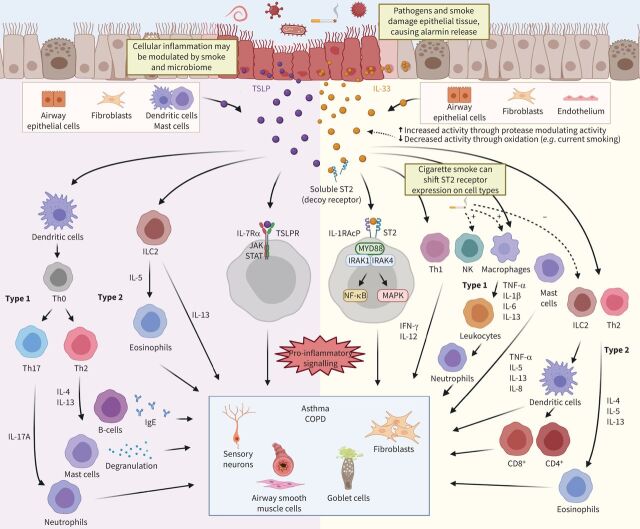
Interleukin-33 (IL-33) and thymic stromal lymphopoietin (TSLP) are alarmins that are released upon airway epithelial injury from insults such as viruses and cigarette smoke, and play critical roles in the activation of immune cell populations such as mast cells, eosinophils and group 2 innate lymphoid cells. Both cytokines were previously understood to primarily drive type 2 (T2) inflammation, but there is emerging evidence for a role for these alarmins to additionally mediate non-T2 inflammation, with recent clinical trial data in asthma and COPD cohorts with non-T2 inflammation providing support. Currently available treatments for both COPD and asthma provide symptomatic relief with disease control, improving lung function and reducing exacerbation rates; however, there still remains an unmet need for further improving lung function and reducing exacerbations, particularly for those not responsive to currently available treatments. The epithelial cytokines/alarmins are involved in exacerbations; biologics targeting TSLP and IL-33 have been shown to reduce exacerbations in moderate-to-severe asthma, either in a broad population or in specific subgroups, respectively. For COPD, while there is clinical evidence for IL-33 blockade impacting exacerbations in COPD, clinical data from anti-TSLP therapies is awaited. Clinical data to date support an acceptable safety profile for patients with airway diseases for both anti-IL-33 and anti-TSLP antibodies in development. We examine the roles of IL-33 and TSLP, their potential use as drug targets, and the evidence for target patient populations for COPD and asthma, together with ongoing and future trials focused on these targets.
Copyright ©The authors 2023.
Conflict of interest statement
Conflict of interest: A.A. Calderon has nothing to declare. C. Dimond, D.F. Choy, R. Pappu, M.A. Grimbaldeston and D. Mohan are employees of Genentech, Inc., a member of the Roche group, and are Roche stockholders. D.F. Choy and M.A. Grimbaldeston are co-inventors on patents that have been filed or are pending relating to the diagnosis and treatment of chronic respiratory diseases for Genentech, Inc. D. Mohan was previously an employee and shareholder of GSK. K.F. Chung received personal payments for service on an advisory board for Roche, Merck, Rickett-Beckinson and Shinogi, data safety monitoring board for Nocion, and for speaking engagements from Novartis and AstraZeneca; and received the MRC, EPSRC, and GSK grants for his institution.
Figures
References
-
- World Health Organization . The top 10 causes of death. www.who.int/news-room/fact-sheets/detail/the-top-10-causes-of-death Date last accessed: 22 February 2022. Date last updated: 9 December 2020.
Publication types
MeSH terms
Substances
LinkOut - more resources
Full Text Sources
Medical