. 2021 Jun 24;4(1):96.
doi: 10.1038/s42004-021-00520-3.

Diversity-oriented synthesis of glycomimetics

Affiliations

Diversity-oriented synthesis of glycomimetics

Michael Meanwell et al. Commun Chem. .

Abstract

Glycomimetics are structural mimics of naturally occurring carbohydrates and represent important therapeutic leads in several disease treatments. However, the structural and stereochemical complexity inherent to glycomimetics often challenges medicinal chemistry efforts and is incompatible with diversity-oriented synthesis approaches. Here, we describe a one-pot proline-catalyzed aldehyde α-functionalization/aldol reaction that produces an array of stereochemically well-defined glycomimetic building blocks containing fluoro, chloro, bromo, trifluoromethylthio and azodicarboxylate functional groups. Using density functional theory calculations, we demonstrate both steric and electrostatic interactions play key diastereodiscriminating roles in the dynamic kinetic resolution. The utility of this simple process for generating large and diverse libraries of glycomimetics is demonstrated in the rapid production of iminosugars, nucleoside analogues, carbasugars and carbohydrates from common intermediates.


Conflict of interest statement

The authors declare no competing interests.

Figures
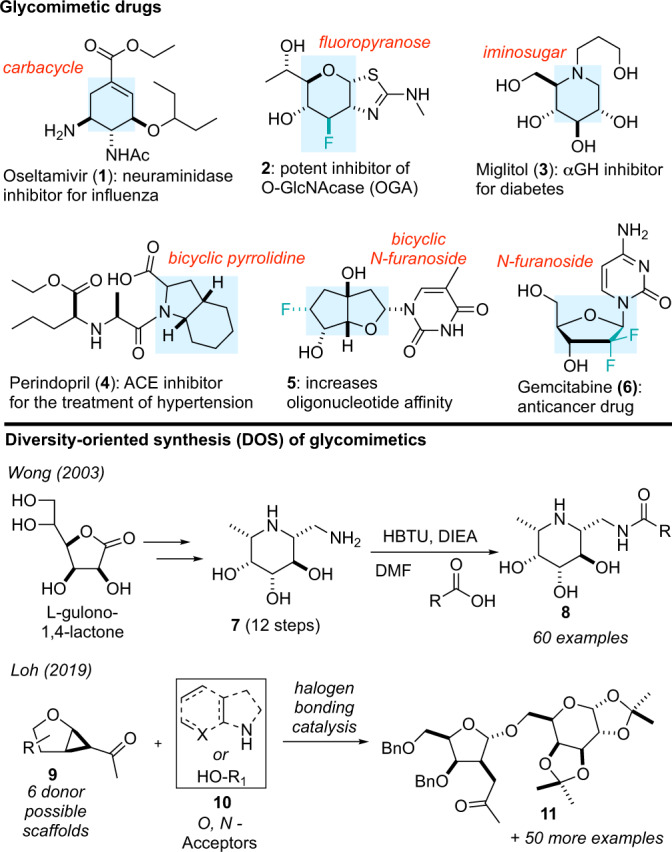
Fig. 1
Fig. 1. Glycomimetics and DOS approaches used to prepare glycomimetic libraries.
Examples of glycomimetic drugs and DOS approaches to prepare DOS libraries of glycomimetics for screening purposes. Shaded regions highlight the glycomimetic structures.
Fig. 2
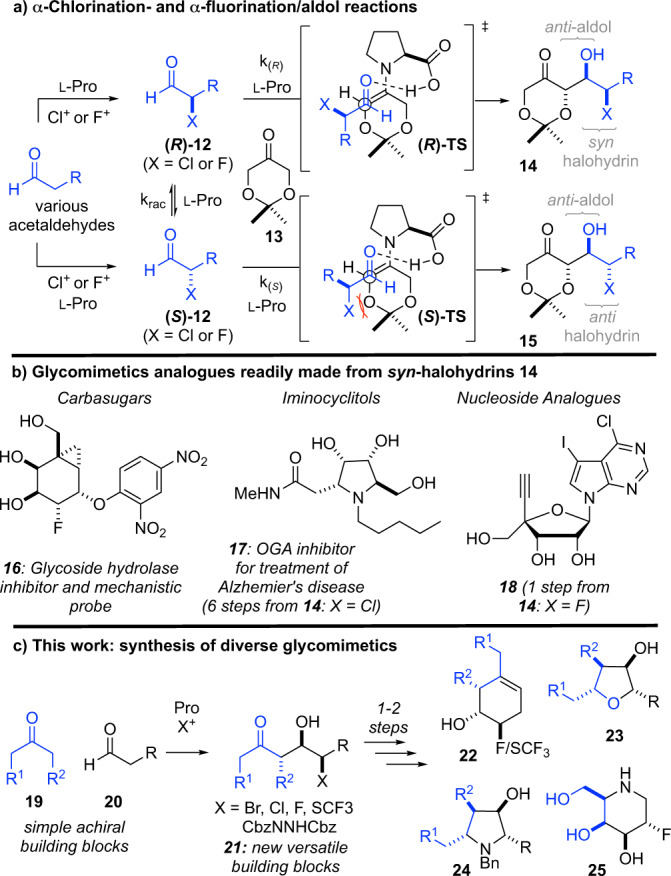
Fig. 2. α-Halogenation/aldol reactions used to prepare glycomimetics.
a Proline-catalyzed α-chlorination- and α-fluorination/aldol reactions used for preparing glycomimetics. The fragments derived from aldehyde coupling partner are colored in blue. b Examples of glycomimetics that have been synthesized from α-chlorination- and α-fluorination/aldol reactions. c The discovery of new α-functionalization/aldol reactions to diversity-oriented synthesis of glycomimetics. The fragments derived from ketone coupling partner are colored in blue.
Fig. 3
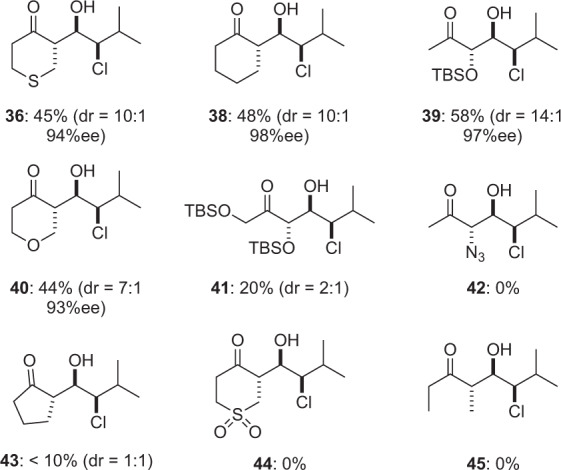
Fig. 3. α-Chlorination/aldol reaction products.
α-Chlorination/aldol reaction products from a range of ketones. Isolated yields for isolated diastereomer shown, diastereomeric ratio determined by 1H NMR spectroscopic analysis of crude reaction mixture.
Fig. 4
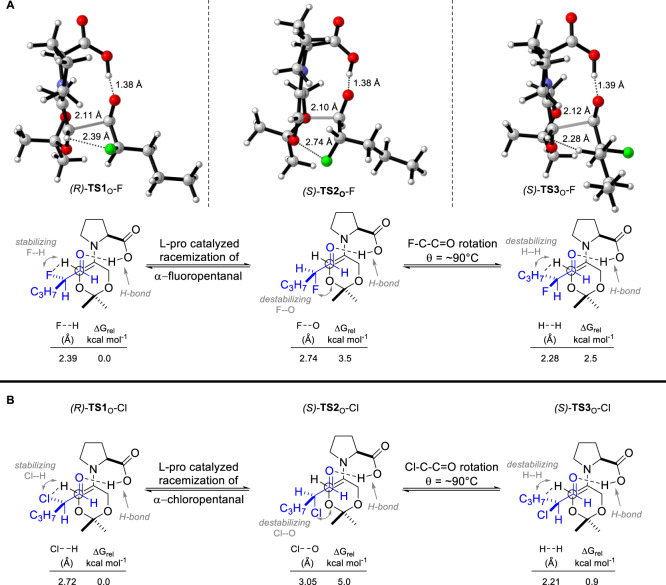
Fig. 4. Computational analysis of proline-catalzyed aldol reactions of α-haloaldehydes.
a Transition state structures (R)-TS1O-F, (S)-TS2O-F and (S)-TS3O-F for l-proline-catalyzed aldol reactions of dioxanone 13 with (R)- or (S)-2-fluoropentanal. Oxygen atoms are colored in red, fluorine atoms are colored in green. b Transition state structures (R)-TS1O-Cl, (S)-TS2O-Cl, and (S)-TS3O-Cl for l-proline-catalyzed aldol reactions involving dioxanone 13 with (R)- or (S)-2-chloropentanal. DFT calculations were performed using IEFPCM(DCM)M06-2X/6-311++G(2d,2p)//IEFPCM(DCM)M06-2X/6-31+G(d,p) level of theory. The α-chloro and α-fluoroaldehydes are colored in blue.
Fig. 5
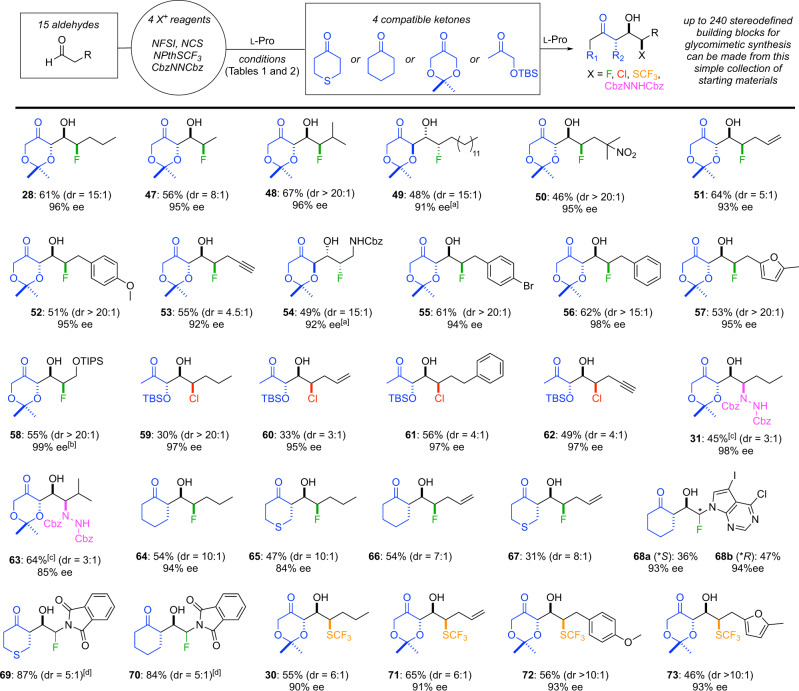
Fig. 5. Scope of α-functionalization/aldol reaction.
Enantioselective synthesis of chlorohydrins (5962), fluorohydrins (28, 4758, 6470), trifluoromethylthiohydrins (30, 7173), and aminohydrins (31, 63). Yields are for the isolated diastereomer depicted. Diastereomeric ratios (dr) were determined by 1H NMR spectroscopic analysis of crude reaction mixtures. Ketones and the fragments of each product that are derived from the ketone are colored in blue. The atoms/groups used to functionalize the aldehyde are colored as follows: fluorine (green), chlorine (red), trifluoromethylthio (orange), and amino group (purple). [a] d-proline was used. [b] Selectfluor was used. [c] Yield over two steps following hydrogenation. [d] Stereochemistry at fluoromethine center not assigned.
Fig. 6
Fig. 6. Synthesis of glycomimetics.
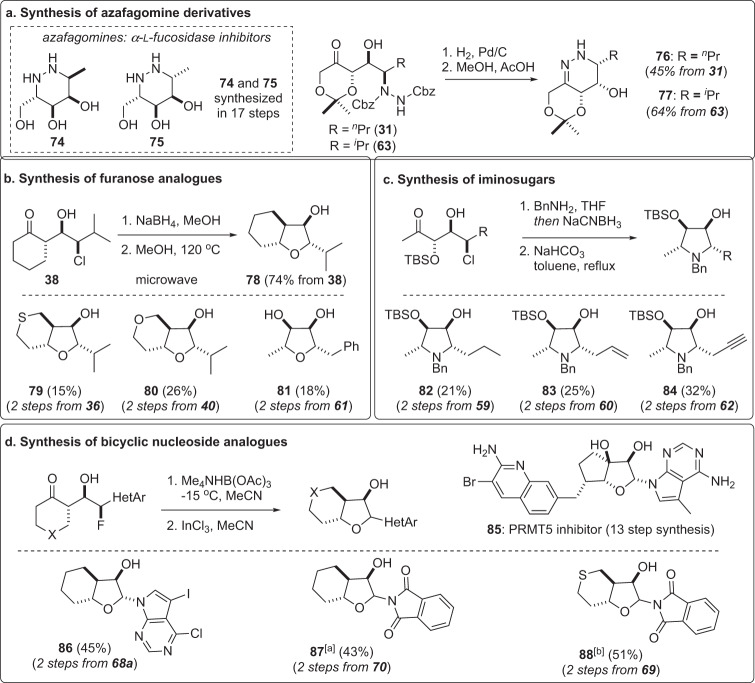
Rapid diversification of α-functionalization/aldol adducts into glycomimetics including azasugars (a), furanose analogs (b), iminosugars (c), and bicyclic nucleoside analogs (d). [a] α:β = 2.5:1; [b] α:β = 3:1.
Fig. 7
Fig. 7. Synthesis of fluorinated glycomimetics.
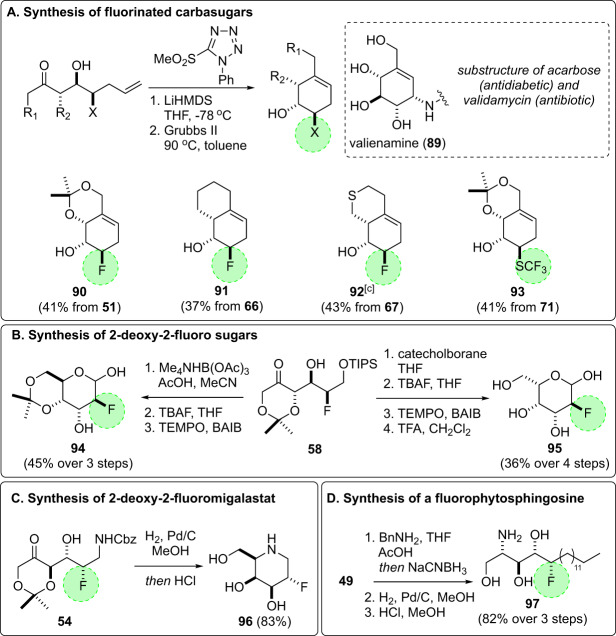
Synthesis of fluorinated glycomimetics including carbasugars (a), 2-deoxy-2-fluoro sugars (b), a fluorinated iminosugar (c), and a fluorinated analog of phytosphingosine (d). Fluorine and fluorinated functional groups are highlighted in green. [c] Grela catalyst.

References

    1. Overend WG. Detection of carbohydrate structures on isolated subcellular organelles of rat liver by heterophile agglutinins. Nature. 1973;242:71–71. doi: 10.1038/242071a0. - DOI - PubMed
    1. Ernst B, Magnani JL. From carbohydrate leads to glycomimetic drugs. Nat. Rev. Drug Discov. 2009;8:661–677. doi: 10.1038/nrd2852. - DOI - PMC - PubMed
    1. Rojo, J., Sousa-Herves, A. & Mascaraque, A. in Comprehensive Medicinal Chemistry III (eds Chackalamannil, S., Rotella, D. & Ward, S. E.) 577–610 (Elsevier, 2017).
    1. Zhang Y, Wang F. Carbohydrate drugs: current status and development prospect. Drug Discov. Ther. 2015;9:79–87. doi: 10.5582/ddt.2015.01028. - DOI - PubMed
    1. Magnani JL, Ernst B. Glycomimetic drugs-a new source of therapeutic opportunities. Discov. Med. 2009;8:247–252. - PubMed