. 2022 Mar 17;5(1):36.
doi: 10.1038/s42004-022-00657-9.

Structure-based design of a dual-warhead covalent inhibitor of FGFR4

Affiliations

Structure-based design of a dual-warhead covalent inhibitor of FGFR4

Xiaojuan Chen et al. Commun Chem. .

Abstract

The fibroblast growth factor 19 (FGF19)/fibroblast growth factor receptor 4 (FGFR4) signaling pathways play critical roles in a variety of cancers, such as hepatocellular carcinoma (HCC). FGFR4 is recognized as a promising target to treat HCC. Currently, all FGFR covalent inhibitors target one of the two cysteines (Cys477 and Cys552). Here, we designed and synthesized a dual-warhead covalent FGFR4 inhibitor, CXF-009, targeting Cys477 and Cys552 of FGFR4. We report the cocrystal structure of FGFR4 with CXF-009, which exhibits a dual-warhead covalent binding mode. CXF-009 exhibited stronger selectivity for FGFR4 than FGFR1-3 and other kinases. CXF-009 can also potently inhibit the single cystine mutants, FGFR4(C477A) and FGFR4(C552A), of FGFR4. In summary, our study provides a dual-warhead covalent FGFR4 inhibitor that can covalently target two cysteines of FGFR4. CXF-009, to our knowledge, is the first reported inhibitor that forms dual-warhead covalent bonds with two cysteine residues in FGFR4. CXF-009 also has the potential to overcome drug induced resistant FGFR4 mutations and might serve as a lead compound for future anticancer drug discovery.


Conflict of interest statement

The authors declare no competing interests.

Figures
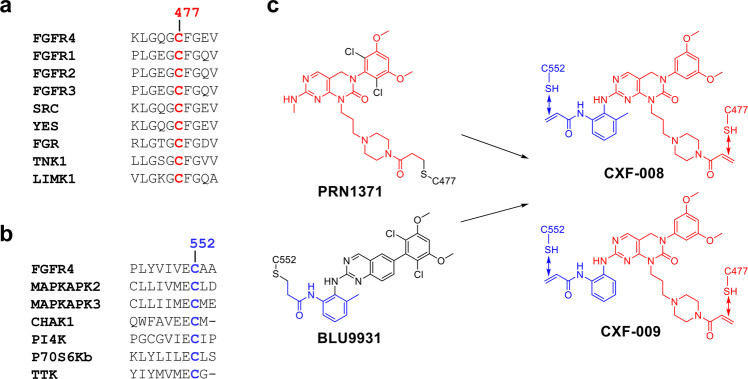
Fig. 1
Fig. 1. Design of dual-warhead covalent inhibitor of FGFR4.
a, b Kinases with the cysteines at the equivalent position of Cys477 (a) and Cys552 (b) in FGFR4 within the human kinome. c Design the new dual-warhead covalent inhibitors CXF-009 and CXF-008 for Cys477 and Cys552 of FGFR4. 4-acrylamidepiperazin-1-propyl from PRN1371 is colored red, and the 2-acrylamidebenzamine group from BLU9931 is indicated in blue.
Fig. 2
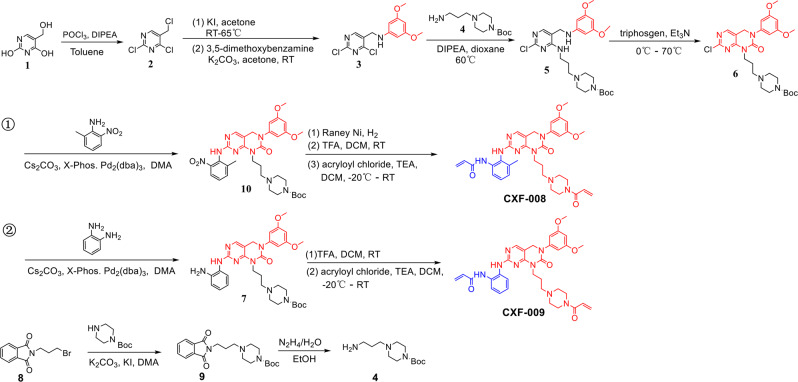
Fig. 2. Synthesis of compound CXF-008 and CXF-009.
CXF-008 and CXF-009 were synthesized using 5-hydroxymethyluracil as the starting material via eight steps.
Fig. 3
Fig. 3. MALDI-TOF MS determination of protein (black) and protein/inhibitor complexes (blue) for CXF-009.
a Apo FGFR4 and FGFR4/CXF-009 mixture; b Apo FGFR4(C477A) and FGFR4(C477A)/CXF-009 mixture; c Apo FGFR4(C552A) and FGFR4(C552A)/CXF-009 mixture; d Apo FGFR4(C477A, C552A) and FGFR4(C477A, C552A)/CXF-009 mixture.
Fig. 4
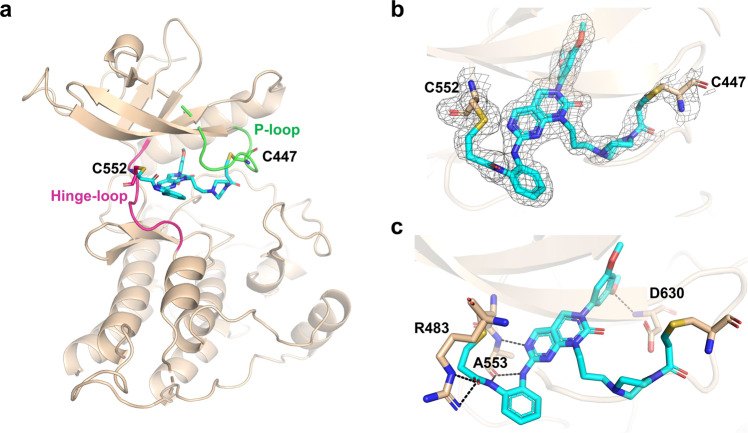
Fig. 4. Crystal structure of FGFR4/CXF-009 complex.
a The overall structure of FGFR4/CXF-009 complex. FGFR4 kinase is colored as wheat, and CXF-009 is shown as cyan. Hinge loop (warm-pink) and P-loop (green) are high-light in the structure. b The 2Fo-Fc omit map (black mesh, contoured at 0.7σ) of the FGFR4/CXF-009 co-crystal structure. c The hydrogen bonds between FGFR4 and CXF-009. Hydrogen bond distance is <3.3 Å.
Fig. 5
Fig. 5. CXF-009 selectively inhibited FGFR4.
a Potency and selectivity of CXF-009 against wild-type FGFR1-4 and FGFR4 mutations using kinase assay. b Cellular activity determination of CXF-009 using a Ba/F3 cell model. Data are presented as dot, n = 3 independent replicates. Error bars indicate mean ± SD. c Kinase inhibition profile of CXF-009 with 185 kinases at 1000 nM.

References

    1. Lu X, Chen H, Patterson AV, Smaill JB, Ding K. Fibroblast growth factor receptor 4 (FGFR4) selective inhibitors as hepatocellular carcinoma therapy: advances and prospects. J. Med. Chem. 2019;62:2905–2915. doi: 10.1021/acs.jmedchem.8b01531. - DOI - PubMed
    1. Dai S, Zhou Z, Chen Z, Xu G, Chen Y. Fibroblast growth factor receptors (FGFRs): structures and small molecule inhibitors. Cells. 2019;8:614. doi: 10.3390/cells8060614. - DOI - PMC - PubMed
    1. Quintanal-Villalonga A, Ferrer I, Molina-Pinelo S, Paz-Ares L. A patent review of FGFR4 selective inhibition in cancer (2007-2018) Expert Opin. Ther. Pat. 2019;29:429–438. doi: 10.1080/13543776.2019.1624720. - DOI - PubMed
    1. Babina IS, Turner NC. Advances and challenges in targeting FGFR signalling in cancer. Nat. Rev. Cancer. 2017;17:318–332. doi: 10.1038/nrc.2017.8. - DOI - PubMed
    1. Helsten T, et al. The FGFR landscape in cancer: analysis of 4,853 tumors by next-generation sequencing. Clin. Cancer Res. 2016;22:259–267. doi: 10.1158/1078-0432.CCR-14-3212. - DOI - PubMed