


Macrophage activation syndrome in children with Kikuchi-Fujimoto disease
- PMID: 36698152
- PMCID: PMC9875483
- DOI: 10.1186/s12969-023-00788-w
Macrophage activation syndrome in children with Kikuchi-Fujimoto disease
Abstract
Background: Kikuchi-Fujimoto disease (KFD) is typically a benign, self-limiting inflammatory disease. However, some patients may have a prolonged or recurrent disease course, or present with life-threatening complications such as macrophage activation syndrome (MAS). In this study, we aimed to describe the incidence and clinical features of MAS in KFD and to access potential laboratory markers for the diagnosis of KFD-associated MAS.
Methods: Patients with KFD were retrospectively enrolled from January 2015 to November 2021 at Shenzhen Children's Hospital. Clinical data were collected from inpatient or outpatient medical records. Data collected included clinical manifestations, laboratory and imaging findings, treatment, and clinical outcomes. Data were analyzed using GraphPad Prism 8.0 statistical software (GraphPad Software Inc., La Jolla, CA, USA). A receiver operating characteristic (ROC) curve analysis was further performed to access the potential predictors for the KFD-MAS diagnosis.
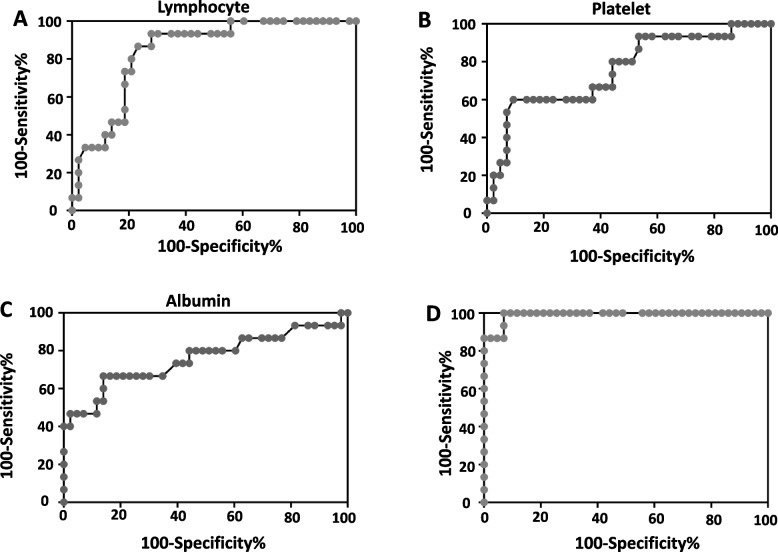
Results: Of 58 patients with a histological diagnosis of KFD, 15 (25.9%) patients had MAS. Compared to patients without MAS, patients with KFD-MAS presented with a higher proportion of skin rash (26.7%, p = 0.01), glucocorticoid treatment (80%, p = 0.003), and disease recurrence (33.3%, p = 0.04). KFD-MAS patients had lower absolute peripheral white blood cell (WBC, p = 0.02), platelet (p = 0.002), serum albumin levels (p = 0.01), and lymphocyte count (p < 0.0001), and higher lactate dehydrogenase (LDH) levels (p < 0.0001). ROC curve analysis showed that the cutoff values of absolute lymphocyte count, an absolute platelet count, serum albumin level, and serum LDH level for KFD-MAS diagnosis were < 1235/μL, < 171 × 106/μL, < 35.6 g/L, and > 679 IU/mL, respectively.
Conclusions: The presence of KFD-MAS in children may be more common than previously expected, especially in those with skin rash. KFD-MAS may be associated with a higher recurrence rate. An extremely elevated serum LDH level and moderate to severe lymphopenia may be useful diagnostic markers for MAS in KFD.
Trial registration: Not applicable; this was a retrospective study.
Keywords: Histiocytic necrotizing lymphadenitis; Kikuchi-Fujimoto disease; Macrophage activation syndrome; Systemic juvenile idiopathic arthritis.
© 2023. The Author(s).
Conflict of interest statement
All authors declare no conflict of interest.
Figures
References
-
- Masab M, Surmachevska N, Farooq H. Kikuchi Disease. 2022. - PubMed
-
- Sykes JA, Badizadegan K, Gordon P, Sokol D, Escoto M, Ten I, et al. Simultaneous Acquired Self-limited Hemophagocytic Lymphohistiocytosis and Kikuchi Necrotizing Lymphadenitis in a 16-Year-Old Teenage Girl: A Case Report and Review of the Literature. Pediatr Emerg Care. 2016;32(11):792–798. doi: 10.1097/PEC.0000000000000560. - DOI - PubMed
MeSH terms
Substances
Grants and funding
LinkOut - more resources
Full Text Sources
Medical
