Review
. 2023 Apr;10(10):e2201718.
doi: 10.1002/advs.202201718. Epub 2023 Jan 25.

Ionic Conduction in Polymer-Based Solid Electrolytes

Affiliations
Review

Ionic Conduction in Polymer-Based Solid Electrolytes

Zhuo Li et al. Adv Sci (Weinh). 2023 Apr.

Abstract

Good safety, high interfacial compatibility, low cost, and facile processability make polymer-based solid electrolytes promising materials for next-generation batteries. Key issues related to polymer-based solid electrolytes, such as synthesis methods, ionic conductivity, and battery architecture, are investigated in past decades. However, mechanistic understanding of the ionic conduction is still lacking, which impedes the design and optimization of polymer-based solid electrolytes. In this review, the ionic conduction mechanisms and optimization strategies of polymer-based solid electrolytes, including solvent-free polymer electrolytes, composite polymer electrolytes, and quasi-solid/gel polymer electrolytes, are summarized and evaluated. Challenges and strategies for enhancing the ionic conductivity are elaborated, while the ion-pair dissociation, ion mobility, polymer relaxation, and interactions at polymer/filler interfaces are highlighted. This comprehensive review is especially pertinent for the targeted enhancement of the Li-ion conductivity of polymer-based solid electrolytes.

Keywords: composite polymer electrolyte; interfacial interaction; ionic conduction; polymer electrolyte; solid-state batteries.


Conflict of interest statement

The authors declare no conflict of interest.

Figures
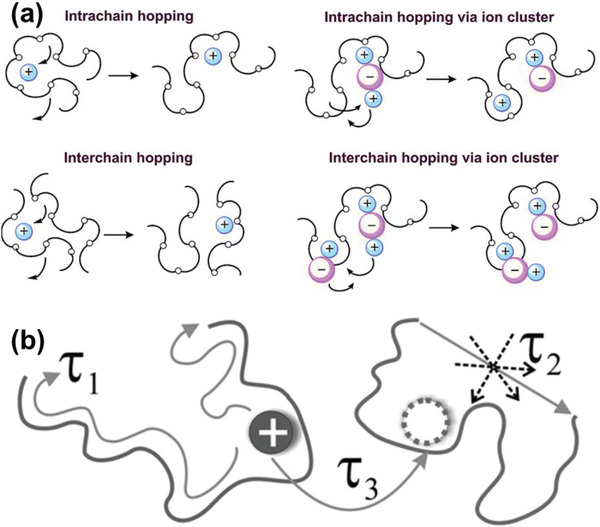
Figure 1
Figure 1
a) Li‐ion conduction occurring in the amorphous region of polymer. Reproduced with permission.[ 6b ] Copyright 2015, Royal Society of Chemistry. b) Li‐ion transport arising from intra‐chain motion, polymer‐segment relaxation, and inter‐chain hopping. Reproduced with permission.[ 41 ] Copyright 2007, American Physical Society.
Figure 2
Figure 2
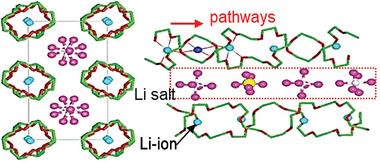
Li‐ion conduction occurring through the crystalline region in polymer. Reproduced with permission.[ 45 ] Copyright 1999, Springer Nature.
Figure 3
Figure 3
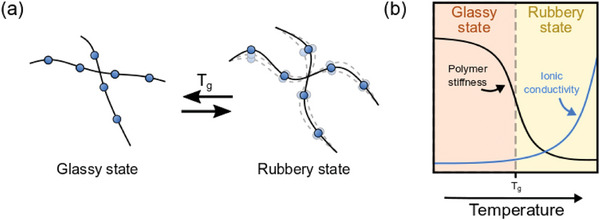
a) Schematic representation of the behavior of polymer segments above and below the glass transition temperature and b) relationship of polymer stiffness and ionic conductivity as a function of temperature. Above T g, polymer segments become more flexible, which aids the ionic conduction. Reproduced with permission.[ 47 ] Copyright 2021, Elsevier.
Figure 4
Figure 4
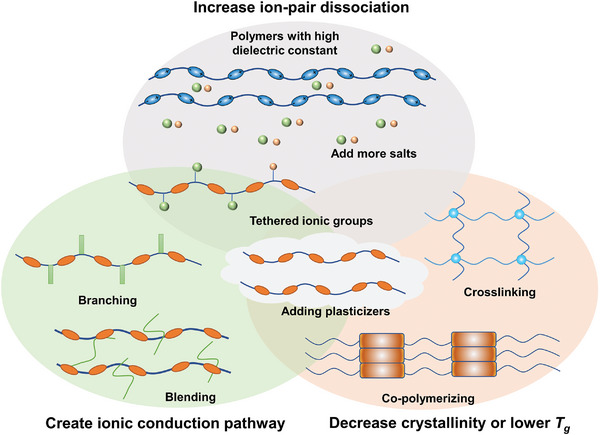
Approaches toward highly ionic‐conducting solid polymer electrolytes.
Figure 5
Figure 5
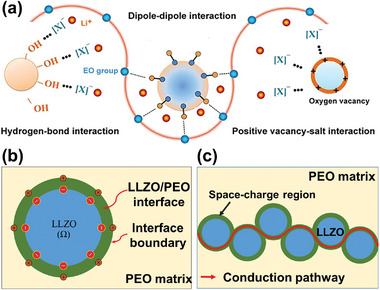
a) Illustration of Lewis acid–base interactions between fillers and polymer hosts. Reproduced with permission.[ 17 ] Copyright 2019, John Wiley and Sons. b) Space‐charge region between polymer host and filler and c) space‐charge regions providing pathway for fast ionic conduction. Reproduced with permission.[ 10 ] Copyright 2019, American Chemical Society.
Figure 6
Figure 6
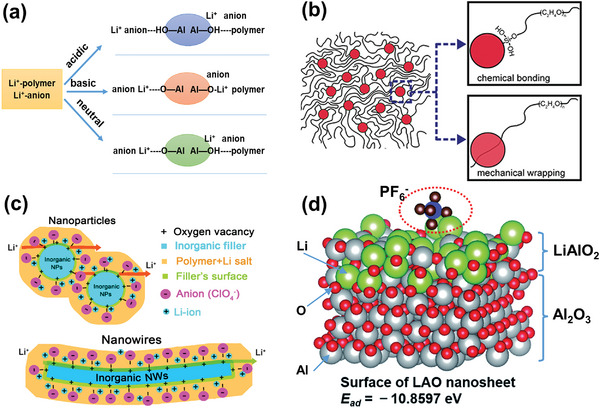
a) Pictorial model of surface interactions between three forms of dispersed fillers. Reproduced with permission.[ 87 ] Copyright 2003, IOP Publishing. b) Schematic representation of Lewis acid–base interactions between polymer and SiO2 nanoparticles. Reproduced with permission.[ 88 ] Copyright 2016, American Chemical Society. c) Schematic illustration of the Li‐ion transport in composite polymer electrolyte owing to the Lewis acid–base effect. Reproduced with permission.[ 89 ] Copyright 2016, American Chemical Society. d) LiAlO2‐coated Al2O3 particles strengthening Lewis acid–base interactions. Reproduced with permission.[ 90 ] Copyright 2021, Royal Society of Chemistry.
Figure 7
Figure 7
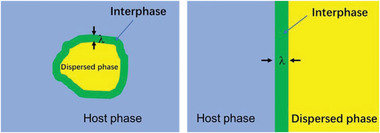
Space‐charge region in composite polymer electrolyte.
Figure 8
Figure 8
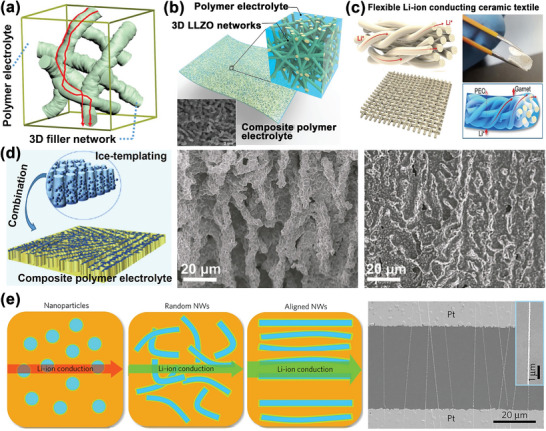
a) 3D LLZO skeleton providing continuous pathways for the Li‐ion conduction in composite polymer electrolyte. Reproduced with permission.[ 78a ] Copyright 2018, American Chemical Society. b) Schematic representation of 3D LLZO nanofiber network in composite polymer electrolyte. Reproduced with permission.[ 105a ] Copyright 2016, the National Academy of Sciences. c) Schematic representation of composite polymer electrolyte reinforced by solid‐garnet‐textile. Reproduced with permission.[ 105b ] Copyright 2018, Elsevier. d) Composite polymer electrolyte reinforced by vertically aligned LAGP‐ceramic. Reproduced with permission.[ 15a ] Copyright 2019, Elsevier. e) Composite polymer electrolyte reinforced by well‐aligned LLTO‐nanowires. Reproduced with permission.[ 105c ] Copyright 2017, Springer Nature.
Figure 9
Figure 9
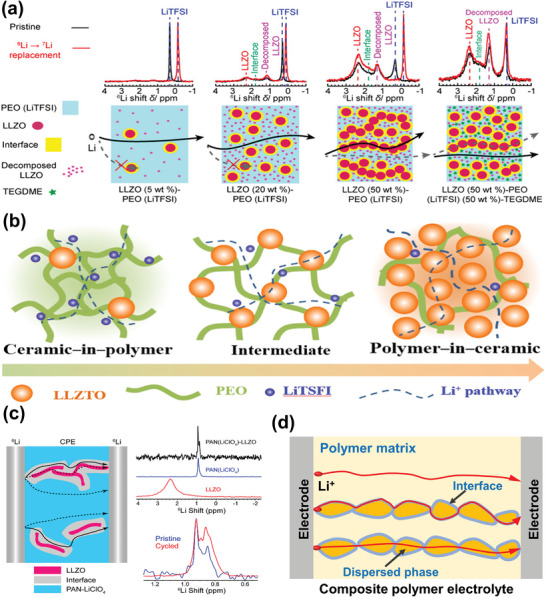
a) ssNMR spectra and schematic of Li‐ion pathways in PEO/LLZO (5 wt%), PEO/LLZO (20 wt%), PEO/LLZO (50 wt%), and TEGDME/PEO/LLZO (50 wt%) composite polymer electrolytes. Reproduced with permission.[ 107 ] Copyright 2018, American Chemical Society. b) Illustration of Li‐ion conduction pathways in the PEO‐LLZTO composite, from “ceramic‐in‐polymer” to “polymer‐in‐ceramic”. Reproduced with permission. [ 108 ] Copyright 2018, Elsevier. c) ssNMR spectra and schematic of Li‐ion pathways in PAN/LLZO composites. Reproduced with permission. [ 93 ] Copyright 2018, American Chemical Society. d) Illustration of ion‐conducting pathways in composite polymer electrolyte.
Figure 10
Figure 10
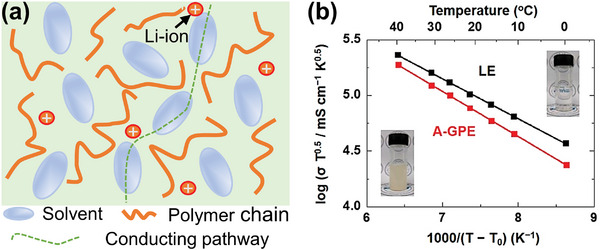
a) Schematic representation of typical quasi‐solid polymer and b) conductivities of liquid electrolyte and quasi‐solid electrolyte. Reproduced with permission.[ 115 ] Copyright 2019, American Chemical Society.
Figure 11
Figure 11
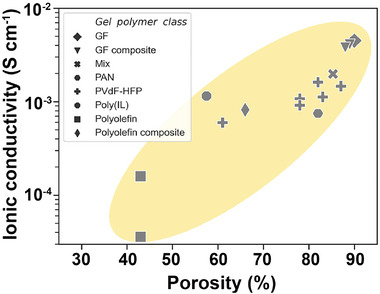
Ionic conductivity of several classes of gel‐polymer electrolytes versus porosity. A correlation between ionic conductivity and porosity is evident across classes of gel polymer electrolyte. Glass fiber (GF) composites are GF separators coated or impregnated with ionically conductive polymers. Reproduced with permission.[ 47 ] Copyright 2021, Elsevier.
Figure 12
Figure 12
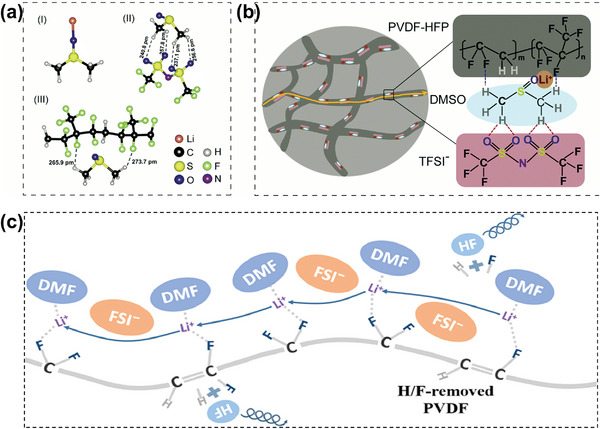
a) Optimized geometric configurations of the interaction systems of Li+/DMSO and b) Li+ transport model in the PVDF‐HFP/DMSO/LiTFSI‐based localized high‐concentration quasi‐solid polymer electrolyte. Reproduced with permission.[ 118 ] Copyright 2022, Royal Society of Chemistry. c) Schematic illustration for the interactions and the lithium‐ transport in the PVDF/DMF/LiFSI quasi‐solid polymer electrolyte. Reproduced with permission.[ 119 ] Copyright 2022, Elsevier.

References

    1. a) Bruce Dunn H. K., Tarascon J.‐M., Science 2011, 334, 928; - PubMed
    2. b) Tarascon J.‐M., Armand M., Nature 2001, 414, 359; - PubMed
    3. c) Armand M., Tarascon J.‐M., Nature 2008, 451, 652. - PubMed
    1. a) Hu Y.‐S., Nat. Energy 2016, 1, 16042;
    2. b) Janek J., Zeier W. G., Nat. Energy 2016, 1, 16141;
    3. c) Manthiram A., Yu X., Wang S., Nat. Rev. Mater. 2017, 2, 16103;
    4. d) Zhang L., Yang T., Du C., Liu Q., Tang Y., Zhao J., Wang B., Chen T., Sun Y., Jia P., Li H., Geng L., Chen J., Ye H., Wang Z., Li Y., Sun H., Li X., Dai Q., Tang Y., Peng Q., Shen T., Zhang S., Zhu T., Huang J., Nat. Nanotechnol. 2020, 15, 94; - PubMed
    5. e) Motavalli J., Nature 2015, 526, S96. - PubMed
    1. a) Yang C., Fu K., Zhang Y., Hitz E., Hu L., Adv. Mater. 2017, 29, 1701169; - PubMed
    2. b) Liu B., Zhang J.‐G., Xu W., Joule 2018, 2, 833;
    3. c) Cheng X.‐B., Zhao C.‐Z., Yao Y.‐X., Liu H., Zhang Q., Chem 2019, 5, 74;
    4. d) Xia S., Wu X., Zhang Z., Cui Y., Liu W., Chem 2019, 5, 753.
    1. a) Wang X., Kerr R., Chen F., Goujon N., Pringle J. M., Mecerreyes D., Forsyth M., Howlett P. C., Adv. Mater. 2020, 32, 1905219; - PubMed
    2. b) Wang C., Fu K., Kammampata S. P., McOwen D. W., Samson A. J., Zhang L., Hitz G. T., Nolan A. M., Wachsman E. D., Mo Y., Thangadurai V., Hu L., Chem. Rev. 2020, 120, 4257; - PubMed
    3. c) Long L., Wang S., Xiao M., Meng Y., J. Mater. Chem. A 2016, 4, 10038.
    1. Zhao Q., Stalin S., Zhao C.‐Z., Archer L. A., Nat. Rev. Mater. 2020, 5, 229.

LinkOut - more resources