Review
. 2023 Jan 9:9:1097426.
doi: 10.3389/fmed.2022.1097426. eCollection 2022.

Rise of the planet of rare anemias: An update on emerging treatment strategies

Affiliations
Review

Rise of the planet of rare anemias: An update on emerging treatment strategies

Bruno Fattizzo et al. Front Med (Lausanne). .

Abstract

Therapeutic options for rare congenital (hemoglobinopathies, membrane and enzyme defects, congenital dyserythropoietic anemia) and acquired anemias [warm autoimmune hemolytic anemia (wAIHA), cold agglutinin disease CAD, paroxysmal nocturnal hemoglobinuria (PNH), and aplastic anemia (AA)] are rapidly expanding. The use of luspatercept, mitapivat and etavopivat in beta-thalassemia and pyruvate kinase deficiency (PKD) improves transfusion dependence, alleviating iron overload and long-term complications. Voxelotor, mitapivat, and etavopivat reduce vaso-occlusive crises in sickle cell disease (SCD). Gene therapy represents a fascinating approach, although patient selection, the toxicity of the conditioning regimens, and the possible long-term safety are still open issues. For acquired forms, wAIHA and CAD will soon benefit from targeted therapies beyond rituximab, including B-cell/plasma cell targeting agents (parsaclisib, rilzabrutinib, and isatuximab for wAIHA), complement inhibitors (pegcetacoplan and sutimlimab for CAD, ANX005 for wAIHA with complement activation), and inhibitors of extravascular hemolysis in the reticuloendothelial system (fostamatinib and FcRn inhibitors in wAIHA). PNH treatment is moving from the intravenous anti-C5 eculizumab to its long-term analog ravulizumab, and to subcutaneous and oral proximal inhibitors (anti-C3 pegcetacoplan, factor D and factor B inhibitors danicopan and iptacopan). These drugs have the potential to improve patient convenience and ameliorate residual anemia, although patient compliance becomes pivotal, and long-term safety requires further investigation. Finally, the addition of eltrombopag significantly ameliorated AA outcomes, and data regarding the alternative agent romiplostim are emerging. The accelerated evolution of treatment strategies will need further effort to identify the best candidate for each treatment in the precision medicine era.

Keywords: aplastic anemia; autoimmune hemolytic anemia; beta-thalassemia; cold agglutinin disease; congenital hemolytic anemias; paroxysmal nocturnal hemoglobinuria; pyruvate kinase deficiency; sickle cell disease.


Conflict of interest statement

The authors declare that the research was conducted in the absence of any commercial or financial relationships that could be construed as a potential conflict of interest.

Figures
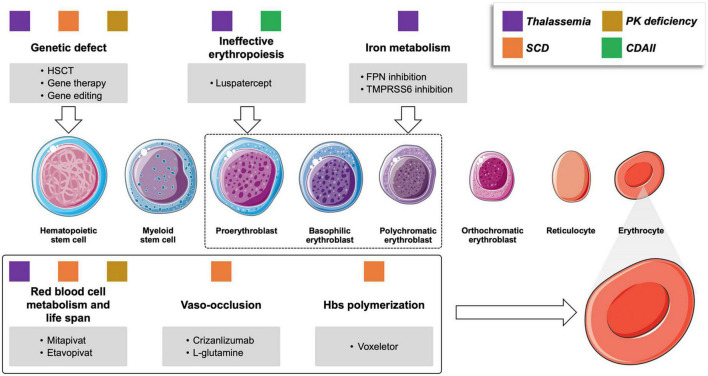
FIGURE 1
FIGURE 1
Novel drugs for rare congenital anemias and their targets. Colored squares represent the different conditions that may benefit of the various compounds under investigation. PK pyruvate kinase; CDAII congenital dyserythropoietic anemia type II; SCD sickle cell anemia; HSCT, hematopoietic stem cell transplant; PK, pyruvate kinase; FPN, ferroportin.
FIGURE 2
FIGURE 2
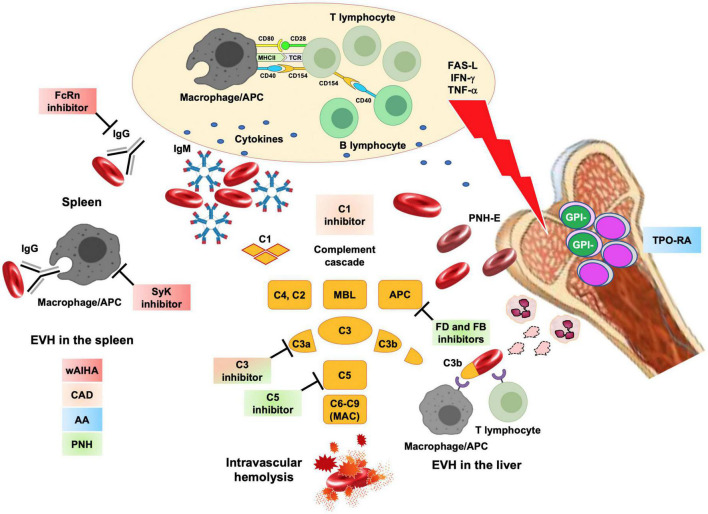
Novel drugs for rare acquired anemias and their targets. Acquired anemias encompass autoimmune hemolytic anemias, where hemolysis is due to autoantibodies produced after a tolerance break with altered B-, T- cells and antigen presenting cells (APC) crosstalk and production of several cytokines. In warm forms (wAIHA), IgG autoantibodies cause extravascular hemolysis (EVH) in the spleen. These processes may be targeted by neonatal Fc receptor inhibitors (FcRn that clear the autoantibodies from the circulation) and spleen tyrosine kinase (SyK) inhibitors (which inhibits phagocytosis). In cold agglutinin disease (CAD), IgM activate the classical complement cascade and cause C3d mediated extravascular hemolysis in the liver and minor C5 mediated intravascular hemolysis. This may be targeted by complement inhibitors (particularly C1 and C3 inhibitors). Even in wAIHA complement activation may occur and complement inhibitors are under study. Aplastic anemia (AA) is due to a T-cell attack to hematopoietic stem cells, through exposure/release of mediators such as FAS, interferon gamma (IFN) and tumor necrosis factor alpha (TNF). Thrombopoietin receptor agonists (TPO–RA) are effective, along with standard immunosuppressors, to restore hematopoiesis. After immune attack to bone marrow precursors, stem cell that acquired PIG-mutation and are glycophosphatidylinositol (GPI-) negative, may be spared and may expand in a paroxysmal nocturnal hemoglobinuria (PNH) clone. PNH erythrocytes lack natural anti-complement molecules CD55 and CD59 and are destroyed intravascularly by complement cascade (mainly through homeostatic alternative pathway activation). Along with already approved C5 inhibitors, novel drugs include C3 inhibitors, Factor B and Factor D (FB, FD). Colored squares represent the different conditions that may benefit of the various compounds under investigation. FAS-L, FAS ligand; IFN, interferon; TNF, tumor necrosis factor; macrophage/APC, antigen presenting cell; APC, alternative complement pathway.

References

    1. Modell B, Darlison M. Global epidemiology of haemoglobin disorders and derived service indicators. Bull World Health Organ. (2008) 86:480–7. 10.2471/BLT.06.036673 - DOI - PMC - PubMed
    1. Taher AT, Musallam KM, Cappellini MD. β-Thalassemias. N Engl J Med. (2021) 384:727–43. 10.1056/NEJMra2021838 - DOI - PubMed
    1. Piel FB, Steinberg MH, Rees DC. Sickle cell disease. N Engl J Med. (2017) 376:1561–73. 10.1056/NEJMra1510865 - DOI - PubMed
    1. Cappellini MD, Marcon A, Fattizzo B, Motta I. Innovative treatments for rare anemias. Hemasphere. (2021) 5:e576. 10.1097/HS9.0000000000000576 - DOI - PMC - PubMed
    1. Cappellini MD, Viprakasit V, Taher AT, Georgiev P, Kuo KHM, Coates T, et al. A phase 3 trial of luspatercept in patients with transfusion-dependent β-thalassemia. N Engl J Med. (2020) 382:1219–31. 10.1056/NEJMoa1910182 - DOI - PubMed