


Newborn screening for X-linked adrenoleukodystrophy in Italy: Diagnostic algorithm and disease monitoring
- PMID: 36698902
- PMCID: PMC9869129
- DOI: 10.3389/fneur.2022.1072256
Newborn screening for X-linked adrenoleukodystrophy in Italy: Diagnostic algorithm and disease monitoring
Erratum in
-
Corrigendum: Newborn screening for X-linked adrenoleukodystrophy in Italy: diagnostic algorithm and disease monitoring.Front Neurol. 2024 Mar 6;15:1376447. doi: 10.3389/fneur.2024.1376447. eCollection 2024. Front Neurol. 2024. PMID: 38510379 Free PMC article.
Abstract
Introduction: X-linked adrenoleukodystrophy (X-ALD) is the most common inherited peroxisomal disorder caused by variants in the ABCD1 gene. The main phenotypes observed in men with X-ALD are primary adrenal insufficiency, adrenomyeloneuropathy, and cerebral ALD (cALD). Cerebral ALD consists of a demyelinating progressive cerebral white matter (WM) disease associated with rapid clinical decline and is fatal if left untreated. Hematopoietic stem cell transplantation is the standard treatment for cALD as it stabilizes WM degeneration when performed early in the disease. For this reason, early diagnosis is crucial, and several countries have already implemented their newborn screening programs (NBS) with the assessment of C26:0-lysophosphatidylcholine (C26:0-LPC) values as screening for X-ALD.
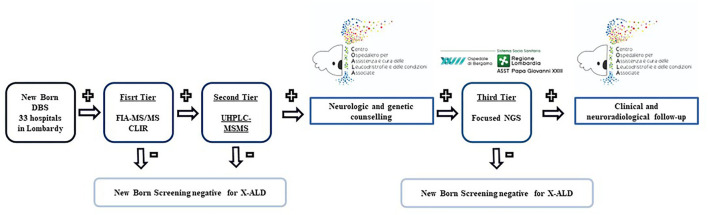
Methods: In June 2021, an Italian group in Lombardy launched a pilot study for the implementation of X-ALD in the Italian NBS program. A three-tiered approach was adopted, and it involved quantifying the values of C26:0-LPC and other metabolites in dried blood spots with FIA-MS/MS first, followed by the more specific ultra-performance liquid chromatography-tandem mass spectrometry (UHPLC-MS/MS) technique and, finally, the genetic confirmation via focused NGS.
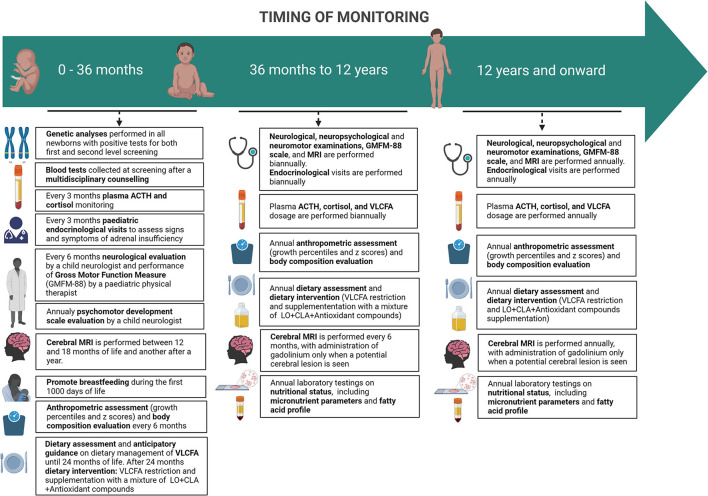
Discussion: Genetically confirmed patients are set to undergo a follow-up protocol and are periodically evaluated to promptly start a specific treatment if and when the first signs of brain damage appear, as suggested by international guidelines. A specific disease monitoring protocol has been created based on literature data and personal direct experience.
Conclusion: The primary aim of this study was to develop a model able to improve the early diagnosis and subsequent follow-up and timely treatment of X-ALD.
Ethics: The study was approved by the local ethics committee. The research was conducted in the absence of any commercial or financial relationship that could be construed as a potential conflict of interest.
Keywords: Aicardi-Goutières syndrome (AGS); C26:0-lysophosphatidylcholine; DBS; X-ALD; X-linked adrenoleukodystrophy (X-ALD); Zellweger Spectrum Disorders; hematopoietic stem cell transplantation (HCST); newborn screening (NBS).
Copyright © 2023 Bonaventura, Alberti, Lucchi, Cappelletti, Fazzone, Cattaneo, Bellini, Izzo, Parazzini, Bosetti, Di Profio, Fiore, Ferrario, Mameli, Sangiorgio, Masnada, Zuccotti, Veggiotti, Spaccini, Iascone, Verduci, Cereda, Tonduti and XALD-NBS Study Group.
Conflict of interest statement
The authors declare that the research was conducted in the absence of any commercial or financial relationships that could be construed as a potential conflict of interest.
Figures
References
LinkOut - more resources
Full Text Sources
Research Materials
Miscellaneous
