Global and national influenza-associated hospitalisation rates: Estimates for 40 countries and administrative regions
- PMID: 36701368
- PMCID: PMC9879557
- DOI: 10.7189/jogh.13.04003
Global and national influenza-associated hospitalisation rates: Estimates for 40 countries and administrative regions
Abstract
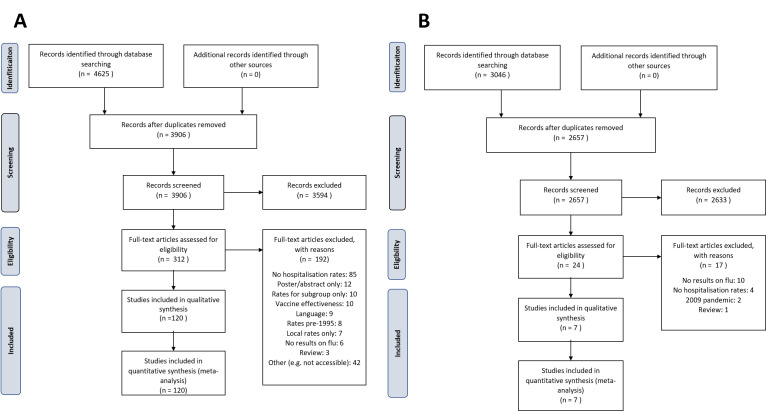
Background: WHO estimates that seasonal influenza epidemics result in three to five million cases of severe illness (hospitalisations) every year. We aimed to improve the understanding of influenza-associated hospitalisation estimates at a national and global level.
Methods: We performed a systematic literature review of English- and Chinese-language studies published between 1995 and 2020 estimating influenza-associated hospitalisation. We included a total of 127 studies (seven in Chinese) in the meta-analysis and analyzed their data using a logit-logistic regression model to understand the influence of five study factors and produce national and global estimates by age groups. The five study factors assessed were: 1) the method used to calculate the influenza-associated hospitalisation estimates (rate- or time series regression-based), 2) the outcome measure (divided into three envelopes: narrow, medium, or wide), 3) whether every case was laboratory-confirmed or not, 4) whether the estimates were national or sub-national, 5) whether the rates were based on a single year or multiple years.
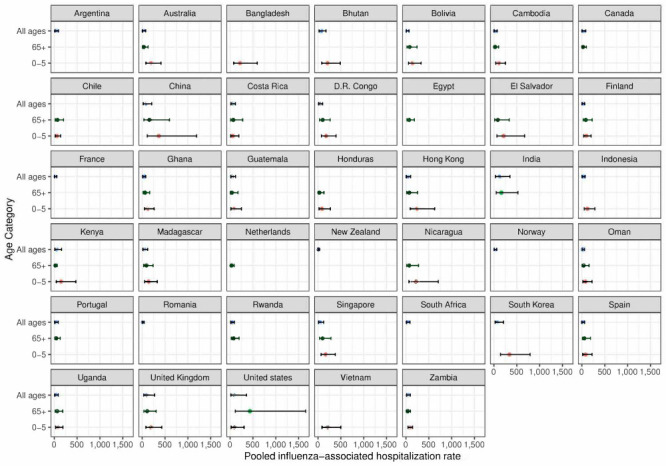
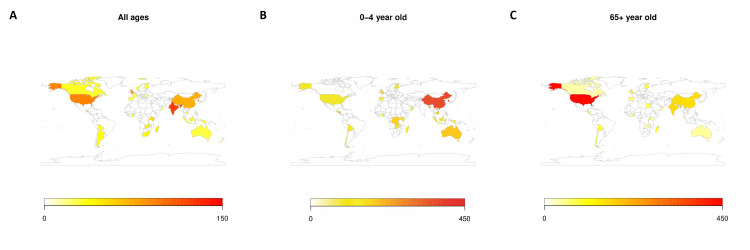
Results: The overall pooled influenza-associated hospitalisation rate was 40.5 (95% confidence interval (CI) = 24.3-67.4) per 100 000 persons, with rates varying substantially by age: 224.0 (95% CI = 118.8-420.0) in children aged 0-4 years and 96.8 (95% CI = 57.0-164.3) in the elderly aged >65 years. The overall pooled hospitalisation rates varied by calculation method; for all ages, the rates were significantly higher when they were based on rate-based methods or calculated on a single season and significantly lower when cases were laboratory-confirmed. The national hospitalisation rates (all ages) varied considerably, ranging from 11.7 (95% CI = 3.8-36.3) per 100 000 in New Zealand to 122.1 (95% CI = 41.5-358.4) per 100 000 in India (all age estimates).
Conclusions: Using the pooled global influenza-associated hospitalisation rate, we estimate that seasonal influenza epidemics result in 3.2 million cases of severe illness (hospitalisations) per annum. More extensive analyses are required to assess the influence of other factors on the estimates (e.g. vaccination and dominant virus (sub)types) and efforts to harmonize the methods should be encouraged. Our study highlights the high rates of influenza-associated hospitalisations in children aged 0-4 years and the elderly aged 65+ years.
Copyright © 2023 by the Journal of Global Health. All rights reserved.
Conflict of interest statement
Disclosure of interest: The authors completed the ICMJE Disclosure of Interest Form (available upon request from the corresponding author) and disclose the following activities and relationships: JP, LS, TvP, MD, PS declare that Nivel has received influenza research grants from the World Health Organization, Sanofi, and the Foundation for Influenza Epidemiology. SSC and CM are employees of Sanofi, but the content of this paper is not representative of the views of their organization. Cecile Viboud is an employee of the NIH, but this study does not necessarily represent the views of the NIH or the US government. All other authors declare no competing interests.
Figures
References
-
- World Health Organization. Influenza (Seasonal). Available: https://www.who.int/news-room/fact-sheets/detail/influenza-(seasonal). Accessed: 31 January 2022.
Publication types
MeSH terms
LinkOut - more resources
Full Text Sources
Medical