. 2020 Nov 11;3(1):166.
doi: 10.1038/s42004-020-00402-0.

Structural characterisation of molecular conformation and the incorporation of adatoms in an on-surface Ullmann-type reaction

Affiliations

Structural characterisation of molecular conformation and the incorporation of adatoms in an on-surface Ullmann-type reaction

Chris J Judd et al. Commun Chem. .

Abstract

The on-surface synthesis of covalently bonded materials differs from solution-phase synthesis in several respects. The transition from a three-dimensional reaction volume to quasi-two-dimensional confinement, as is the case for on-surface synthesis, has the potential to facilitate alternative reaction pathways to those available in solution. Ullmann-type reactions, where the surface plays a role in the coupling of aryl-halide functionalised species, has been shown to facilitate extended one- and two-dimensional structures. Here we employ a combination of scanning tunnelling microscopy (STM), X-ray photoelectron spectroscopy (XPS) and X-ray standing wave (XSW) analysis to perform a chemical and structural characterisation of the Ullmann-type coupling of two iodine functionalised species on a Ag(111) surface held under ultra-high vacuum (UHV) conditions. Our results allow characterisation of molecular conformations and adsorption geometries within an on-surface reaction and provide insight into the incorporation of metal adatoms within the intermediate structures of the reaction.


Conflict of interest statement

The authors declare no competing interests.

Figures
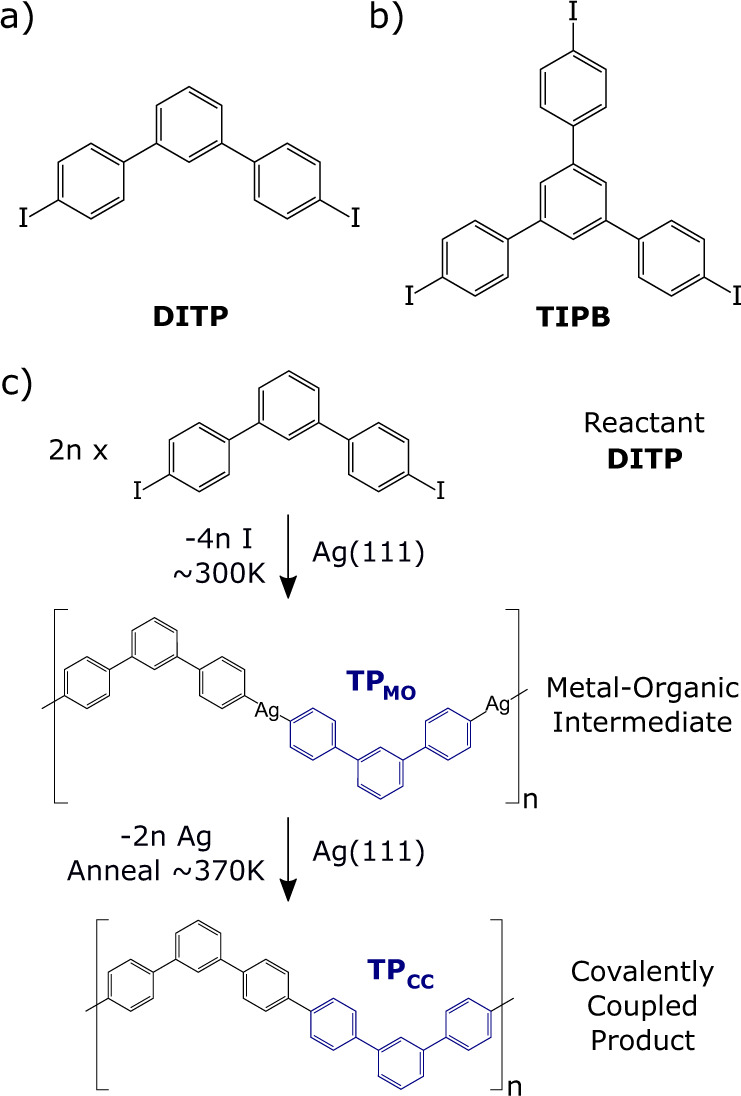
Fig. 1
Fig. 1. Chemical structure of reactant molecules studied and scheme showing the progression of an Ullmann-type on-surface reaction.
Chemical structures of a 4,4″-diiodo-m-terphenyl (DITP) and b 1,3,5-tris(4-iodophenyl)benzene (TIPB). c Reaction scheme for DITP on Ag(111) where cleavage of the C–I bond and formation of an extended metal-organic intermediate, TPMO, occurs at 300 K (room temperature). Annealing at 370 ± 50 K, based on XPS data, results in the formation of a covalently coupled product, TPCC (see refs. ,).
Fig. 2
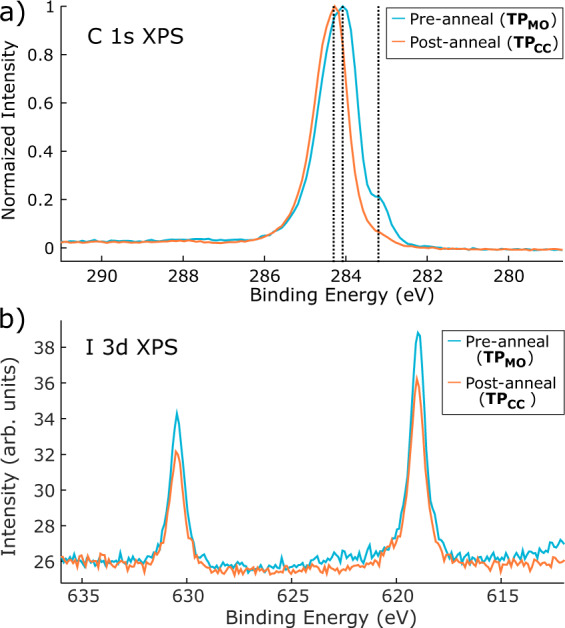
Fig. 2. C 1s and I 3d photoelectron spectra acquired for the metal-organic and covalent phases of TP on Ag(111).
The metal-organic phase (TPMO) is present on the surface following deposition, and the covalent phase (TPCC) is formed following annealing at 370 ± 50 K. a C 1s photoelectron spectra, obtained using a photon energy of 435 eV, before (blue) and after (orange) annealing. b I 3d photoelectron spectra, obtained using a photon energy of 770 eV on Ag(111) before (blue) and after (orange) annealing.
Fig. 3
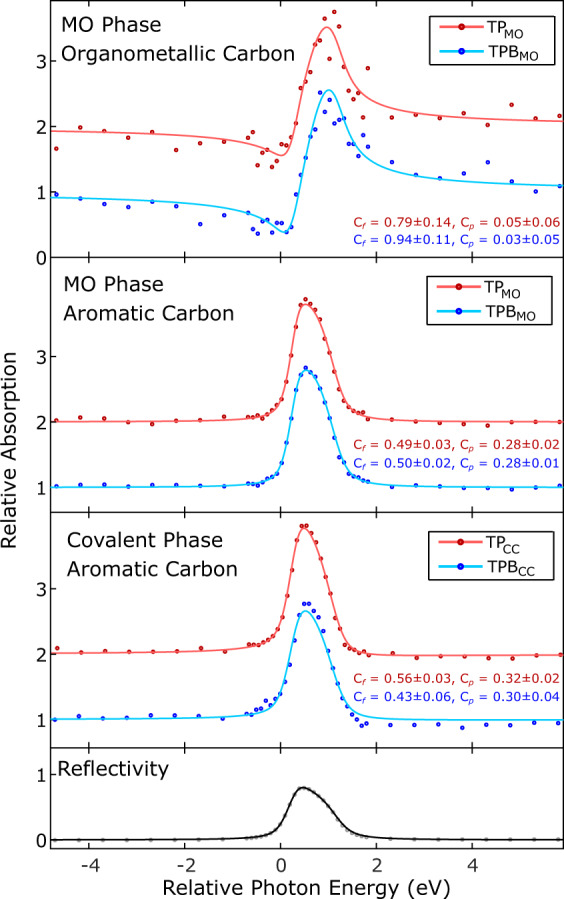
Fig. 3. Chemically sensitive NIXSW measurements of the C1s region of TP and TPB within the metal-organic (MO) and covalently coupled (CC) phases.
NIXSW photoelectron yields obtained using the (111) reflection of the Ag substrate for the C 1s core level, comparing MO and covalent phases of TP (red) and TPB (blue). Each profile is normalised to 1 away from the Bragg condition, with TP results offset by 1 unit for clarity. The obtained Cf and Cp values are shown for each fit.
Fig. 4
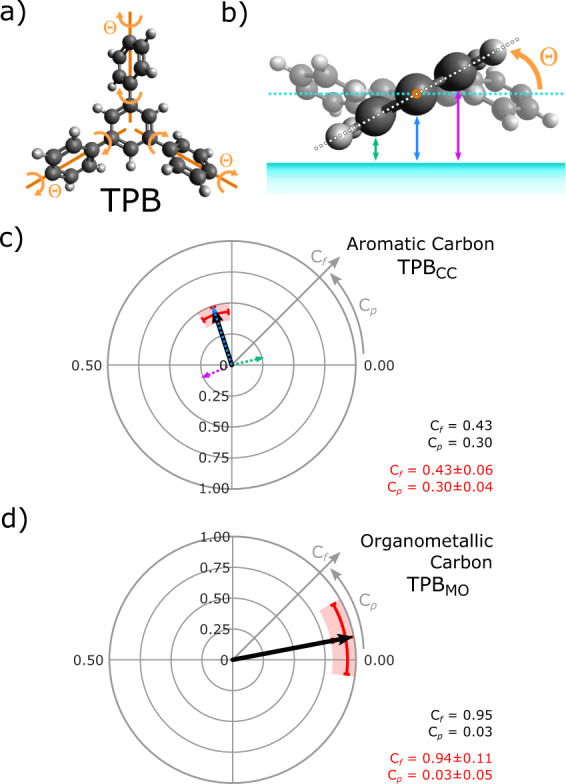
Fig. 4. Structural model for the conformation of TPBCC on Ag(111).
a Model showing twisting of TPBCC aryl end groups around axes of rotation (orange) parallel to the (111) plane and the plane of the molecule; Θ—dihedral angle. b Side view of twisted TPBCC model. Arrows show three different heights of carbon atoms above the surface: above (purple), below (green) and level with (blue) the molecular plane (dashed cyan line). c Argand diagram showing Cf and Cp values for aromatic carbon atoms in TPBCC. XSW results (red) with a model for twisted TPBCC (Θ = 30°) overlaid. Dashed arrows show vectors for carbon atoms at the three different heights above the surface (colours match those in b), with the resultant vector shown in black. d Argand diagram showing model of organometallic carbon atoms in TPBMO, based on measurements of Cf and Cp. Both argand diagrams show the resultant vector Cf and Cp values in bottom right.
Fig. 5
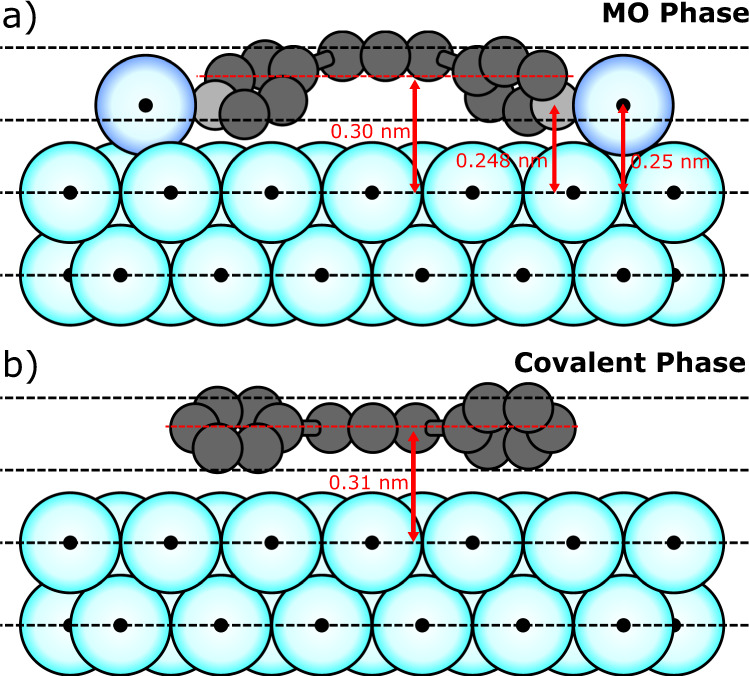
Fig. 5. Models for the vertical positioning of molecules above the Ag(111) surface.
a Metal-organic intermediate phase of the Ullmann-type coupling reaction, with molecules bonded to silver adatoms (dark blue) adsorbed in bridge sites. Average heights of the molecule (red dashed line), C–Ag–C bonded carbon (light grey) and Ag adatoms are shown. b Covalent phase of Ullmann coupling reaction, with average height of the molecule shown.
Fig. 6
Fig. 6. Structural characterisation of the adsorption geometry for the metal-organic (MO) and covalently coupled (CC) phases of TPB on Ag(111).
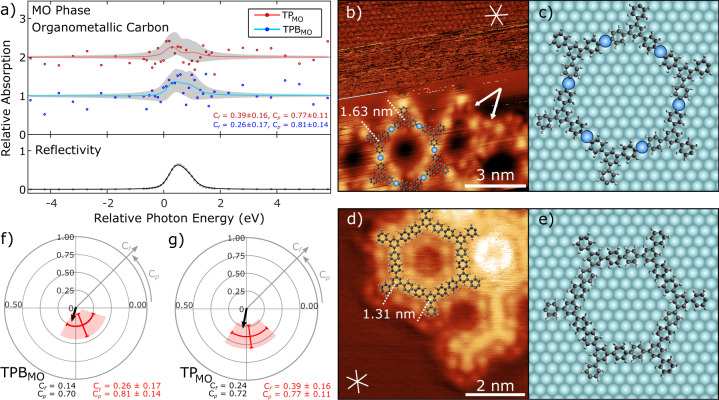
a NIXSW photoelectron yields obtained using the (200) reflection for the C 1s core level, comparing TPMO (red) and TPBMO (blue). Grey shading shows curves fitted using values of Cf and Cp within quoted uncertainty range. Each profile is normalised to 1, away from the Bragg condition, with TPMO results offset by 1 unit for clarity. The obtained Cf and Cp values are shown for each profile. b STM image showing the metal-organic phase of TPB. Top section shows a region of atomic contrast, used to calibrate image. Molecular model, intermolecular separations and lattice vector directions are overlaid. White arrows indicate example locations of iodine atoms. Imaging parameters: Vbias = −80mV, Iset = 2 nA for the top section, Vbias = −1.8 V, Iset = 20 pA for bottom section. c Proposed adsorption models for metal-organic phases of TPB on Ag(111) based on XSW modelling. d STM image of covalently bonded TPB on Ag(111) after annealing the surface. Molecular model, intermolecular separations and lattice vector directions are overlaid. Image parameters: Vbias = −1.8 V, Iset = 20 pA. e Proposed adsorption model for covalent phase of TPB. Models based on measurements obtained from STM images. f, g Argand diagrams for TPBMO and TPMO respectively, showing resultant vector (black) for organometallic carbon atom locations relative to the (200) plane, based on proposed adsorption models (c, e). Measured coherent fraction and position values are shown in red and the model Cf and Cp values are given in the bottom left.

References

    1. Shen Q, Gao H-Y, Fuchs H. Frontiers of on-surface synthesis: from principles to applications. Nano Today. 2017;13:77–96. doi: 10.1016/j.nantod.2017.02.007. - DOI
    1. Cai J, et al. Atomically precise bottom-up fabrication of graphene nanoribbons. Nature. 2010;466:470–473. doi: 10.1038/nature09211. - DOI - PubMed
    1. Grill L, et al. Nano-architectures by covalent assembly of molecular building blocks. Nat. Nanotechnol. 2007;2:687–691. doi: 10.1038/nnano.2007.346. - DOI - PubMed
    1. Lafferentz L, et al. Controlling on-surface polymerization by hierarchical and substrate-directed growth. Nat. Chem. 2012;4:215–220. doi: 10.1038/nchem.1242. - DOI - PubMed
    1. Bieri M, et al. Two-dimensional polymer formation on surfaces: insight into the roles of precursor mobility and reactivity. J. Am. Chem. Soc. 2010;132:16669–16676. doi: 10.1021/ja107947z. - DOI - PubMed