


Plausible Sources of Membrane-Forming Fatty Acids on the Early Earth: A Review of the Literature and an Estimation of Amounts
- PMID: 36704178
- PMCID: PMC9869395
- DOI: 10.1021/acsearthspacechem.2c00168
Plausible Sources of Membrane-Forming Fatty Acids on the Early Earth: A Review of the Literature and an Estimation of Amounts
Abstract
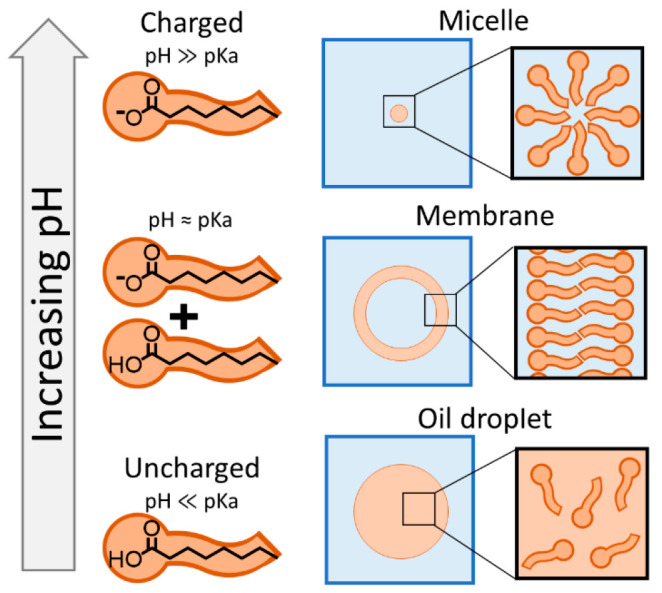
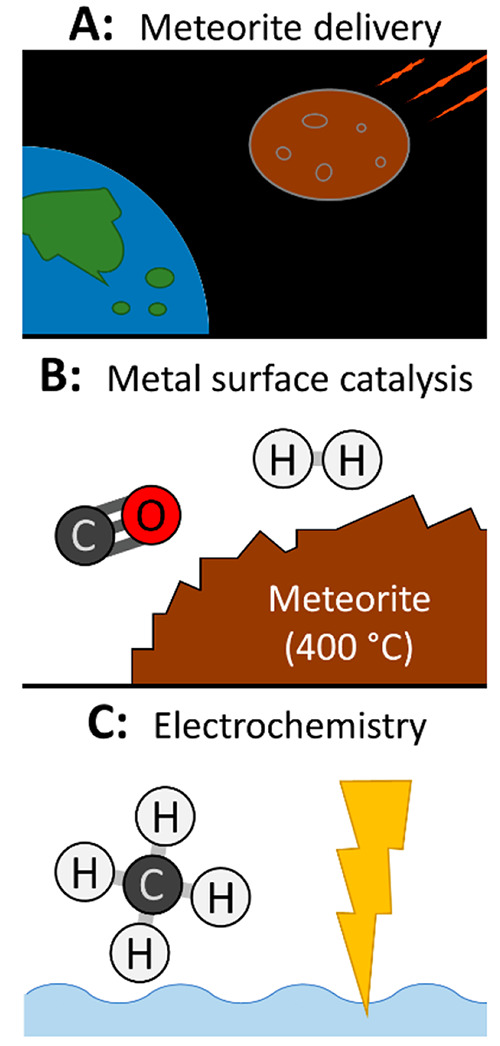
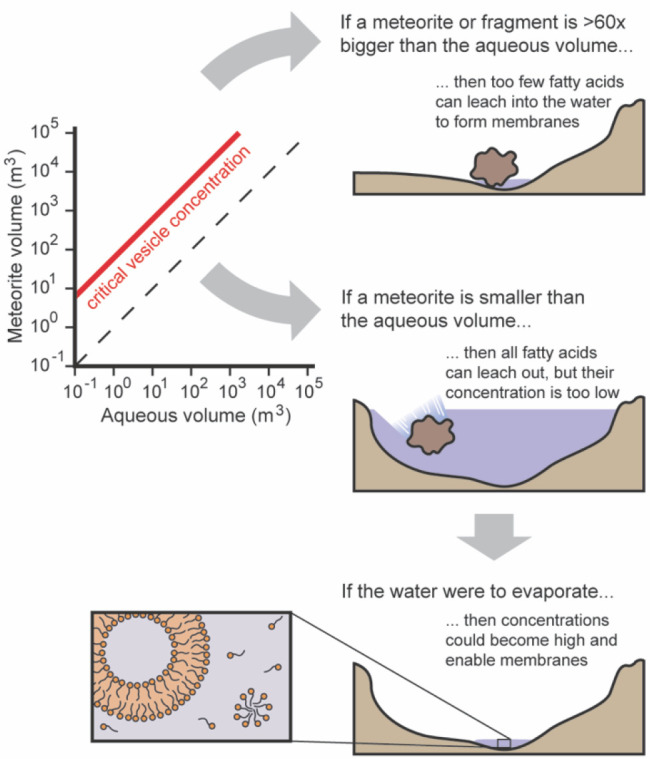
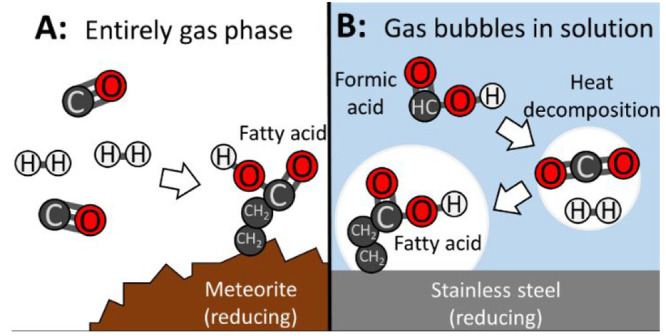
The first cells were plausibly bounded by membranes assembled from fatty acids with at least 8 carbons. Although the presence of fatty acids on the early Earth is widely assumed within the astrobiology community, there is no consensus regarding their origin and abundance. In this Review, we highlight three possible sources of fatty acids: (1) delivery by carbonaceous meteorites, (2) synthesis on metals delivered by impactors, and (3) electrochemical synthesis by spark discharges. We also discuss fatty acid synthesis by UV or particle irradiation, gas-phase ion-molecule reactions, and aqueous redox reactions. We compare estimates for the total mass of fatty acids supplied to Earth by each source during the Hadean eon after an extremely massive asteroid impact that would have reset Earth's fatty acid inventory. We find that synthesis on iron-rich surfaces derived from the massive impactor in contact with an impact-generated reducing atmosphere could have contributed ∼102 times more total mass of fatty acids than subsequent delivery by either carbonaceous meteorites or electrochemical synthesis. Additionally, we estimate that a single carbonaceous meteorite would not deliver a high enough concentration of fatty acids (∼15 mM for decanoic acid) into an existing body of water on the Earth's surface to spontaneously form membranes unless the fatty acids were further concentrated by another mechanism, such as subsequent evaporation of the water. Our estimates rely heavily on various assumptions, leading to significant uncertainties; nevertheless, these estimates provide rough order-of-magnitude comparisons of various sources of fatty acids on the early Earth. We also suggest specific experiments to improve future estimates. Our calculations support the view that fatty acids would have been available on the early Earth. Further investigation is needed to assess the mechanisms by which fatty acids could have been concentrated sufficiently to assemble into membranes during the origin of life.
© 2022 The Authors. Published by American Chemical Society.
Conflict of interest statement
The authors declare no competing financial interest.
Figures
References
-
- Black R. A.; Blosser M. C.; Stottrup B. L.; Tavakley R.; Deamer D. W.; Keller S. L. Nucleobases Bind to and Stabilize Aggregates of a Prebiotic Amphiphile, Providing a Viable Mechanism for the Emergence of Protocells. Proc. Natl. Acad. Sci. USA 2013, 110 (33), 13272. 10.1073/pnas.1300963110. - DOI - PMC - PubMed
-
- Cornell C. E.; Black R. A.; Xue M.; Litz H. E.; Ramsay A.; Gordon M.; Mileant A.; Cohen Z. R.; Williams J. A.; Lee K. K.; Drobny G. P.; Keller S. L. Prebiotic Amino Acids Bind to and Stabilize Prebiotic Fatty Acid Membranes. Proc. Natl. Acad. Sci. USA 2019, 116 (35), 17239–17244. 10.1073/pnas.1900275116. - DOI - PMC - PubMed
-
- Xue M.; Black R. A.; Cohen Z. R.; Roehrich A.; Drobny G. P.; Keller S. L. Binding of Dipeptides to Fatty Acid Membranes Explains Their Colocalization in Protocells but Does Not Select for Them Relative to Unjoined Amino Acids. J. Phys. Chem. B 2021, 125 (29), 7933–7939. 10.1021/acs.jpcb.1c01485. - DOI - PMC - PubMed
Publication types
LinkOut - more resources
Full Text Sources