


A Comprehensive Review with Future Prospects on the Medicinal Properties and Biological Activities of Curcuma caesia Roxb
- PMID: 36704214
- PMCID: PMC9873438
- DOI: 10.1155/2023/7006565
A Comprehensive Review with Future Prospects on the Medicinal Properties and Biological Activities of Curcuma caesia Roxb
Abstract
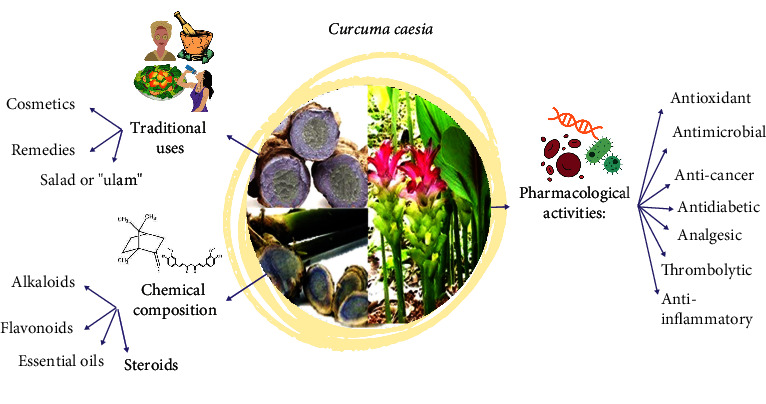
Plants are the primary source of the food chain and are rich in nutrients and biochemical compounds that mainly give beneficial effects to humans as well as other living organisms. Curcuma caesia Roxb. is a family member of Zingiberaceae commonly known as black turmeric. The leaves and rhizomes of this plant are extensively used in Ayurvedic medicine and as traditional remedies for various ailments. The aromatic rhizomes and leaves are due to the presence of essential oils reported as camphor, ar-turmerone, (Z)-β-ocimene, ar-curcumene, 1,8-cineole, β-elemene, borneol, bornyl acetate, tropolone, ledol, β-elemenone, and α-bulnesene. Previous research studies have revealed most of the biological activities of C. caesia, such as antioxidant, antimicrobial, and anti-inflammatory properties, which are due to the presence of various bioactive components. The diverse chemical composition contained in this plant contributes to various biological activities, which may be beneficial for the health, food, and cosmetic industries. The purpose of this review was to summarise updated research on the in vitro and in vivo activities of C. caesia as well as the current clinical investigations. A compilation of the latest findings regarding the potential activities of C. caesia and mechanisms related to its health benefits is discussed and reviewed. This valuable information is the key that can be used for the development of drugs, functional food ingredients, and food products.
Copyright © 2023 Nurul Najiha Ain Ibrahim et al.
Conflict of interest statement
The authors declare that there are no conflicts of interest regarding the publication of this article.
Figures


References
-
- Sheth P. P. Chapter—17 Global Opportunities and challenges for medicinal uses of Ayurveda, herbal products, neutraceuticals and alternatives. Administrator XIX . 2005;1:74–75.
-
- Akmar K., Mat Noor M. Gynura procumbens leaf improves blood glucose level, restores fertility and libido of diabetic-induced male rats. Sains Malaysiana . 2017;46(9):1471–1477. doi: 10.17576/jsm-2017-4609-16. - DOI
-
- Hashim H., Embong F., Yee C. K., Rahman H. A. Effect of different drying methods and ethanol concentrations on antioxidant and anti-hyperglycaemic properties of Gynura procumbens leaves extract. Malaysian Applied Biology . 2018;47:157–164.
-
- Khalid Abduljabar M., Farihan Kasim K., Hadi Ma’Radzi A., Soffalina Sofian Seng N. Recent advances in extraction of Clinachanthus nutans: a review. Journal of Physics: Conference Series . 2019;1424(1) doi: 10.1088/1742-6596/1424/1/012001.012001 - DOI
-
- Global Biodiversity Information Facility. Gbif backbone taxonomy. 2017. https://www.gbif.org/en/species/2757606 .
Publication types
LinkOut - more resources
Full Text Sources
Research Materials
