The Relationship of Vascular Aging to Reduced Cognitive Function: Pulsatile and Steady State Arterial Hemodynamics
- PMID: 36704265
- PMCID: PMC9872056
- DOI: 10.1159/000528147
The Relationship of Vascular Aging to Reduced Cognitive Function: Pulsatile and Steady State Arterial Hemodynamics
Abstract
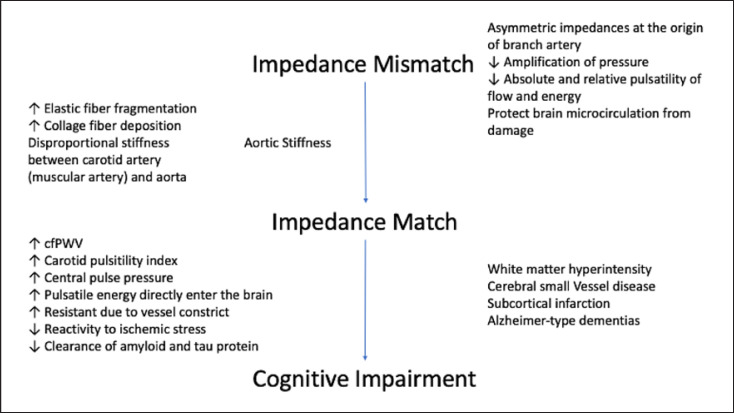
Aortic stiffness increases with age and is a robust predictor of cerebrovascular events and cognitive decline including Alzheimer's disease and other forms of dementia. Recent clinical studies have investigated the association between proximal aortic stiffness and pulsatile energy transmission that has deleterious effects on the cerebrovascular network in order to identify potential therapeutic targets. Aging causes disproportionate stiffening of the aorta compared with the carotid arteries, reducing protective impedance mismatches at their interface, increasing the transmission of destructive pulsatile pressure and energy to the cerebral circulation, and leading to cerebral small vessel disease. Thus, aortic stiffening and high-flow pulsatility are associated with alterations in the microvasculature of the brain, vascular endothelial dysfunction, and white matter damage, which contribute to impaired memory function with advancing age. Previous studies have also shown that silent lacunar infarcts and white matter hyperintensities are strongly associated with arterial stiffness. More and more evidence suggests that vascular etiologies, including aortic stiffness, impedance match, and microvascular damage, are associated with cognitive impairment and the pathogenesis of dementia. The measurement of arterial flow and pressure can help understand pulsatile hemodynamics and its impact on vital organs. Interventions that reduce aortic stiffness, such as improvement of the living environment, management of risk factors, and innovation and development of novel drugs, may reduce the risk for dementia.
Keywords: Arterial stiffness; Carotid artery; Cognitive dysfunction; Excessive pulsatile energy; Vascular hemodynamics.
Copyright © 2022 by The Author(s). Published by S. Karger AG, Basel.
Conflict of interest statement
The authors have no conflicts of interest to declare.
Figures
References
-
- Climie RED, Picone DS, Blackwood S, Keel SE, Qasem A, Rattigan S, et al. Pulsatile interaction between the macro-vasculature and micro-vasculature: proof-of-concept among patients with type 2 diabetes. Eur J Appl Physiol. 2018 Nov;118((11)):2455–63. - PubMed
-
- Nilsson PM, Boutouyrie P, Laurent S. Vascular aging: a tale of EVA and ADAM in cardiovascular risk assessment and prevention. Hypertension. 2009 Jun;54((1)):3–10. - PubMed
-
- Laurent S, Boutouyrie P, Cunha PG, Lacolley P, Nilsson PM. Concept of extremes in vascular aging. Hypertension. 2019 Aug;74((2)):218–28. - PubMed
Publication types
LinkOut - more resources
Full Text Sources