


Damage mapping techniques and the light they have shed on canonical and atypical UV photoproducts
- PMID: 36704334
- PMCID: PMC9871259
- DOI: 10.3389/fgene.2022.1102593
Damage mapping techniques and the light they have shed on canonical and atypical UV photoproducts
Abstract
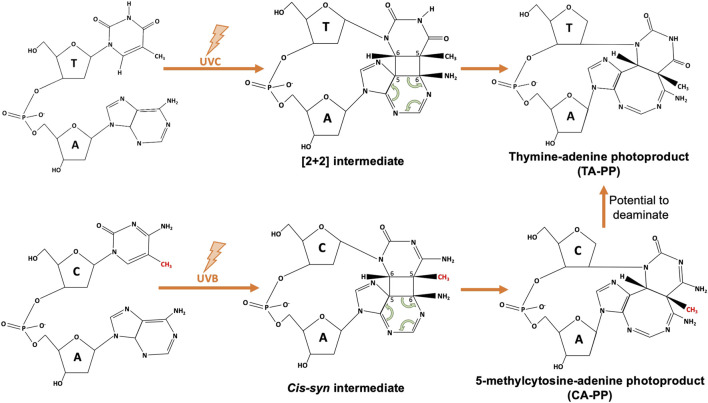
Ultraviolet (UV) light is a pervasive threat to the DNA of terrestrial organisms. UV light induces helix-distorting DNA lesions, primarily cyclobutane pyrimidine dimers (CPDs) that form between neighboring pyrimidine bases. Unrepaired CPD lesions cause cytosine-to-thymine (C>T) substitutions in dipyrimidine sequences, which is the predominant mutation class in skin cancer genomes. However, many driver mutations in melanoma (e.g., in the BRAF and NRAS oncogenes) do not fit this UV mutation signature. Recent studies have brought to light the intriguing hypothesis that these driver mutations may be induced by infrequent or atypical UV photoproducts, including pyrimidine 6-4 pyrimidone photoproducts (6-4PP) and thymine-adenine (TA) photoproducts. Here, we review innovative methods for mapping both canonical and atypical UV-induced photoproducts across the genome.
Keywords: 6-4 photoproduct; CPD; hotspot; melanoma; mutation; nucleosome; thymine-adenine photoproduct; transcription factor.
Copyright © 2023 Bohm and Wyrick.
Conflict of interest statement
The authors declare that the research was conducted in the absence of any commercial or financial relationships that could be construed as a potential conflict of interest.
Figures
References
Publication types
Grants and funding
LinkOut - more resources
Full Text Sources
Research Materials
Miscellaneous
