


Accompanying patients in clinical oncology teams: Reported activities and perceived effects
- PMID: 36704843
- PMCID: PMC10010089
- DOI: 10.1111/hex.13710
Accompanying patients in clinical oncology teams: Reported activities and perceived effects
Abstract
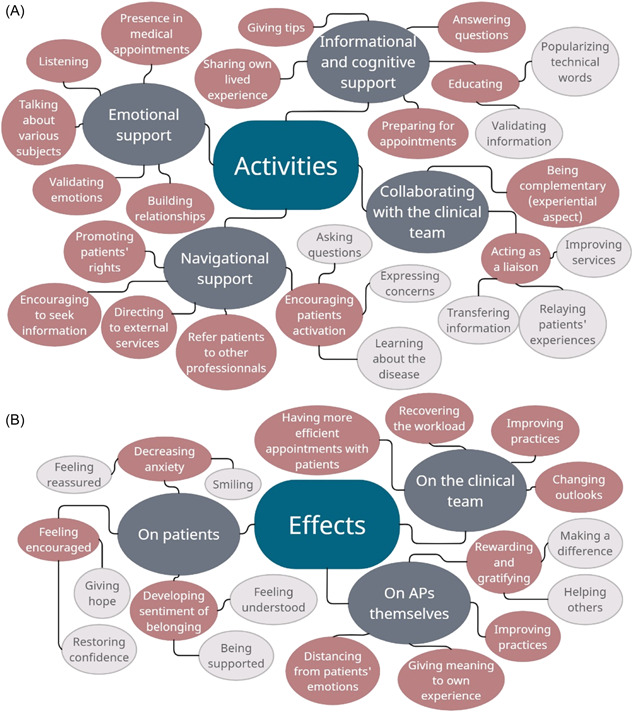
Introduction: Since 2018, four establishments in Quebec, Canada, have decided to implement the PAROLE-Onco programme, which introduced accompanying patients (APs) in healthcare teams to improve the experience of cancer patients. APs are patient advisors who have had a cancer treatment experience and who conduct consultations to complement the service offered by providing emotional, informational and educational support to patients undergoing treatments (e.g., radiotherapy, chemotherapy, surgery), mostly for breast cancer. We aimed to explore the evolution of APs' perspectives regarding their activities within the clinical oncology teams as well as the perceived effects of their intervention with patients, the clinical team and themselves.
Methods: A qualitative study based on semistructured interviews and focus groups was conducted with APs at the beginning of their intervention (T1) and 2 years afterwards (T2). The themes discussed were APs' activities and the perceived effects of their interventions on themselves, on the patients and on the clinical team.
Results: In total, 20 APs were interviewed. In T2, APs' activities shifted from listening and sharing experiences to empowering patients by helping them become partners in their care and felt generally more integrated into the clinical team. APs help patients feel understood and supported, alleviate stress and become partners in the care they receive. They also alleviate the clinical team's workload by offering a complementary service through emotional support, which, according to them, helps patients feel calmer and more prepared for their appointments with healthcare professionals. They communicate additional information about their patients' health journey, which makes the appointment more efficient for healthcare professionals. When APs accompany patients, they feel as if they can make a difference in patients' lives. Their activities are perceived by some as an opportunity to give back but also as a way of giving meaning to their own experience, in turn serving as a learning experience.
Conclusion: By mobilizing their experiential knowledge, APs provide emotional, informational, cognitive and navigational support, which allows patients to be more empowered in their care and which complements professionals' scientific knowledge, thereby helping to refine their sensitivity to the patients' experiences.
Patient or public contribution: Two patient-researchers have contributed to the study design, the conduct of the study, the data analysis and interpretation, as well as in the preparation and writing of this manuscript.
Keywords: accompanying patients; clinical team; oncology; patient advisor; patient care experience; peer support.
© 2023 The Authors. Health Expectations published by John Wiley & Sons Ltd.
Conflict of interest statement
The authors declare no conflict of interest.
References
-
- Lacoursière A. Registre québécois du cancer: Le Québec est « dans le noir ». La Presse. 2022. Accessed September 12, 2022. https://www.lapresse.ca/actualites/sante/2022-06-14/registre-quebecois-d...
-
- Santéscope . Principales causes de décès. Institut National de Santé Publique du Québec. 2019. Accessed September 7, 2022. https://www.inspq.qc.ca/santescope/syntheses/principales-causes-de-deces
-
- Société canadienne du cancer . Vue d'ensemble des statistiques sur le cancer. Société canadienne du cancer. 2022. Accessed January 10, 2022. https://cancer.ca/fr/research/cancer-statistics/cancer-statistics-at-a-g...
-
- Pomey M, Morin E, Nault C, Clavel N, Beaumont M, D'Amour M. Engager les patients à tous les niveaux de gouvernance: l'exemple du CIUSSS de la Mauricie‐et‐du‐centre‐du Québec. Le Point en Santé et Services Sociaux. 2017;12(4):12‐17.
Publication types
MeSH terms
Grants and funding
LinkOut - more resources
Full Text Sources
Medical
Miscellaneous
