


Quantitative Methods Used to Evaluate Impact of Combination HIV Prevention Intervention: A Methodological Systematic Review
- PMID: 36705772
- PMCID: PMC9881517
- DOI: 10.1007/s10461-023-04000-8
Quantitative Methods Used to Evaluate Impact of Combination HIV Prevention Intervention: A Methodological Systematic Review
Abstract
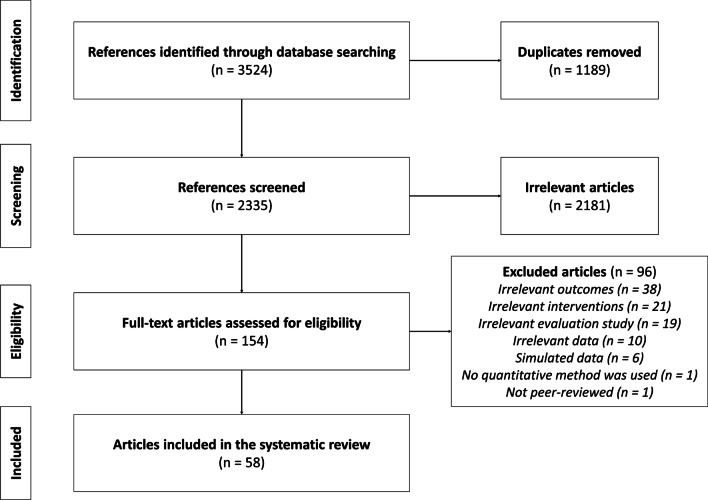
Combination HIV prevention aims to provide the right mix of biomedical, behavioral and structural interventions, and is considered the best approach to curb the HIV pandemic. The impact evaluation of combined HIV prevention intervention (CHPI) provides critical information for decision making. We conducted a systematic review of the literature to map the designs and methods used in these studies. We searched original articles indexed in Web of Science, Scopus and PubMed. Fifty-eight studies assessing the impact of CHPI on HIV transmission were included. Most of the studies took place in Asia or sub-Saharan Africa and were published from 2000 onward. We identified 36 (62.1%) quasi-experimental studies (posttest, pretest-posttest and nonequivalent group designs) and 22 (37.9%) experimental studies (randomized designs). The findings suggest that diverse methods are already rooted in CHPI impact evaluation practices as recommended but should be better reported. CHPI impact evaluation would benefit from more comprehensive approaches.
Keywords: Combination HIV prevention intervention; Decision-making; Evidence-based; Impact evaluation.
© 2023. The Author(s), under exclusive licence to Springer Science+Business Media, LLC, part of Springer Nature.
Conflict of interest statement
We declare no conflicts of interest.
Figures
References
-
- Joint United Nations Programme on HIV/AIDS . Unequal, unprepared, under threat: why bold action against inequalities is needed to end AIDS, stop COVID-19 and prepare for future pandemics. Geneva: Joint United Nations Programme on HIV/AIDS; 2021.
Publication types
MeSH terms
LinkOut - more resources
Full Text Sources
Medical
