. 2023 Jan 27;13(1):1554.
doi: 10.1038/s41598-023-28768-w.

Molecular identification of Cryptosporidium, Giardia, and Blastocystis from stray and household cats and cat owners in Tehran, Iran

Affiliations

Molecular identification of Cryptosporidium, Giardia, and Blastocystis from stray and household cats and cat owners in Tehran, Iran

Poorya Karimi et al. Sci Rep. .

Abstract

Cryptosporidiosis, giardiasis, and blastocystosis are among the most important parasitic diseases common between humans and cats. In addition, there are concerns about the possible transmission of zoonotic parasites from infected cats to humans. Hence, we investigated the molecular epidemiology of Cryptosporidium spp., Giardia duodenalis, and Blastocystis sp. in stray and household cats and cat owners. Our study was performed on 132, 33, and 33 fecal samples of stray and household cats, as well as cat owners in Tehran, Iran. Cryptosporidium spp. was identified using a nested PCR targeting the small subunit ribosomal RNA gene (SSU rRNA) and sequencing the internal amplified fragments. Furthermore, to perform multilocus genotyping of G. duodenalis, the ß-giardin (bg), glutamate dehydrogenase (gdh), and triosephosphate isomerase (tpi) genes were amplified to assess the DNA of G. duodenalis in the fecal samples of cats and cat owners. In addition, Blastocystis was detected by targeting the SSU rRNA gene, and the subtypes of Blastocystis were determined via the sequencing of amplicons. Cryptosporidium felis and Cryptosporidium canis were detected in seven stray cats (5.3%) and one household cat (3%). The bg gene of G. duodenalis was amplified and successfully sequenced in two (1.5%) stray cats and revealed assemblages F and B of G. duodenalis. Sequencing and phylogenic analysis of SSU rRNA gene nucleotide sequences of Blastocystis detected ST5 and ST10 in stray cats (1.5%), ST1 in household cats (9.1%), and ST1, ST2, ST3, and ST7 in owners (30.3%). The low prevalence of Cryptosporidium, Giardia and Blastocystis in cats and the presence of species/assemblages/subtypes with limited zoonotic potential indicate that cats had a minor role in their owners' infection in the investigated population. However, the presence of zoonotic protozoa in cats suggests the necessity of special attention to high-risk individuals during close contact with cats. Therefore, it is recommended that veterinarians, physicians, and urban managers plan to prevent, control, or treat these parasites to help the urban community live healthily alongside cats.


Conflict of interest statement

The authors declare no competing interests.

Figures
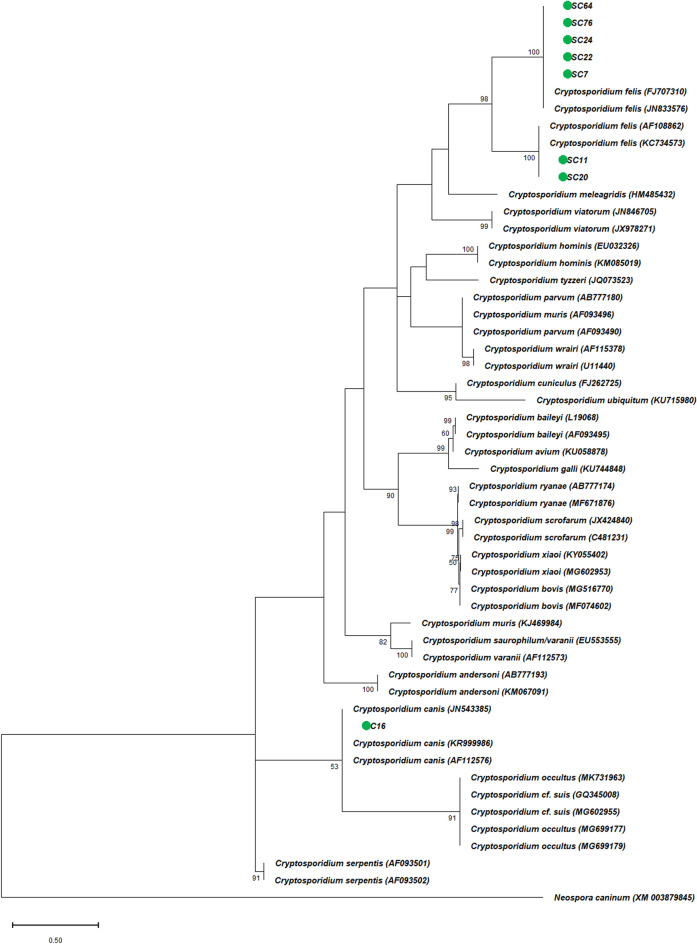
Figure 1
Figure 1
The phylogram of Cryptosporidium spp. was inferred based on the nucleotide sequences of SSU rRNA gene. The evolutionary relationship of Cryptosporidium spp. was constructed by the Maximum Likelihood method and Kimura 2-parameter model, based on the nucleotide sequences of SSU rRNA gene of C. felis and C. canis isolated from stray cats [SC] and household cats [C] in this study (green circles) compared with nucleotide sequences of Cryptosporidium species retrieved from GenBank, with Neospora caninum (XM_003879845) as outgroup. Bootstrap values obtained from 1000 replicates are indicated on branches in percentage; only bootstrap values > 50% are displayed. Evolutionary analyses were conducted in MEGA X.
Figure 2
Figure 2
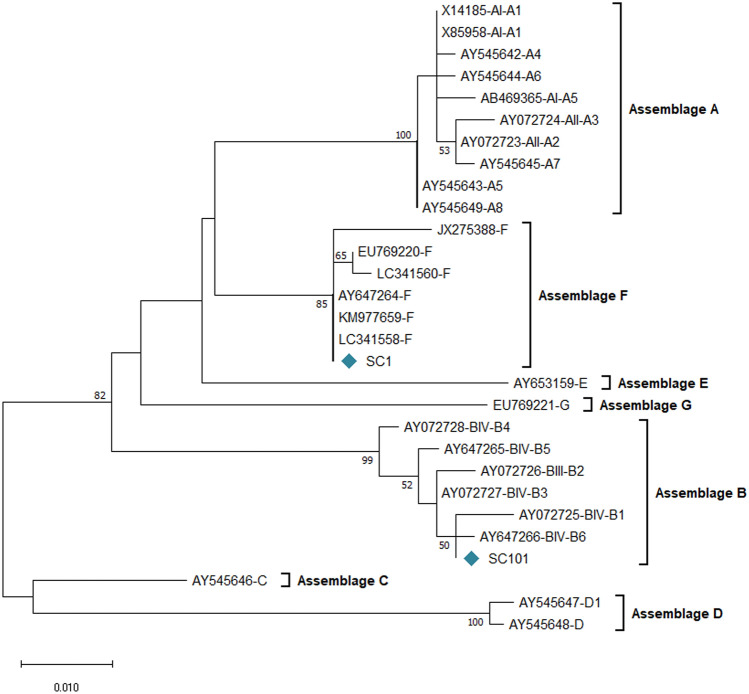
The phylogram of Giardia duodenalis was inferred based on the nucleotide sequences of the β-giardin (bg) gene. The evolutionary relationship of G. duodenalis was constructed by the Maximum Likelihood method and Kimura 2-parameter model, based on the nucleotide sequences of the bg gene of G. duodenalis isolated from stray cats [SC] in this study (light sea green rhombus) compared with nucleotide sequences of known assemblages retrieved from GenBank. Bootstrap values obtained from 1000 replicates are indicated on branches in percentage; only bootstrap values > 50% are displayed. Evolutionary analyses were conducted in MEGA X.
Figure 3
Figure 3
The phylogram of Blastocystis subtypes was inferred based on the nucleotide sequences of SSU rRNA gene. The evolutionary relationship of Blastocystis subtypes was constructed by the Maximum Likelihood method and Kimura 2-parameter model, based on the nucleotide sequences of SSU rRNA gene of Blastocystis isolated from stray cats [SC], household cats [C], and cat owners [H] in this study (blue circles) compared with nucleotide sequences of Blastocystis subtypes retrieved from GenBank, with Proteromonas lacertae (U37108) as outgroup. Bootstrap values obtained from 1000 replicates are indicated on branches in percentage; only bootstrap values > 50% are displayed. Evolutionary analyses were conducted in MEGA X.

References

    1. Baneth G, Thamsborg SM, Otranto D, Guillot J, Blaga R, Deplazes P, et al. Major parasitic zoonoses associated with dogs and cats in Europe. J. Comp. Pathol. 2016;155(1 Suppl 1):S54–74. doi: 10.1016/j.jcpa.2015.10.179. - DOI - PubMed
    1. Kvac M, Hofmannova L, Ortega Y, Holubova N, Horcickova M, Kicia M, et al. Stray cats are more frequently infected with zoonotic protists than pet cats. Folia Parasitol. (Praha). 2017;64:034. doi: 10.14411/fp.2017.034. - DOI - PubMed
    1. Ryan U, Zahedi A, Feng Y, Xiao L. An update on zoonotic Cryptosporidium species and genotypes in humans. Animals. 2021;11:3307. doi: 10.3390/ani11113307. - DOI - PMC - PubMed
    1. Ryan UM, Feng Y, Fayer R, Xiao L. Taxonomy and molecular epidemiology of Cryptosporidium and Giardia—A 50 year perspective (1971–2021) Int. J. Parasitol. 2021;51(13):1099–1119. doi: 10.1016/j.ijpara.2021.08.007. - DOI - PubMed
    1. Li J, Ryan U, Guo Y, Feng Y, Xiao L. Advances in molecular epidemiology of cryptosporidiosis in dogs and cats. Int. J. Parasitol. 2021;51(10):787–795. doi: 10.1016/j.ijpara.2021.03.002. - DOI - PubMed

Publication types