


The Determining Effective Testing in Emergency Departments and Care Coordination on Treatment Outcomes (DETECT) for Hepatitis C (Hep C) Linkage-to-Care Trial: rationale and design of an emergency department-based randomized clinical trial of linkage-to-care strategies for hepatitis C
- PMID: 36707909
- PMCID: PMC9880363
- DOI: 10.1186/s13063-022-07018-w
The Determining Effective Testing in Emergency Departments and Care Coordination on Treatment Outcomes (DETECT) for Hepatitis C (Hep C) Linkage-to-Care Trial: rationale and design of an emergency department-based randomized clinical trial of linkage-to-care strategies for hepatitis C
Abstract
Background: Hepatitis C (HCV) poses a major public health problem in the USA. While early identification is a critical priority, subsequent linkage to a treatment specialist is a crucial step that bridges diagnosed patients to treatment, cure, and prevention of ongoing transmission. Emergency departments (EDs) serve as an important clinical setting for HCV screening, although optimal methods of linkage-to-care for HCV-diagnosed individuals remain unknown. In this article, we describe the rationale and design of The Determining Effective Testing in Emergency Departments and Care Coordination on Treatment Outcomes (DETECT) for Hepatitis C (Hep C) Linkage-to-Care Trial.
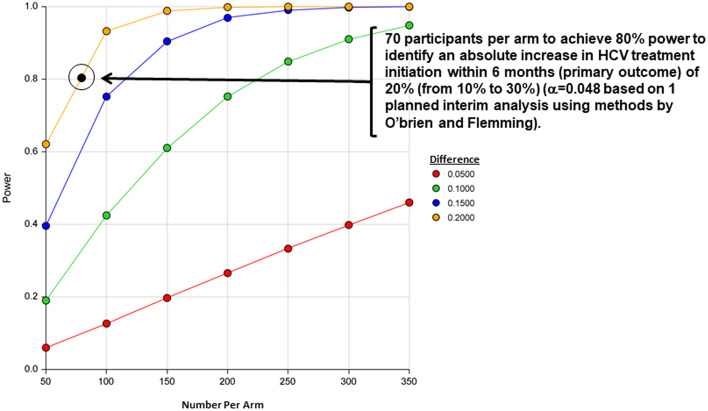
Methods: The DETECT Hep C Linkage-to-Care Trial will be a single-center prospective comparative effectiveness randomized two-arm parallel-group superiority trial to test the effectiveness of linkage navigation and clinician referral among ED patients identified with untreated HCV with a primary hypothesis that linkage navigation plus clinician referral is superior to clinician referral alone when using treatment initiation as the primary outcome. Participants will be enrolled in the ED at Denver Health Medical Center (Denver, CO), an urban, safety-net hospital with approximately 75,000 annual adult ED visits. This trial was designed to enroll a maximum of 280 HCV RNA-positive participants with one planned interim analysis based on methods by O'Brien and Fleming. This trial will further inform the evaluation of cost effectiveness, disparities, and social determinants of health in linkage-to-care, treatment, and disease progression.
Discussion: When complete, the DETECT Hep C Linkage-to-Care Trial will significantly inform how best to perform linkage-to-care among ED patients identified with HCV.
Trial registration: ClinicalTrials.gov ID: NCT04026867 Original date: July 1, 2019 URL: https://clinicaltrials.gov/ct2/show/NCT04026867.
Keywords: Clinical trial; Comparative effectiveness; Emergency department; HCV; Hepatitis C; Implementation; Linkage-to-care; Methods; Navigation; Randomized trial.
© 2023. The Author(s).
Conflict of interest statement
JSH has received grant funding from the Centers for Disease Control and Prevention (CDC) (R01CE003006). SER and KFK have received grant funding from Gilead Sciences, Inc. JRM has received grant funding from the National Institute on Drug Abuse (NIDA) (P30DA040500). EMG serves as site principal investigator for clinical trials sponsored by Cepheid, Gilead Science, and Viiv Healthcare. MSL and DAEW receive investigator-initiated grant support paid to the institution from Gilead Sciences. All other authors report no conflicts of interest.
Figures


References
-
- Centers for Disease Control and Prevention. Viral Hepatitis Surveillance Report United States, 2019. 2021 https://www.cdc.gov/hepatitis/statistics/2019surveillance/index.htm. Accessed 7 June 2021.
-
- World Health Organization. Global health sector strategy on viral hepatitis 2016–2021. 2016. https://apps.who.int/iris/bitstream/handle/10665/246177/WHO-HIV-2016.06-.... Accessed 26 Sept 2022.
Publication types
MeSH terms
Associated data
Grants and funding
LinkOut - more resources
Full Text Sources
Medical
