


Synergistic effects of 3D chitosan-based hybrid scaffolds and mesenchymal stem cells in orthopaedic tissue engineering
- PMID: 36708277
- PMCID: PMC10116017
- DOI: 10.1049/nbt2.12103
Synergistic effects of 3D chitosan-based hybrid scaffolds and mesenchymal stem cells in orthopaedic tissue engineering
Abstract
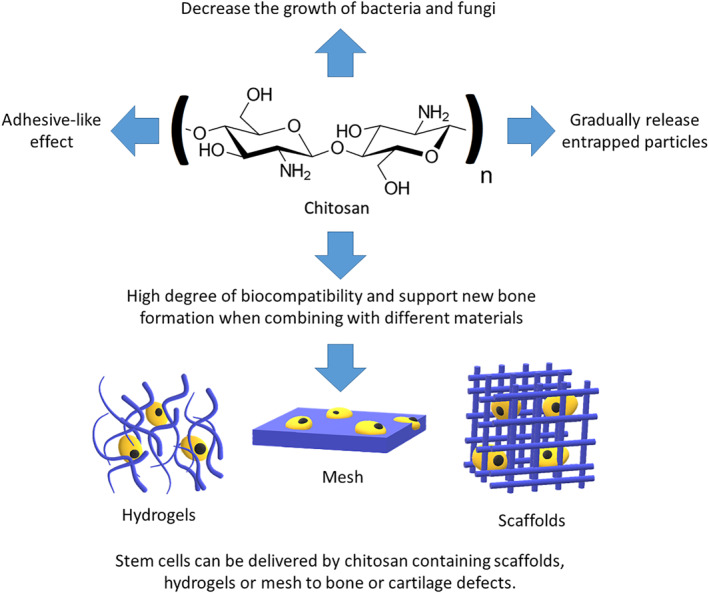
Restoration of damaged bone and cartilage tissue with biomaterial scaffolds is an area of interest in orthopaedics. Chitosan is among the low-cost biomaterials used as scaffolds with considerable biocompability to almost every human tissue. Considerable osteoconductivity, porosity, and appropriate pore size distribution have made chitosan an appropriate scaffold for loading of stem cells and a good homing place for differentiation of stem cells to bone tissue. Moreover, the similarity of chitosan to glycosaminoglycans and its potential to be used as soft gels, which could be lasting more than 1 week in mobile chondral defects, has made chitosan a polymer of interest in repairing bone and cartilage defects. Different types of scaffolds using chitosan in combination with mesenchymal stem cells (MSCs) are discussed. MSCs are widely used in regenerative medicine because of their regenerative ability, and recent line evidence reviewed demonstrated that the combination of MSCs with a combination of chitosan with different materials, including collagen type 1, hyaluronic acid, Poly(L-lacticacid)/gelatin/β-tricalcium phosphate, gamma-poly[glutamic acid] polyelectrolyte/titanium alloy, modified Poly(L-Lactide-co-Epsilon-Caprolactone), calcium phosphate, β-glycerophosphate hydrogel/calcium phosphate cement (CPC), and CPC-Chitosan-RGD, can increase the efficacy of using MSCs, and chitosan-based stem cell delivery can be a promising method in restoration of damaged bone and cartilage tissue.
Keywords: Chitosan; bone; cartilage; stem cell.
© 2022 The Authors. IET Nanobiotechnology published by John Wiley & Sons Ltd on behalf of The Institution of Engineering and Technology.
Conflict of interest statement
The authors declare that there are no conflicts of interest and financial support for the present review article.
Figures

References
-
- Nia, F.B. , et al.: An introduction to tissue engineering and orthopedic applications. J. Orthopedic Spine Trauma. 6, 1–8 (2020)
-
- Alaribe, F.N. , Manoto, S.L. , Motaung, S.C. : Scaffolds from biomaterials: advantages and limitations in bone and tissue engineering. Biologia. 71(4), 353–366 (2016). 10.1515/biolog-2016-0056 - DOI
Publication types
MeSH terms
Substances
LinkOut - more resources
Full Text Sources
