


Improved glycaemic control in patients with type 2 diabetes has a beneficial impact on NAFLD, independent of change in BMI or glucose lowering agent
- PMID: 36710114
- PMCID: PMC11876092
- DOI: 10.1016/j.numecd.2022.12.010
Improved glycaemic control in patients with type 2 diabetes has a beneficial impact on NAFLD, independent of change in BMI or glucose lowering agent
Abstract
Background and aim: The current focus of the treatment of Non-Alcoholic Fatty Liver Disease (NAFLD) is lifestyle intervention with the aim of significant weight loss alongside aggressive cardiovascular risk reduction. NAFLD is tightly associated with type 2 diabetes (T2D) and obesity. In patients with T2D, glucose lowering agents that promote weight loss have shown a beneficial impact on NAFLD. However, it remains unclear as to whether glucose lowering can improve NALFD in patients with T2D, independent of weight loss.
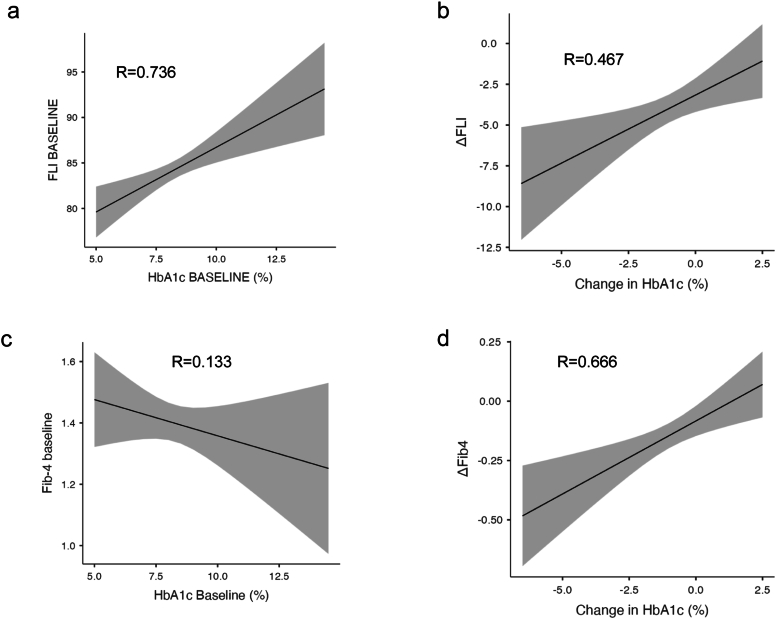
Methods and results: In a retrospective analysis of data from 637 people with T2D, we examined the longitudinal impact of optimizing glycaemic control with DPP-IV inhibitors, GLP-1RAs and SGLT2 inhibitors on Fatty liver index (FLI) and Fibrosis score 4 (Fib-4) adjusting for changes in BMI and choice of glucose lowering regimen over a 12-month period. Multiple linear regression analysis demonstrated a significant correlation between the change in glycated haemoglobin and change in FLI after adjustment for change in BMI, age, sex, and drug class (R = 0.467, p = 0.031). The greatest reduction in FLI was observed in patients with the largest reduction in glycated haemoglobin (p < 0.0001). The probability of improvements in FLI with optimization of glycaemic control was similar with all 3 glucose lowering agents, despite differences in weight reduction. Similar relationships were observed examining the changes in glycaemic control and Fib-4.
Conclusions: Improvements in glucose control that are independent of weight loss are associated with improvement in NAFLD and should form an integral part of the management patients with co-existent NAFLD and T2D.
Keywords: DPP-IVi; Fatty liver Index; Fib-4; GLP-1RA; Glucose control; NAFLD; SGLT2i; T2DM.
Copyright © 2022 The Author(s). Published by Elsevier B.V. All rights reserved.
Figures


References
-
- Musso G., Cassader M., Rosina F., Gambino R. Impact of current treatments on liver disease, glucose metabolism and cardiovascular risk in non-alcoholic fatty liver disease (NAFLD): a systematic review and meta-analysis of randomised trials. Diabetologia. 2012;55(4):885–904. - PubMed
-
- Newsome P.N., Buchholtz K., Cusi K., Linder M., Okanoue T., Ratziu V., et al. A placebo-controlled trial of subcutaneous semaglutide in nonalcoholic steatohepatitis. N Engl J Med. 2021;384(12):1113–1124. - PubMed
Publication types
MeSH terms
Substances
Grants and funding
LinkOut - more resources
Full Text Sources
Medical
