


Psychological birth trauma: A concept analysis
- PMID: 36710822
- PMCID: PMC9880163
- DOI: 10.3389/fpsyg.2022.1065612
Psychological birth trauma: A concept analysis
Abstract
Aim: To define and analyze the concept of psychological birth trauma.
Design: The concept analysis method of Walker and Avant was used.
Method: Eight databases (PubMed, CINAHL Complete, Cochrane Library, Web of Science, China National Knowledge Infrastructure, Wanfang, VIP Information Chinese Journal Service Platform, and Chinese BioMedicine Literature Database) were searched from inception to July 2022 for studies focused on psychological birth trauma.
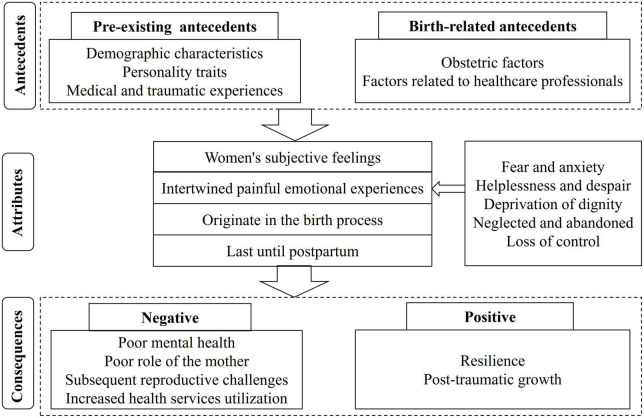
Results: Of the 5,372 studies identified, 44 ultimately met the inclusion criteria. The attributes identified were (1) women's subjective feelings, (2) intertwined painful emotional experiences, (3) originating in the birth process, and (4) lasting until postpartum. Antecedents were divided into two groups: pre-existing antecedents and birth-related antecedents. Consequences were identified as negative and positive.
Conclusion: Psychological birth trauma is a more complex and comprehensive concept than previously thought, and should be regarded as a separate postpartum mental health problem. This study deepens the understanding of psychological birth trauma through a comprehensive concept analysis and also puts forward some suggestions for the prevention, identification, and intervention of psychological birth trauma, which provides a basis for assisting in the identification of psychological birth trauma and provides a reference for the development of rigorous assessment tools and the design of appropriate interventions in the future. Further research is needed to update and refine this concept.
Keywords: birth; concept analysis; obstetric; perinatal mental health; psychological; psychological birth trauma; trauma.
Copyright © 2023 Sun, Fan, Cong, Wang, Sha, Xie, Han, Zhu and Zhang.
Conflict of interest statement
The authors declare that the research was conducted in the absence of any commercial or financial relationships that could be construed as a potential conflict of interest.
Figures

References
-
- American Psychiatric Association (2000). Diagnostic and statistical manual of mental disorders, 4th Edn. Washington, DC: American Psychiatric Pub.
Publication types
LinkOut - more resources
Full Text Sources
Miscellaneous
