


Mechanical property of pixel extrusion and pin forming for polymer, ceramic, and metal formation
- PMID: 36711282
- PMCID: PMC9879782
- DOI: 10.1016/j.heliyon.2023.e12871
Mechanical property of pixel extrusion and pin forming for polymer, ceramic, and metal formation
Abstract
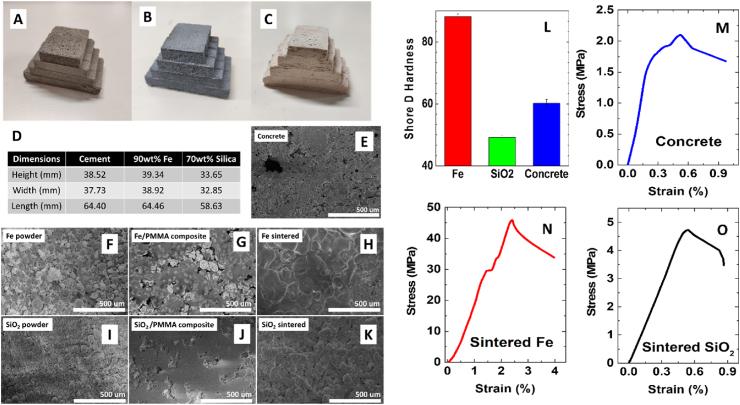
The rapid material fabrications in pixel shape were mechanically studied in comparison with FDM and STL 3D printing technique. The pixel extrusion technique was the extrusion with a set of holes in the die. By controlling the flow of each hole in the die, the shape could be adjustable. The pixel molding technique composed of a set of pins. By adjusting the length of pin inside the mold, the shape of cavity could be designed. Compared to 3D printing which requires the material deposition with 2D scanning for several layers, 3D material fabrication by pixel extrusion and pixel molding were much faster; however, their resolutions were still much worse compared to 3D printing at the moment. SEM, Tensile test, flexural test, including hardness were used to observe the properties of pixel extrusion and pixel molding. The pixel molding technique was also used to fabricate many materials to compare the properties such as cement, iron, and silica. Apparently, materials could be formed and mechanical properties were investigated.
Keywords: 3D molding; 3D printing; Material forming.
© 2023 The Authors.
Figures


References
-
- Junpha J., Wisitsoraat A., Prathumwan R., Chaengsawang W., Khomungkhun K., Subannajui K. Electronic tongue and cyclic voltammetric sensors based on carbon nanotube/polylactic composites fabricated by fused deposition modelling 3D printing. Mater. Sci. Eng. C. 2020;117 doi: 10.1016/J.MSEC.2020.111319. - DOI - PubMed
-
- Manapat J.Z., Chen Q., Ye P., Advincula R.C. 3D printing of polymer nanocomposites via stereolithography. Macromol. Mater. Eng. 2017;302 doi: 10.1002/MAME.201600553. - DOI
LinkOut - more resources
Full Text Sources
