


Projecting the chronic disease burden among the adult population in the United States using a multi-state population model
- PMID: 36711415
- PMCID: PMC9881650
- DOI: 10.3389/fpubh.2022.1082183
Projecting the chronic disease burden among the adult population in the United States using a multi-state population model
Abstract
Introduction: As the United States population ages, the adult population with chronic diseases is expected to increase. Exploring credible, evidence-based projections of the future burden of chronic diseases is fundamental to understanding the likely impact of established and emerging interventions on the incidence and prevalence of chronic disease. Projections of chronic disease often involve cross-sectional data that fails to account for the transition of individuals across different health states. Thus, this research aims to address this gap by projecting the number of adult Americans with chronic disease based on empirically estimated age, gender, and race-specific transition rates across predetermined health states.
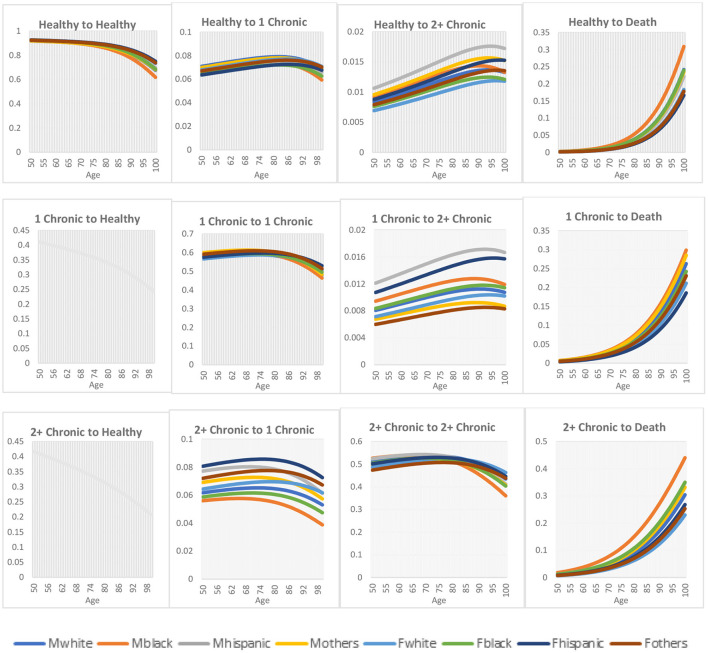
Methods: We developed a multi-state population model that disaggregates the adult population in the United States into three health states, i.e., (a) healthy, (b) one chronic condition, and (c) multimorbidity. Data from the 1998 to 2018 Health and Retirement Study was used to estimate age, gender, and race-specific transition rates across the three health states, as input to the multi-state population model to project future chronic disease burden.
Results: The number of people in the United States aged 50 years and older will increase by 61.11% from 137.25 million in 2020 to 221.13 million in 2050. Of the population 50 years and older, the number with at least one chronic disease is estimated to increase by 99.5% from 71.522 million in 2020 to 142.66 million by 2050. At the same time, those with multimorbidity are projected to increase 91.16% from 7.8304 million in 2020 to 14.968 million in 2050. By race by 2050, 64.6% of non-Hispanic whites will likely have one or more chronic conditions, while for non-Hispanic black, 61.47%, and Hispanic and other races 64.5%.
Conclusion: The evidence-based projections provide the foundation for policymakers to explore the impact of interventions on targeted population groups and plan for the health workforce required to provide adequate care for current and future individuals with chronic diseases.
Keywords: United States of America; adult population; chronic disease; multi-state population projection; projections.
Copyright © 2023 Ansah and Chiu.
Conflict of interest statement
The authors declare that the research was conducted in the absence of any commercial or financial relationships that could be construed as a potential conflict of interest.
Figures
References
Publication types
MeSH terms
LinkOut - more resources
Full Text Sources
Research Materials
Miscellaneous
