[Preprint]. 2023 Jan 20:2023.01.19.522856.
doi: 10.1101/2023.01.19.522856.

FcyRIIB is a novel immune checkpoint in the tumor microenvironment limiting activity of Treg-targeting antibodies

Affiliations

FcyRIIB is a novel immune checkpoint in the tumor microenvironment limiting activity of Treg-targeting antibodies

David Knorr et al. bioRxiv. .

Update in

Abstract

Despite pre-clinical murine data supporting T regulatory (Treg) cell depletion as a major mechanism by which anti-CTLA-4 antibodies function in vivo, the two main antibodies tested in patients (ipilimumab and tremelimumab) have failed to demonstrate similar effects. We report analogous findings in an immunocompetent murine model humanized for CTLA-4 and Fcy receptors (hCTLA-4/hFcyR mice), where both ipilimumab and tremelimumab fail to show appreciable Treg depletion. Immune profiling of the tumor microenvironment (TME) in both mice and human samples revealed upregulation of the inhibitory Fcy receptor, FcyRIIB, which limits the ability of the antibody Fc fragment of human anti-CTLA-4 antibodies to induce effective antibody dependent cellular cytotoxicty/phagocytosis (ADCC/ADCP). Blocking FcyRIIB in humanized mice rescues Treg depleting capacity and anti-tumor activity of ipilimumab. For another target, CC motif chemokine receptor 8 (CCR8), which is selectively expressed on tumor infiltrating Tregs, we show that Fc engineering to enhance binding to activating Fc receptors, while limiting binding to the inhibitory Fc receptor, leads to consistent Treg depletion and single-agent activity across multiple tumor models, including B16, MC38 and MB49. These data reveal the importance of reducing engagement to the inhibitory Fc receptor to optimize Treg depletion by TME targeting antibodies. Our results define the inhibitory FcyRIIB receptor as a novel immune checkpoint limiting antibody-mediated Treg depletion in tumors, and demonstrate Fc variant engineering as a means to overcome this limitation and augment efficacy for a repertoire of antibodies currently in use or under clinical evaluation in oncology.


Conflict of interest statement

COI: The authors declare no financial conflicts of interests relevant to this work.

Figures
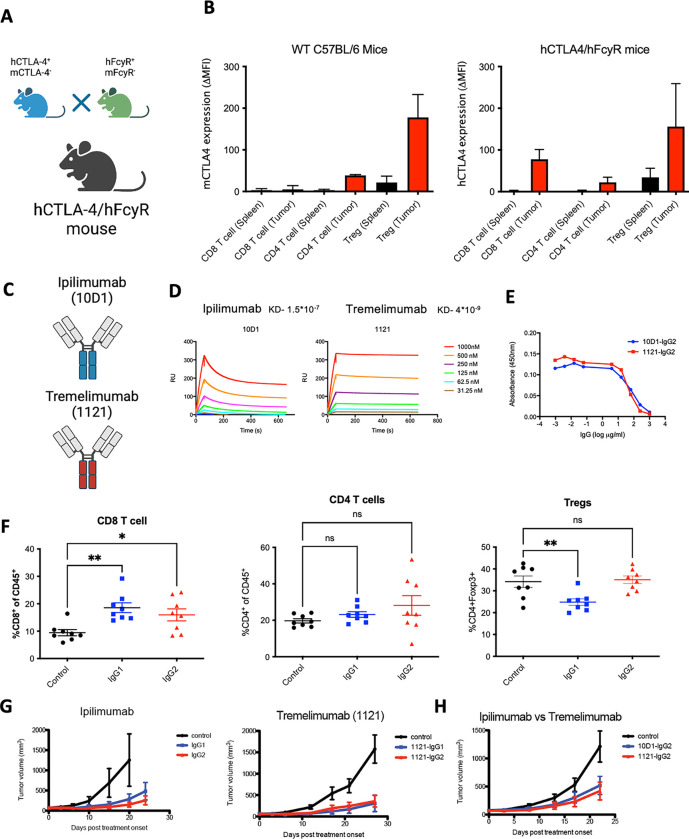
Figure 1.
Figure 1.. Development and characterization of ipilimumab and tremelimumab in humanized CTLA-4/hFcyR mice.
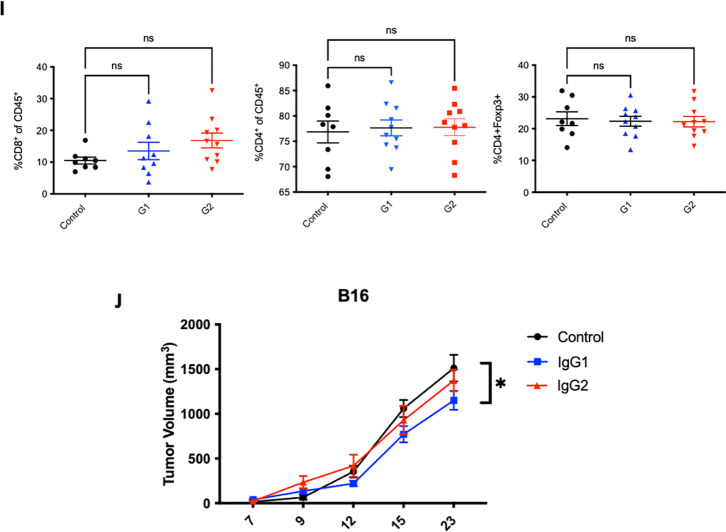
A) Cartoon illustration of humanized CTLA-4 mice crossed to hFcyR mice to generate a hCTLA-4/hFcyR colony for the in vivo evaluation of fully human anti-CTLA-4 antibody variants. B) Flow cytometry evaluation of endogenous murine CTLA-4 cell surface expression in WT C57BL/6 mice compared to hCTLA-4/hFcyR mice, expressed as mean fluorescence intensity (MFI). C) Ipilimumab is a human IgG1 antibody whereas tremelimumab is a human IgG2 subclass. D) Surface plasmon resonance characterization of binding to human CTLA-4 by recombinant variants of ipilimumab and tremelimumab and their respective KDs. E) Evaluation of the ability of 10D1 and 1121 Fabs on IgG2 backbone to block interaction of hCTLA-4 with B7.1 as measured by ELISA. F) In vivo evaluation of the MC38 colon carcinoma tumor microenvironment of subcutaneous tumors following systemic (i.p.) administration of 10D1-IgG1 or 10D1-IgG2 when compared to IgG1 isotype control. Tumor bearing hCTLA-4/hFcγR mice were treated with 200 μg of anti-CTLA-4 mAb variants on days 0 and 3 following randomization, and sacrificed 24 hours later for flow cytometry analysis of CD8 T cells, CD4 effector T cells, and T regulatory cells (Tregs). G) Evaluation of the in vivo activity of anti-CTLA-4 subclass variant on MC38 tumor growth. Ipilimumab and tremelimumab were tested as both IgG1 and IgG2 Fc subclass variants. Tumor bearing hCTLA-4/hFcγR mice were treated with 200 μg of anti-CTLA-4 mAb variants on days 0, 3 and 6. H) Ipilimumab and tremelimumab were both placed on an IgG2 Fc backbone and tested for antitumor activity in the MC38 tumor model. I) In vivo evaluation of the B16 melanoma tumor microenvironment of subcutaneous tumors following systemic (i.p.) administration of 10D1-IgG1 or 10D1-IgG2 when compared to IgG1 isotype control. Tumor bearing hCTLA-4/hFcγR mice were treated with 200 μg of anti-CTLA-4 mAb variants on days 0 and 3 following randomization, and sacrificed 24 hours later for flow cytometry analysis of CD8 T cells, CD4 effector T cells, and T regulatory cells (Tregs). J) Ipilimumab in either and IgG1 or IgG2 format was tested for antitumor activity in the B16 tumor model. n = 4–8 mice per group; bars represent SEM, and *p < 0.05, **p < 0.01, ***p < 0.001. ****p < 0.0001.
Figure 1.
Figure 1.. Development and characterization of ipilimumab and tremelimumab in humanized CTLA-4/hFcyR mice.
A) Cartoon illustration of humanized CTLA-4 mice crossed to hFcyR mice to generate a hCTLA-4/hFcyR colony for the in vivo evaluation of fully human anti-CTLA-4 antibody variants. B) Flow cytometry evaluation of endogenous murine CTLA-4 cell surface expression in WT C57BL/6 mice compared to hCTLA-4/hFcyR mice, expressed as mean fluorescence intensity (MFI). C) Ipilimumab is a human IgG1 antibody whereas tremelimumab is a human IgG2 subclass. D) Surface plasmon resonance characterization of binding to human CTLA-4 by recombinant variants of ipilimumab and tremelimumab and their respective KDs. E) Evaluation of the ability of 10D1 and 1121 Fabs on IgG2 backbone to block interaction of hCTLA-4 with B7.1 as measured by ELISA. F) In vivo evaluation of the MC38 colon carcinoma tumor microenvironment of subcutaneous tumors following systemic (i.p.) administration of 10D1-IgG1 or 10D1-IgG2 when compared to IgG1 isotype control. Tumor bearing hCTLA-4/hFcγR mice were treated with 200 μg of anti-CTLA-4 mAb variants on days 0 and 3 following randomization, and sacrificed 24 hours later for flow cytometry analysis of CD8 T cells, CD4 effector T cells, and T regulatory cells (Tregs). G) Evaluation of the in vivo activity of anti-CTLA-4 subclass variant on MC38 tumor growth. Ipilimumab and tremelimumab were tested as both IgG1 and IgG2 Fc subclass variants. Tumor bearing hCTLA-4/hFcγR mice were treated with 200 μg of anti-CTLA-4 mAb variants on days 0, 3 and 6. H) Ipilimumab and tremelimumab were both placed on an IgG2 Fc backbone and tested for antitumor activity in the MC38 tumor model. I) In vivo evaluation of the B16 melanoma tumor microenvironment of subcutaneous tumors following systemic (i.p.) administration of 10D1-IgG1 or 10D1-IgG2 when compared to IgG1 isotype control. Tumor bearing hCTLA-4/hFcγR mice were treated with 200 μg of anti-CTLA-4 mAb variants on days 0 and 3 following randomization, and sacrificed 24 hours later for flow cytometry analysis of CD8 T cells, CD4 effector T cells, and T regulatory cells (Tregs). J) Ipilimumab in either and IgG1 or IgG2 format was tested for antitumor activity in the B16 tumor model. n = 4–8 mice per group; bars represent SEM, and *p < 0.05, **p < 0.01, ***p < 0.001. ****p < 0.0001.
Figure 2.
Figure 2.. Murine and human tumor express high levels of FcyRIIB in the tumor microenvironment.
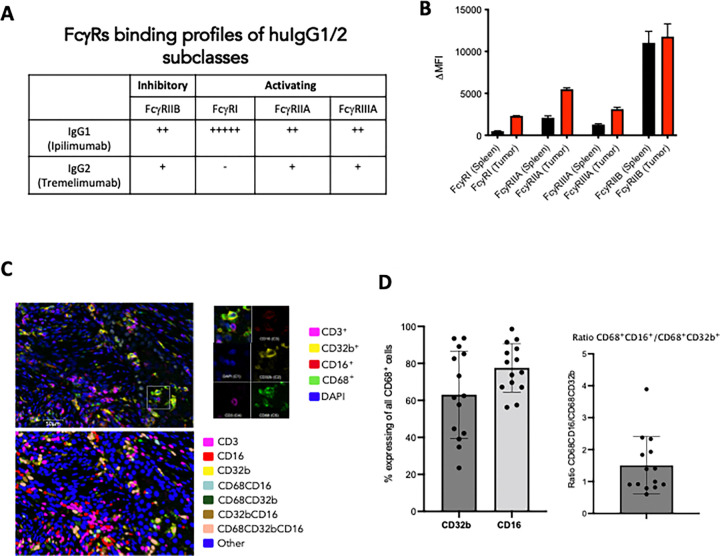
A) Table demonstrating the relative binding affinities of ipilimumab or tremelimumab subclasses for activating and inhibitory FcyRs. B) Characterization of human FcyR expression in spleen or tumor infiltrating leukocytes. Each hFcyR was evaluated using flow cytometry of dissociated tissues. C) mIF of human tissue samples for hFcyRIIIA (CD16) and FcyRIIB (CD32B) on infiltrating myeloid cells using the PhenoImager HT. D) Quantification of CD32B and CD16 expression on tumor infiltrating CD68+ myeloid cells and ratio of staining of the activating (CD16) and inhibitory (CD32B) profile.
Figure 3:
Figure 3:. Limiting binding to FcyRIIB leads to enhanced Treg depletion and tumor control in vivo.
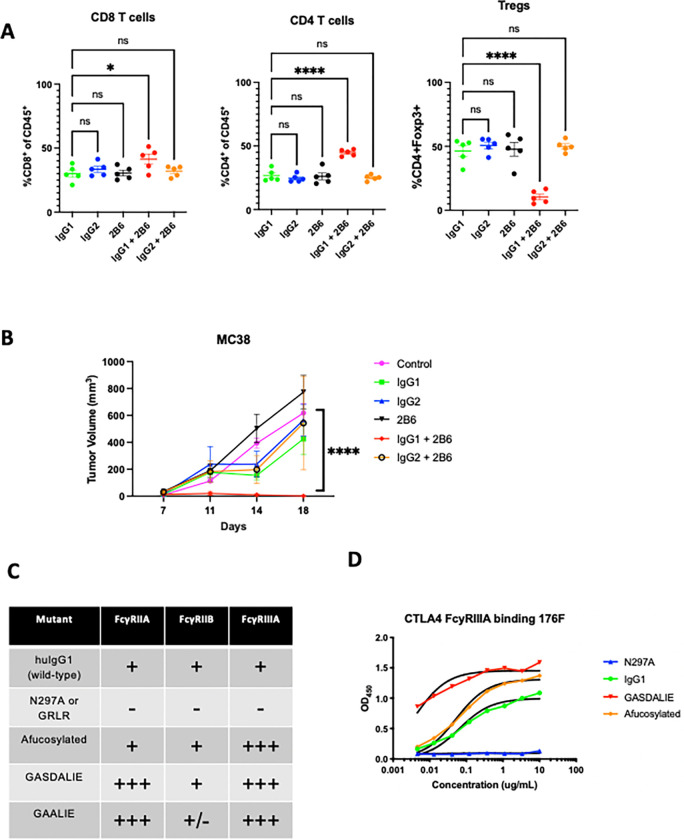
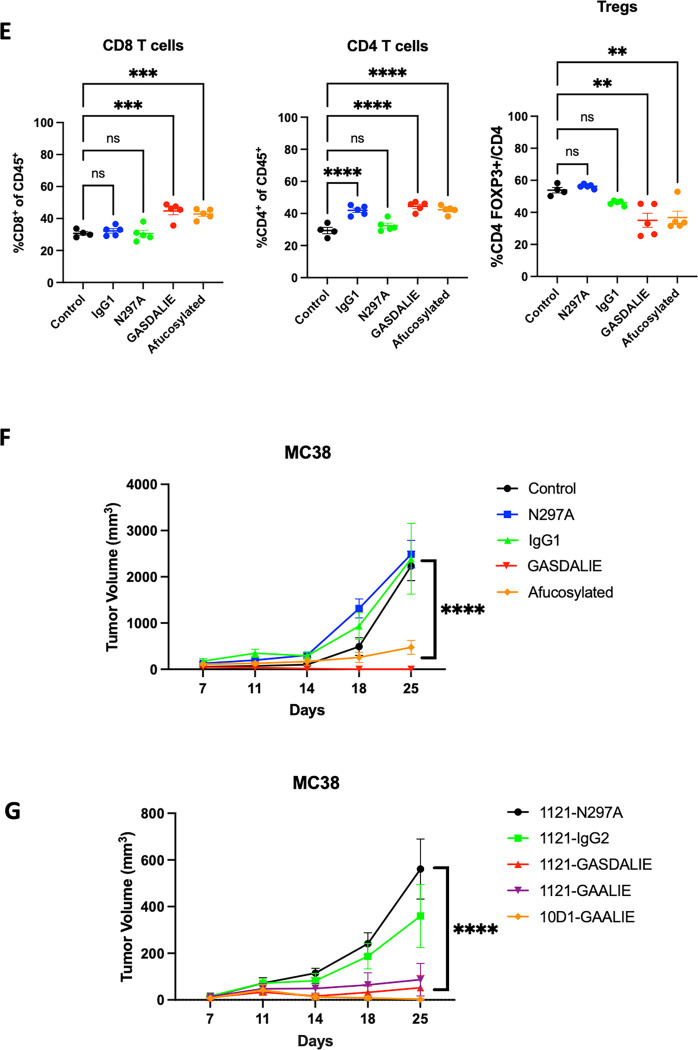
A) In vivo evaluation of the effect of FcyRIIB blocking antibody (clone 2B6) on Treg depletion. Flow cytometric evaluation of the MC38 colon carcinoma tumor microenvironment following systemic (i.p.) administration of 10D1-IgG1 or 10D1-IgG2 (200 ug alone or in combination with 50 ug intratumoral 2B6 blockade prior on days 0 and 3) comapred to 2B6 only control. Mice were sacrificed 24 hours later and flow cytometry analysis was performed for CD8 T cells, CD4 effector T cells, and T regulatory cells (Tregs). Blockade of the inhibitory FcyR (FcyRIIB) leads to significantly less Tregs when coadministered with 10D1-IgG1 compared to 10D1-IgG2. B) In vivo evaluation of the effect of FcyRIIB blocking antibody (clone 2B6) on tumor control in the MC38 tumor model. Here, 200 ug of 10D1 subclass variants (e.g. IgG1 or IgG2) were given alone or in combination with 2B6 antibody blockade (50 ug given intratumoral) on days 0, 3, and 6. The combination of the IgG1-subclass variant led to significantly improved tumor control when compared to anti-CTLA-4 antibody alone or the anti-CTLA-4 IgG2 subclass antibody with 2B6. C) Table of the 10D1 IgG subclass variants generated for these studies, along with their relative binding affinities for activating vs inhibitory FcyRs. D) ELISA-based quantification of the relative affinity of the various subclass variants tested (in E and F). E) In vivo evaluation of the effect of Fc-enhanced anti-CTLA-4 antibodies (clone 10D1) on Treg depletion. Flow cytometric evaluation of the MC38 colon carcinoma tumor microenvironment following systemic (i.p.) administration of anti-CTLA-4 antibody variants (200 ug on days 0 and 3) comapred to to IgG control. Mice were sacrificed 24 hours later and flow cytometry analysis was performed for CD8 T cells, CD4 effector T cells, and T regulatory cells (Tregs). F) In vivo evaluation of the effect of Fc-enhanced anti-CTLA-4 antibodies (clone 10D1) on tumor control in the MC38 tumor model. Here, 200 ug of 10D1 subclass variants were given on days 0, 3, and 6. The Fc-enhanced variants led to significantly improved tumor control when compared to control, Fc-null (N297A), or IgG1. G) In vivo evaluation of the effect of Fc-enhanced anti-CTLA-4 antibodies (clone 10D1 or 1121) on tumor control in the MC38 tumor model. Here, 200 ug of 10D1 subclass variants were given on days 0, 3, and 6. The Fc-enhanced GAALIE variants led to significantly improved tumor control, even when placed on the 1121 (tremelimumab) backbone. n = 4–7 mice per group; bars represent SEM, and *p < 0.05, **p < 0.01, ***p < 0.001. ****p < 0.0001.
Figure 3:
Figure 3:. Limiting binding to FcyRIIB leads to enhanced Treg depletion and tumor control in vivo.
A) In vivo evaluation of the effect of FcyRIIB blocking antibody (clone 2B6) on Treg depletion. Flow cytometric evaluation of the MC38 colon carcinoma tumor microenvironment following systemic (i.p.) administration of 10D1-IgG1 or 10D1-IgG2 (200 ug alone or in combination with 50 ug intratumoral 2B6 blockade prior on days 0 and 3) comapred to 2B6 only control. Mice were sacrificed 24 hours later and flow cytometry analysis was performed for CD8 T cells, CD4 effector T cells, and T regulatory cells (Tregs). Blockade of the inhibitory FcyR (FcyRIIB) leads to significantly less Tregs when coadministered with 10D1-IgG1 compared to 10D1-IgG2. B) In vivo evaluation of the effect of FcyRIIB blocking antibody (clone 2B6) on tumor control in the MC38 tumor model. Here, 200 ug of 10D1 subclass variants (e.g. IgG1 or IgG2) were given alone or in combination with 2B6 antibody blockade (50 ug given intratumoral) on days 0, 3, and 6. The combination of the IgG1-subclass variant led to significantly improved tumor control when compared to anti-CTLA-4 antibody alone or the anti-CTLA-4 IgG2 subclass antibody with 2B6. C) Table of the 10D1 IgG subclass variants generated for these studies, along with their relative binding affinities for activating vs inhibitory FcyRs. D) ELISA-based quantification of the relative affinity of the various subclass variants tested (in E and F). E) In vivo evaluation of the effect of Fc-enhanced anti-CTLA-4 antibodies (clone 10D1) on Treg depletion. Flow cytometric evaluation of the MC38 colon carcinoma tumor microenvironment following systemic (i.p.) administration of anti-CTLA-4 antibody variants (200 ug on days 0 and 3) comapred to to IgG control. Mice were sacrificed 24 hours later and flow cytometry analysis was performed for CD8 T cells, CD4 effector T cells, and T regulatory cells (Tregs). F) In vivo evaluation of the effect of Fc-enhanced anti-CTLA-4 antibodies (clone 10D1) on tumor control in the MC38 tumor model. Here, 200 ug of 10D1 subclass variants were given on days 0, 3, and 6. The Fc-enhanced variants led to significantly improved tumor control when compared to control, Fc-null (N297A), or IgG1. G) In vivo evaluation of the effect of Fc-enhanced anti-CTLA-4 antibodies (clone 10D1 or 1121) on tumor control in the MC38 tumor model. Here, 200 ug of 10D1 subclass variants were given on days 0, 3, and 6. The Fc-enhanced GAALIE variants led to significantly improved tumor control, even when placed on the 1121 (tremelimumab) backbone. n = 4–7 mice per group; bars represent SEM, and *p < 0.05, **p < 0.01, ***p < 0.001. ****p < 0.0001.
Figure 4:
Figure 4:. Potent targeting of Tregs with Fc-optimized anti-CCR8 antibodies.
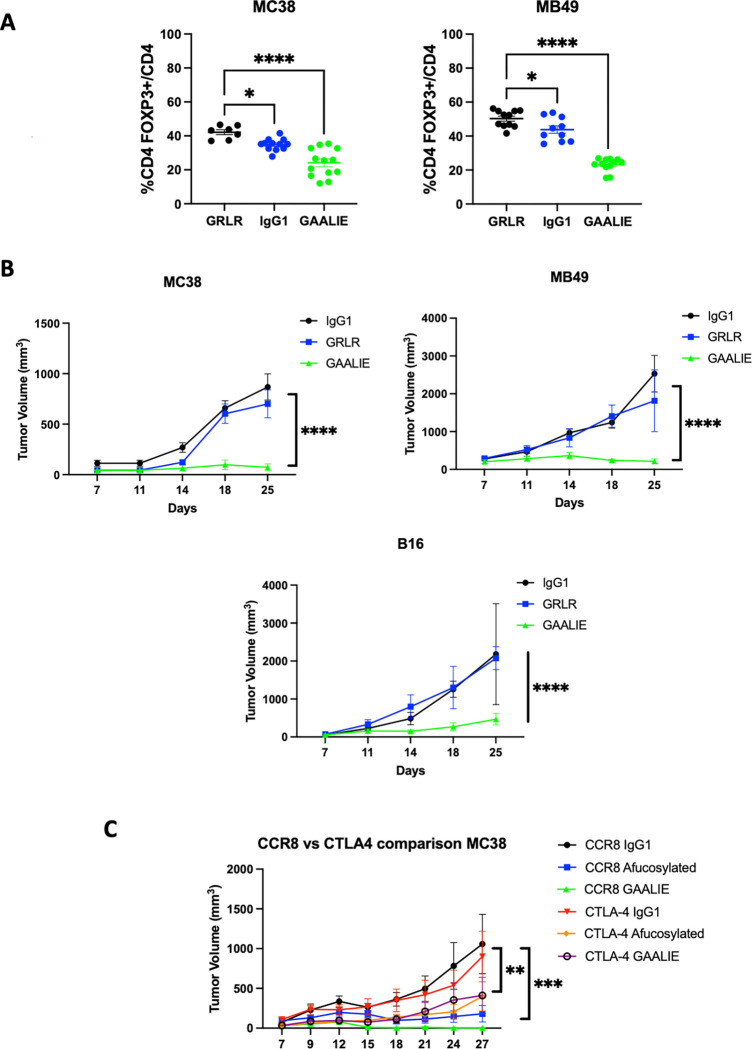
A) In vivo evaluation of the Fc-optimized anti-CCR8 antibody (GAALIE variant with decreased FcyRIIB binding) on Treg depletion. Flow cytometric evaluation of the MC38 colon carcinoma and MB49 bladder tumor microenvironment following systemic (i.p.) administration of 200 ug of CCR8-IgG1, CCR8-GRLR, or CCR8-GAALIE on days 0 and 3 following randomization. Mice were sacrificed 24 hours later and flow cytometry analysis was performed for CD8 T cells, CD4 effector T cells, and T regulatory cells (Tregs). B) In vivo evaluation of the effect of Fc-enhanced anti-CCR8 antibodies on tumor control in the MC38, MB49, and B16 tumor models. Here, 200 ug of anti-CCR8 subclass variants were given on days 0, 3, and 6. The Fc-enhanced variant GAALIE led to significantly improved tumor control when compared to Fc-null (GRLR), or IgG1. C) In vivo comparison of the effect of Fc-enhanced anti-CTLA-4 antibodies (clone 10D1) versus anti-CCR8 antibodies on tumor control in the MC38 tumor model. Here, 200 ug of each subclass variant was given on days 0, 3, and 6. The Fc-enhanced variants led to significantly improved tumor control when compared to IgG1 or afucosylated versions, with anti-CCR8 GAALIE demonstrating improved activity over anti-CTLA-4 GAALIE. n = 5–10 mice per group; bars represent SEM, and *p < 0.05, **p < 0.01, ***p < 0.001. ****p < 0.0001.

References

    1. Morad G, Helmink BA, Sharma P, Wargo JA. Hallmarks of response, resistance, and toxicity to immune checkpoint blockade. Cell. 2021. Oct 14;184(21):5309–5337. - PMC - PubMed
    1. Sharma P, Allison JP. Dissecting the mechanisms of immune checkpoint therapy. Nat Rev Immunol. 2020. Feb;20(2):75–76. - PubMed
    1. Waight JD, Chand D, Dietrich S, Gombos R, Horn T, Gonzalez AM, Manrique M, Swiech L, Morin B, Brittsan C, Tanne A, Akpeng B, Croker BA, Buell JS, Stein R, Savitsky DA, Wilson NS. Selective FcγR Co-engagement on APCs Modulates the Activity of Therapeutic Antibodies Targeting T Cell Antigens. Cancer Cell. 2018. Jun 11;33(6):1033–1047.e5. - PMC - PubMed
    1. Simpson TR, Li F, Montalvo-Ortiz W, Sepulveda MA, Bergerhoff K, Arce F, Roddie C, Henry JY, Yagita H, Wolchok JD, Peggs KS, Ravetch JV, Allison JP, Quezada SA. Fc-dependent depletion of tumor-infiltrating regulatory T cells co-defines the efficacy of anti–CTLA-4 therapy against melanoma. J Exp Med. The Rockefeller University Press; 2013. Aug 26;210(9):1695–1710. - PMC - PubMed
    1. Arce Vargas F, Furness AJS, Litchfield K, Joshi K, Rosenthal R, Ghorani E, Solomon I, Lesko MH, Ruef N, Roddie C, Henry JY, Spain L, Ben Aissa A, Georgiou A, Wong YNS, Smith M, Strauss D, Hayes A, Nicol D, O’Brien T, Mårtensson L, Ljungars A, Teige I, Frendéus B, TRACERx Melanoma, TRACERx Renal, TRACERx Lung consortia, Pule M, Marafioti T, Gore M, Larkin J, Turajlic S, Swanton C, Peggs KS, Quezada SA. Fc Effector Function Contributes to the Activity of Human Anti-CTLA-4 Antibodies. Cancer Cell. 2018. Apr 9;33(4):649–663.e4. - PMC - PubMed

Publication types