


This is a preprint.
Analysis of donor pancreata defines the transcriptomic signature and microenvironment of early pre-neoplastic pancreatic lesions
- PMID: 36712058
- PMCID: PMC9882230
- DOI: 10.1101/2023.01.13.523300
Analysis of donor pancreata defines the transcriptomic signature and microenvironment of early pre-neoplastic pancreatic lesions
Update in
-
Analysis of Donor Pancreata Defines the Transcriptomic Signature and Microenvironment of Early Neoplastic Lesions.Cancer Discov. 2023 Jun 2;13(6):1324-1345. doi: 10.1158/2159-8290.CD-23-0013. Cancer Discov. 2023. PMID: 37021392 Free PMC article.
Abstract
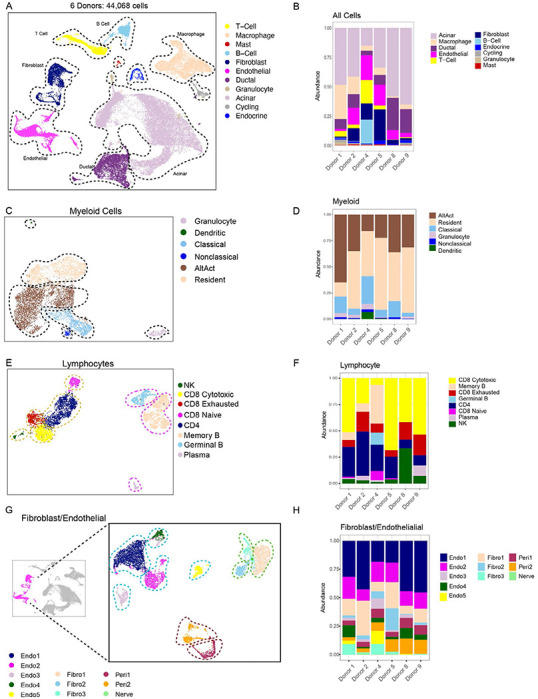
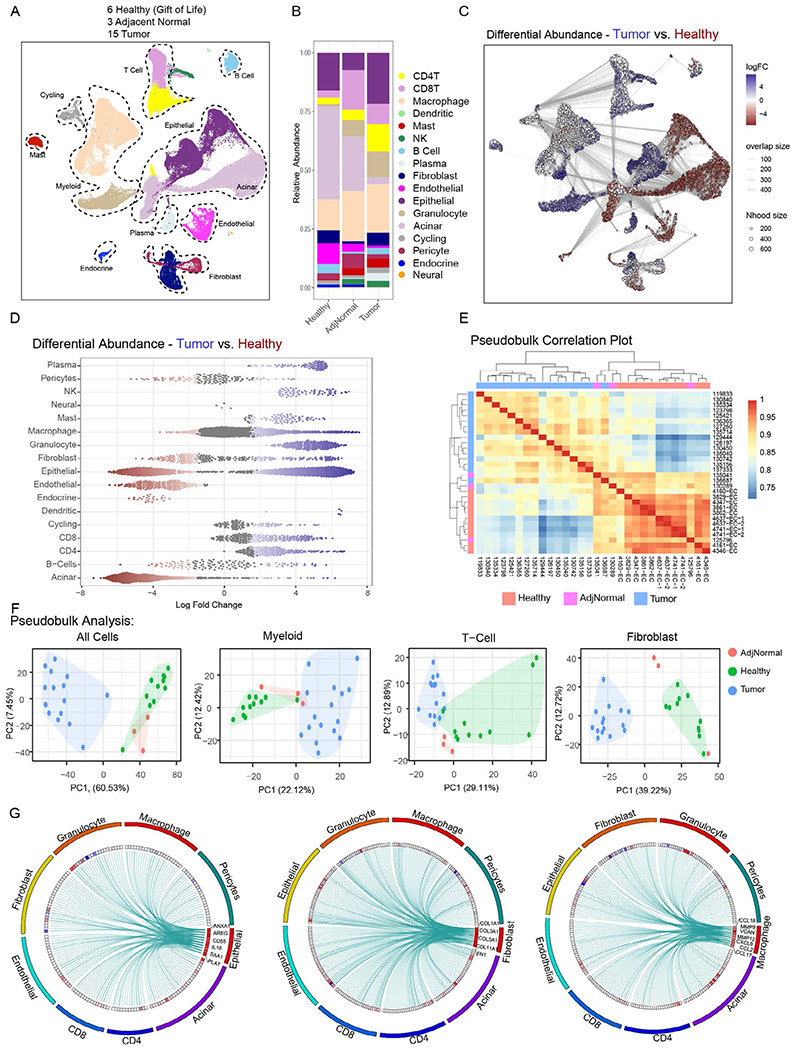
The adult healthy human pancreas has been poorly studied given lack of indication to obtain tissue from the pancreas in the absence of disease and rapid postmortem degradation. We obtained pancreata from brain dead donors thus avoiding any warm ischemia time. The 30 donors were diverse in age and race and had no known pancreas disease. Histopathological analysis of the samples revealed PanIN lesions in most individuals irrespective of age. Using a combination of multiplex immunohistochemistry, single cell RNA sequencing, and spatial transcriptomics, we provide the first ever characterization of the unique microenvironment of the adult human pancreas and of sporadic PanIN lesions. We compared healthy pancreata to pancreatic cancer and peritumoral tissue and observed distinct transcriptomic signatures in fibroblasts, and, to a lesser extent, macrophages. PanIN epithelial cells from healthy pancreata were remarkably transcriptionally similar to cancer cells, suggesting that neoplastic pathways are initiated early in tumorigenesis.
Statement of significance: The causes underlying the onset of pancreatic cancer remain largely unknown, hampering early detection and prevention strategies. Here, we show that PanIN are abundant in healthy individuals and present at a much higher rate than the incidence of pancreatic cancer, setting the stage for efforts to elucidate the microenvironmental and cell intrinsic factors that restrain, or, conversely, promote, malignant progression.
Conflict of interest statement
Conflict of interest disclosure statement
The authors declare no competing interests for this manuscript.
Figures




References
Publication types
Grants and funding
- F31 CA265085/CA/NCI NIH HHS/United States
- P30 CA046592/CA/NCI NIH HHS/United States
- I01 BX005777/BX/BLRD VA/United States
- R37 CA262209/CA/NCI NIH HHS/United States
- IK2 BX005875/BX/BLRD VA/United States
- U01 CA224145/CA/NCI NIH HHS/United States
- R01 CA264843/CA/NCI NIH HHS/United States
- U54 CA274371/CA/NCI NIH HHS/United States
- T32 GM113900/GM/NIGMS NIH HHS/United States
- T32 GM007863/GM/NIGMS NIH HHS/United States
- K08 CA234222/CA/NCI NIH HHS/United States
- R01 CA260752/CA/NCI NIH HHS/United States
- R37 CA214955/CA/NCI NIH HHS/United States
- R01 DK128102/DK/NIDDK NIH HHS/United States
- U01 CA274154/CA/NCI NIH HHS/United States
- R01 CA271510/CA/NCI NIH HHS/United States
- T32 DK094775/DK/NIDDK NIH HHS/United States
- T32 AI007413/AI/NIAID NIH HHS/United States
- R01 CA268426/CA/NCI NIH HHS/United States
LinkOut - more resources
Full Text Sources
Research Materials
