


Efficacy of digital health interventions on depression and anxiety in patients with cardiac disease: a systematic review and meta-analysis
- PMID: 36712158
- PMCID: PMC9707908
- DOI: 10.1093/ehjdh/ztac037
Efficacy of digital health interventions on depression and anxiety in patients with cardiac disease: a systematic review and meta-analysis
Abstract
Aims: Depression and anxiety have a detrimental effect on the health outcomes of patients with heart disease. Digital health interventions (DHIs) could offer a solution to treat depression and anxiety in patients with heart disease, but evidence of its efficacy remains scarce. This review summarizes the latest data about the impact of DHIs on depression/anxiety in patients with cardiac disease.
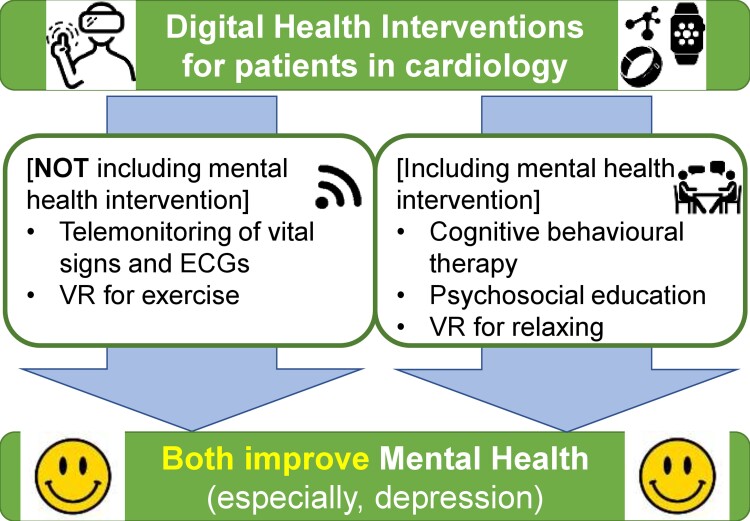
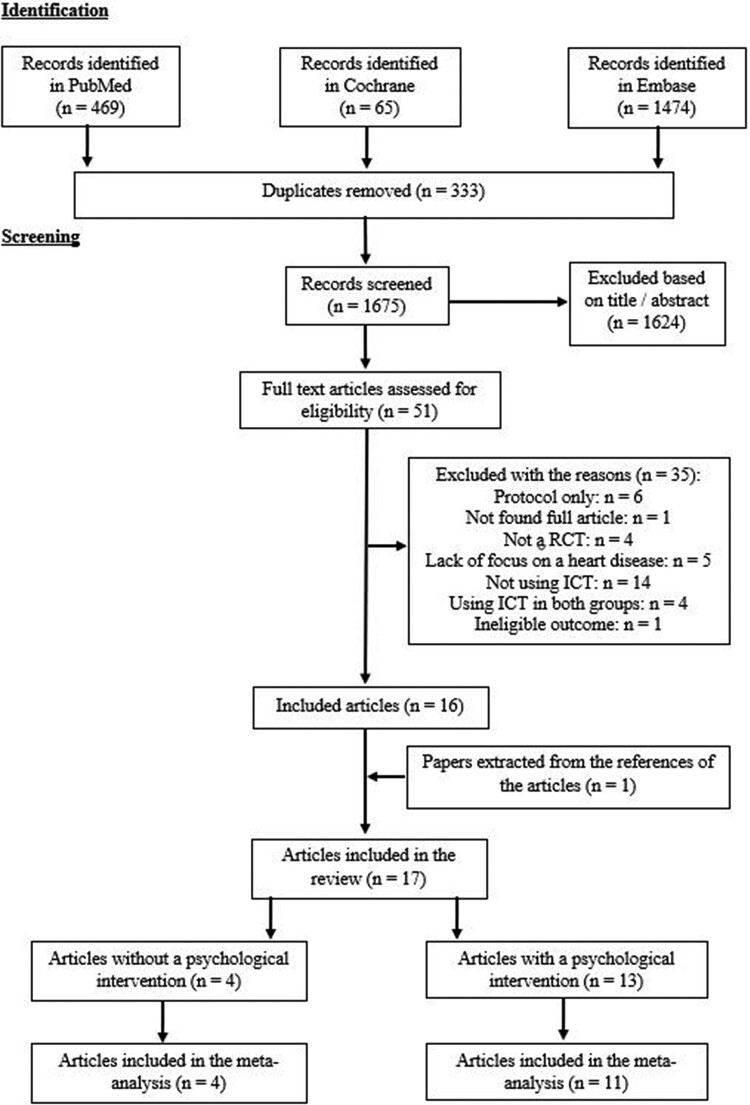
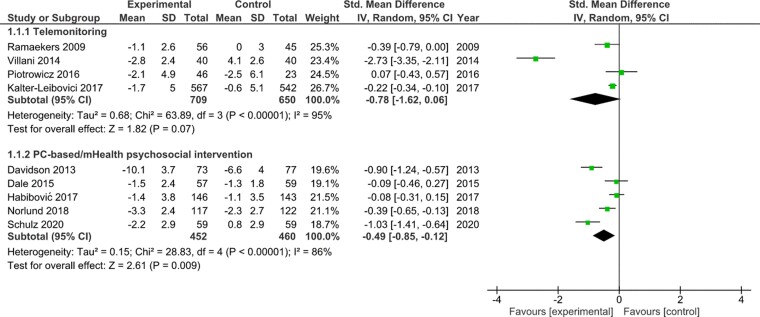
Methods and results: Articles from 2000 to 2021 in English were searched through electronic databases (PubMed, Cochrane Library, and Embase). Articles were included if they incorporated a randomized controlled trial design for patients with cardiac disease and used DHIs in which depression or anxiety was set as outcomes. A systematic review and meta-analysis were performed. A total of 1675 articles were included and the screening identified a total of 17 articles. Results indicated that telemonitoring systems have a beneficial effect on depression [standardized mean difference for depression questionnaire score -0.78 (P = 0.07), -0.55 (P < 0.001), for with and without involving a psychological intervention, respectively]. Results on PC or cell phone-based psychosocial education and training have also a beneficial influence on depression [standardized mean difference for depression questionnaire score -0.49 (P = 0.009)].
Conclusion: Telemonitoring systems for heart failure and PC/cell phone-based psychosocial education and training for patients with heart failure or coronary heart disease had a beneficial effect especially on depression. Regarding telemonitoring for heart failure, this effect was reached even without incorporating a specific psychological intervention. These results illustrate the future potential of DHIs for mental health in cardiology.
Keywords: Anxiety; Cardiac disease; Depression; Digital cardiology; Preventive cardiology; Telemonitoring; Virtual reality.
© The Author(s) 2022. Published by Oxford University Press on behalf of the European Society of Cardiology.
Conflict of interest statement
Conflict of interest: None declared.
Figures

References
-
- Vaccarino V, Badimon L, Bremner JD, Cenko E, Cubedo J, Dorobantu M, Duncker DJ, Koller A, Manfrini O, Milicic D, Padro T, Pries AR, Quyyumi AA, Tousoulis D, Trifunovic D, Vasiljevic Z, De Wit C, Bugiardini R, Lancellotti P, Carneiro AV. Depression and coronary heart disease: 2018 position paper of the ESC working group on coronary pathophysiology and microcirculation. Eur Heart J 2020;41:1687–1696. - PMC - PubMed
-
- Freedenberg V, Thomas SA, Friedmann E. Anxiety and depression in implanted cardioverter-defibrillator recipients and heart failure: a review. Heart Fail Clin 2011;7:59–68. - PubMed
-
- Richards SH, Anderson L, Jenkinson CE, Whalley B, Rees K, Davies P, Bennett P, Liu Z, West R, Thompson DR, Taylor RS. Psychological interventions for coronary heart disease: cochrane systematic review and meta-analysis. Eur J Prev Cardiol 2018;25:247–259. - PubMed
-
- Oneil A, Taylor B, Hare DL, Sanderson K, Cyril S, Venugopal K, Chan B, Atherton JJ, Hawkes A, Walters DL, Oldenburg B. Long-term efficacy of a tele-health intervention for acute coronary syndrome patients with depression: 12-month results of the MoodCare randomized controlled trial. Eur J Prev Cardiol 2015;22:1111–1120. - PubMed
Publication types
LinkOut - more resources
Full Text Sources