Review
. 2023 Jan 12:9:1080131.
doi: 10.3389/fcvm.2022.1080131. eCollection 2022.

Role of Connexin 43 phosphorylation on Serine-368 by PKC in cardiac function and disease

Affiliations
Review

Role of Connexin 43 phosphorylation on Serine-368 by PKC in cardiac function and disease

Renju Pun et al. Front Cardiovasc Med. .

Abstract

Intercellular communication mediated by gap junction channels and hemichannels composed of Connexin 43 (Cx43) is vital for the propagation of electrical impulses through cardiomyocytes. The carboxyl terminal tail of Cx43 undergoes various post-translational modifications including phosphorylation of its Serine-368 (S368) residue. Protein Kinase C isozymes directly phosphorylate S368 to alter Cx43 function and stability through inducing conformational changes affecting channel permeability or promoting internalization and degradation to reduce intercellular communication between cardiomyocytes. Recent studies have implicated this PKC/Cx43-pS368 circuit in several cardiac-associated diseases. In this review, we describe the molecular and cellular basis of PKC-mediated Cx43 phosphorylation and discuss the implications of Cx43 S368 phosphorylation in the context of various cardiac diseases, such as cardiomyopathy, as well as the therapeutic potential of targeting this pathway.

Keywords: Connexin 43; cardiac disease; cardiology; gap junctions; phosphorylation; protein kinase C.


Conflict of interest statement

MK reports consulting support from Sanofi. The remaining authors declare that the research was conducted in the absence of any commercial or financial relationships that could be construed as a potential conflict of interest.

Figures

FIGURE 1
FIGURE 1
Schematic showing the life cycle of Cx43 beginning from trafficking through trans-Golgi network to accrual at the perinexus followed by gap junction activity at the nexus and degradation through endocytosis followed by proteasomal or lysosomal degradation. Phosphorylation of various serine residues in Cx43 is shown.
FIGURE 2
FIGURE 2
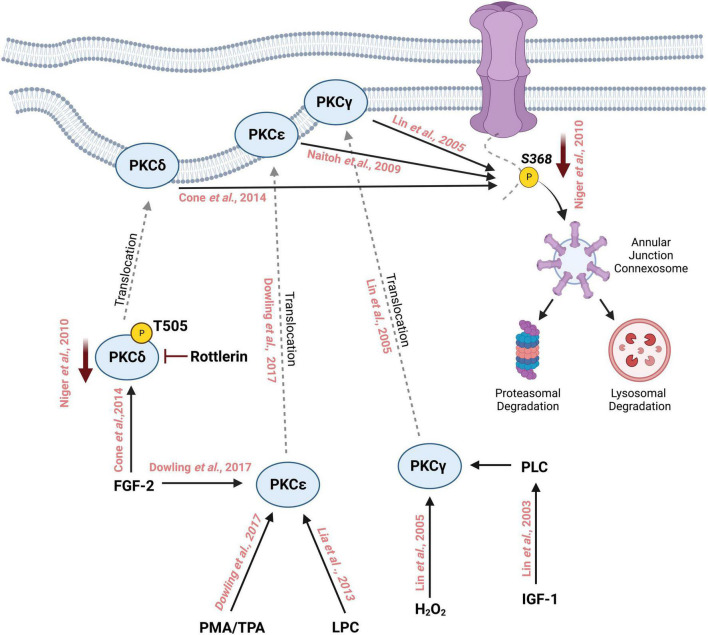
Schematic representation of phosphorylation of Cx43 by different isoforms of Protein Kinase C on Serine 368 followed by its degradation through the lysosomal and proteasomal degradation machinery. Treatment with phorbol myristate acetate (PMA) or 12-O-tetradecanoylphorbol-13-acetate (TPA) activates PKCε which then translocates to the cell membrane from the cytosol. Similarly, fibroblast growth factor-2 (FGF-2) and lysophosphatidylcholine (LPC) can also activate PKCε which in turn interacts with the C-terminal tail of Cx43 and phosphorylates it at S368. FGF-2 can activate and increase the phosphorylation of PKCδ at T505, which then translocates to the cell membrane where it phosphorylates Cx43 at S368. Inhibition with rottlerin reduces the activity of PKCδ which in turn reduces the phosphorylation of S368. PKCγ is activated by oxidative stress such as the addition of H202 thereby inducing the translocation of PKCγ to the cell membrane where it interacts with Cx43 and phosphorylates S368. Insulin-like growth factor 1 (IGF-1) activates PKCγ leading to the phosphorylation of Cx43 S368.

References

    1. Goodenough D, Goliger J, Paul D. Connexins, connexons, and intercellular communication. Annu Rev Biochem. (1996) 65:475–502. 10.1146/annurev.bi.65.070196.002355 - DOI - PubMed
    1. Lawrence T, Beers W, Gilula N. Transmission of hormonal stimulation by cell-to-cell communication. Nature. (1978) 272:501–6. 10.1038/272501a0 - DOI - PubMed
    1. McArthur L, Chilton L, Smith G, Nicklin S. Electrical consequences of cardiac myocyte: fibroblast coupling. Biochem Soc Trans. (2015) 43:513–8. 10.1042/BST20150035 - DOI - PubMed
    1. Sohl G, Willecke K. Gap junctions and the connexin protein family. Cardiovasc Res. (2004) 62:228–32. 10.1016/j.cardiores.2003.11.013 - DOI - PubMed
    1. Riquelme M, Kar R, Gu S, Jiang J. Antibodies targeting extracellular domain of connexins for studies of hemichannels. Neuropharmacology. (2013) 75:525–32. 10.1016/j.neuropharm.2013.02.021 - DOI - PMC - PubMed