


Moralized language predicts hate speech on social media
- PMID: 36712927
- PMCID: PMC9837664
- DOI: 10.1093/pnasnexus/pgac281
Moralized language predicts hate speech on social media
Erratum in
-
Correction to: Volume 2 Issue 1 of PNAS Nexus.PNAS Nexus. 2023 Jan 27;2(1):pgad016. doi: 10.1093/pnasnexus/pgad016. eCollection 2023 Jan. PNAS Nexus. 2023. PMID: 36744020 Free PMC article.
Abstract
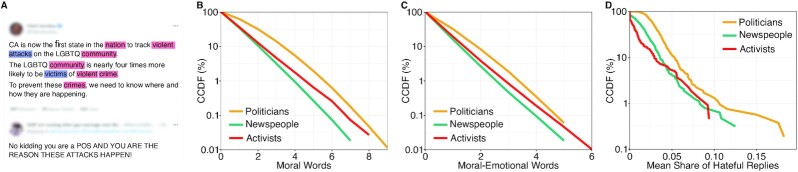
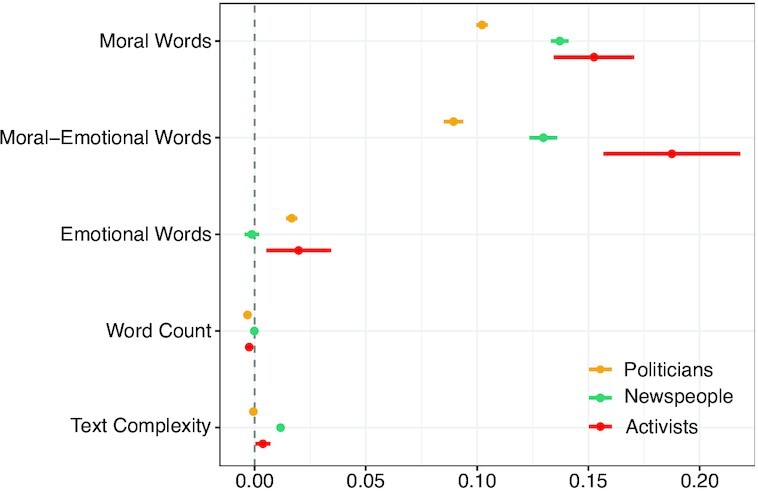
Hate speech on social media threatens the mental health of its victims and poses severe safety risks to modern societies. Yet, the mechanisms underlying its proliferation, though critical, have remained largely unresolved. In this work, we hypothesize that moralized language predicts the proliferation of hate speech on social media. To test this hypothesis, we collected three datasets consisting of N = 691,234 social media posts and ∼35.5 million corresponding replies from Twitter that have been authored by societal leaders across three domains (politics, news media, and activism). Subsequently, we used textual analysis and machine learning to analyze whether moralized language carried in source tweets is linked to differences in the prevalence of hate speech in the corresponding replies. Across all three datasets, we consistently observed that higher frequencies of moral and moral-emotional words predict a higher likelihood of receiving hate speech. On average, each additional moral word was associated with between 10.76% and 16.48% higher odds of receiving hate speech. Likewise, each additional moral-emotional word increased the odds of receiving hate speech by between 9.35 and 20.63%. Furthermore, moralized language was a robust out-of-sample predictor of hate speech. These results shed new light on the antecedents of hate speech and may help to inform measures to curb its spread on social media.
Keywords: hate speech; moralized language; social media.
© The Author(s) 2022. Published by Oxford University Press on behalf of National Academy of Sciences.
Figures
References
-
- Bilewicz M, Soral W., 2020. Hate speech epidemic. The dynamic effects of derogatory language on intergroup relations and political radicalization. Pol Psychol. 41: 3–33.
-
- United Nations . 2020. United Nations strategy and plan of action on hate speech–detailed guidance on implementation for United Nations field presences. https://www.un.org/en/genocideprevention/hate-speech-strategy.shtml(last accessed: 11/25/2022).
-
- Müller K, Schwarz C., 2021. Fanning the flames of hate: social media and hate crime. J Eur Econ Assoc. 19(4): 2131–2167.
-
- Piazza JA., 2020. Politician hate speech and domestic terrorism. Int Interact. 46(3): 431–453.
-
- Freelon D, Marwick A, Kreiss D., 2020. False equivalencies: online activism from left to right. Science. 369(6508): 1197–1201. - PubMed
LinkOut - more resources
Full Text Sources
