


On the interplay of hierarchies, conflicts, and cooperation: An experimental approach
- PMID: 36712929
- PMCID: PMC9837665
- DOI: 10.1093/pnasnexus/pgac283
On the interplay of hierarchies, conflicts, and cooperation: An experimental approach
Erratum in
-
Correction to: Volume 2 Issue 1 of PNAS Nexus.PNAS Nexus. 2023 Jan 27;2(1):pgad016. doi: 10.1093/pnasnexus/pgad016. eCollection 2023 Jan. PNAS Nexus. 2023. PMID: 36744020 Free PMC article.
-
Correction to: On the interplay of hierarchies, conflicts, and cooperation: An experimental approach.PNAS Nexus. 2023 Nov 15;2(11):pgad367. doi: 10.1093/pnasnexus/pgad367. eCollection 2023 Nov. PNAS Nexus. 2023. PMID: 38024392 Free PMC article.
Abstract
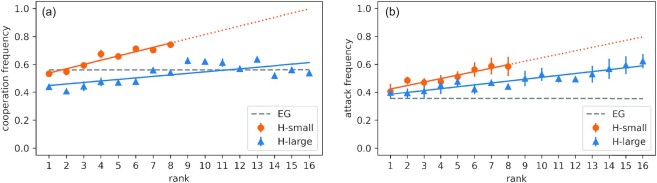
Previous research suggests that it is difficult to maintain cooperation in a large society when there is a strong hierarchical structure. In this study, we implement online human experiments to study the effects of exogenous variation in a particular notion of hierarchy on cooperation and conflict within groups. We demonstrate how cooperation can be maintained when collective action is accompanied by dyadic conflicts whose outcome feeds back on the hierarchical rank of the contestants. We find that the majority of individuals take part in conflicts and that highly ranked individuals mostly cooperate and engage in conflicts as a way to punish noncooperators. As a consequence, stable hierarchical groups can arise and maintain high levels of cooperation. Our results are in agreement with the prediction of earlier theoretical models on hierarchical societies and are relevant to understanding the interplay of hierarchy, cooperation, and conflict.
Keywords: behavioral economics; cooperation; hierarchies; online experiments.
© The Author(s) 2022. Published by Oxford University Press on behalf of National Academy of Sciences.
Figures
References
-
- Wilson EO. 1975. Sociobiology: the new synthesis. Cambridge (MA): Harvard University Press.
-
- Jachowsky RL. 1974. Agonistic behaviour of the blue crab, Callinectes sapidus Rathbun. Behaviour. 50:232–253.
-
- Van de Poll NE, Jonge FD, Oyen HGV. Pelt JV. 1982. Aggressive behaviour in rats: effects of winning and losing on subsequent aggressive interactions. Behav Process. 7:143–155. - PubMed
-
- Theraulaz G, Gervet BTJ, Pratte M, Semenoff-Tian-Chansky S. 1992. Patterns of agonistic interactions in three species of macaques (Macaca mulatta, M. fascicularis, M. tonkeana). Ethology. 91:177–202.
-
- Van Honk C, Hogeweg P. 1981. The ontogeny of the social structure in a captive Bombus terrestris colony. Behav Ecol Sociobiol. 9:111–119.
LinkOut - more resources
Full Text Sources
Research Materials
