


Topical SCD-153, a 4-methyl itaconate prodrug, for the treatment of alopecia areata
- PMID: 36712931
- PMCID: PMC9832969
- DOI: 10.1093/pnasnexus/pgac297
Topical SCD-153, a 4-methyl itaconate prodrug, for the treatment of alopecia areata
Erratum in
-
Correction to: Volume 2 Issue 1 of PNAS Nexus.PNAS Nexus. 2023 Jan 27;2(1):pgad016. doi: 10.1093/pnasnexus/pgad016. eCollection 2023 Jan. PNAS Nexus. 2023. PMID: 36744020 Free PMC article.
Abstract
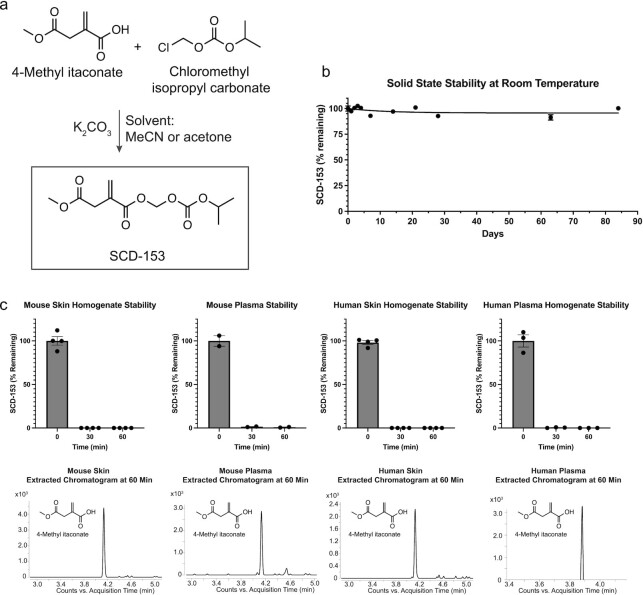
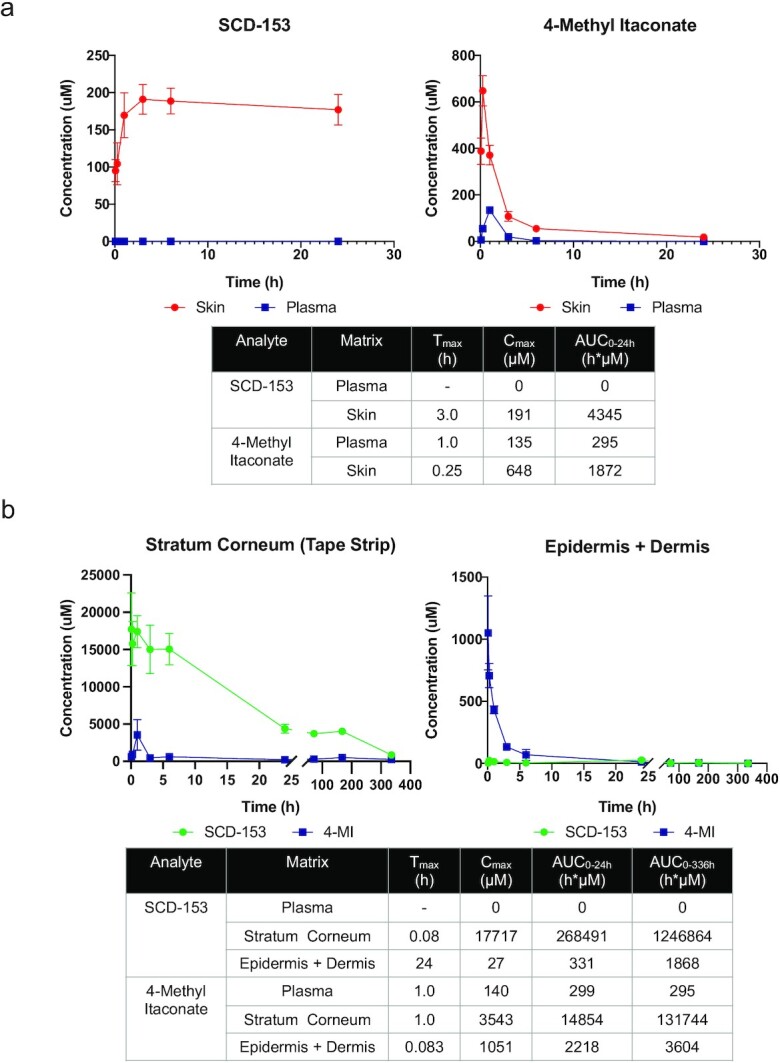
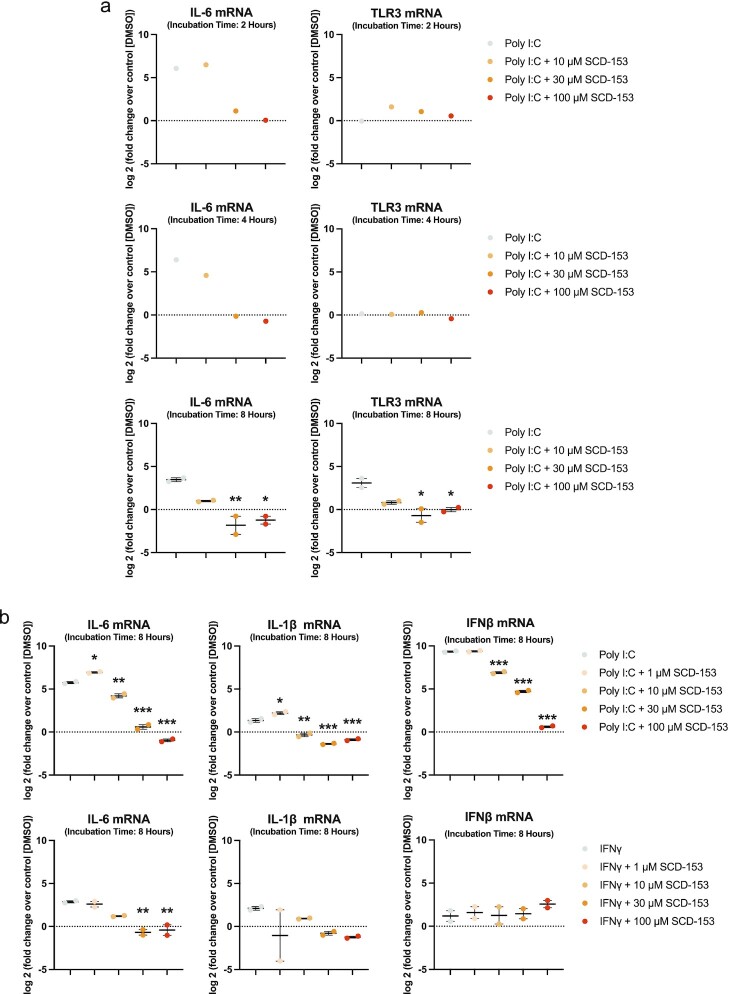
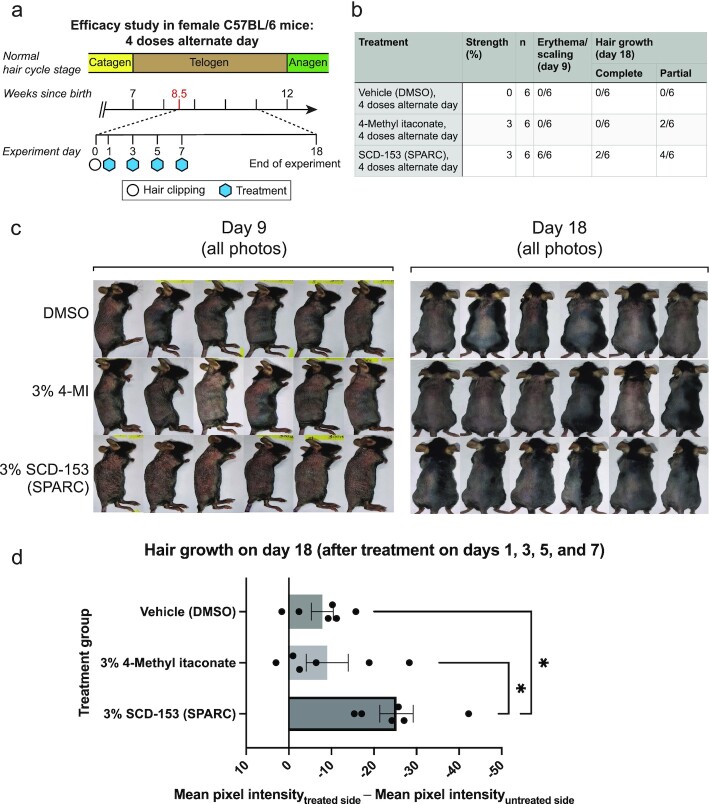
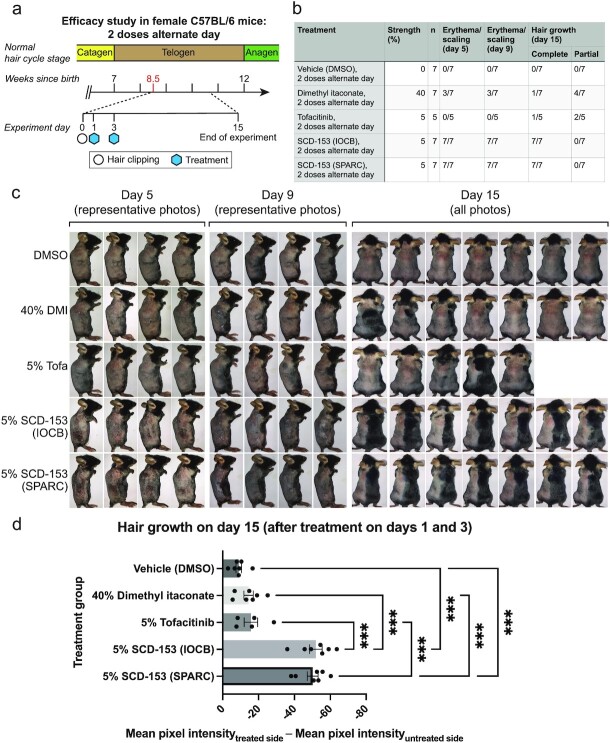
Alopecia areata is a chronic hair loss disorder that involves autoimmune disruption of hair follicles by CD8+ T cells. Most patients present with patchy hair loss on the scalp that improves spontaneously or with topical and intralesional steroids, topical minoxidil, or topical immunotherapy. However, recurrence of hair loss is common, and patients with extensive disease may require treatment with oral corticosteroids or oral Janus kinase (JAK) inhibitors, both of which may cause systemic toxicities with long-term use. Itaconate is an endogenous molecule synthesized in macrophages that exerts anti-inflammatory effects. To investigate the use of itaconate derivatives for treating alopecia areata, we designed a prodrug of 4-methyl itaconate (4-MI), termed SCD-153, with increased lipophilicity compared to 4-MI (CLogP 1.159 vs. 0.1442) to enhance skin and cell penetration. Topical SCD-153 formed 4-MI upon penetrating the stratum corneum in C57BL/6 mice and showed low systemic absorption. When added to human epidermal keratinocytes stimulated with polyinosinic-polycytidylic acid (poly I:C) or interferon (IFN)γ, SCD-153 significantly attenuated poly I:C-induced interleukin (IL)-6, Toll-like receptor 3, IL-1β, and IFNβ expression, as well as IFNγ-induced IL-6 expression. Topical application of SCD-153 to C57BL/6 mice in the resting (telogen) phase of the hair cycle induced significant hair growth that was statistically superior to vehicle (dimethyl sulfoxide), the less cell-permeable itaconate analogues 4-MI and dimethyl itaconate, and the JAK inhibitor tofacitinib. Our results suggest that SCD-153 is a promising topical candidate for treating alopecia areata.
Keywords: alopecia areata; anagen; cytokine; cytotoxicity; double-stranded RNA; hair cycle; hair growth; immunosuppression; inflammation; interferon; interleukin; itaconate; keratinocyte; pharmacokinetics; polyinosinic–polycytidylic acid; prodrug; stability; telogen; topical.
© The Author(s) 2022. Published by Oxford University Press on behalf of the National Academy of Sciences.
Figures
References
-
- Lee HH, et al. 2020. Epidemiology of alopecia areata, ophiasis, totalis, and universalis: a systematic review and meta-analysis. J Am Acad Dermatol. 82(3):675–682. - PubMed
-
- Bertolini M, Mcelwee K, Gilhar A, Bulfone-Paus S, Paus R. 2020. Hair follicle immune privilege and its collapse in alopecia areata. Exp Dermatol. 29(8):703–725. - PubMed
-
- Strazzulla LC, et al. 2018. Alopecia areata: disease characteristics, clinical evaluation, and new perspectives on pathogenesis. J Am Acad Dermatol. 78(1):1–12. - PubMed
-
- Tosti A, Bellavista S, Iorizzo M. 2006. Alopecia areata: a long term follow-up study of 191 patients. J Am Acad Dermatol. 55(3):438–441. - PubMed
LinkOut - more resources
Full Text Sources
Research Materials
