


Exercise reduces the anxiogenic effects of meta-chlorophenylpiperazine: The role of 5-HT2C receptors in the bed nucleus of the stria terminalis
- PMID: 36713088
- PMCID: PMC9880271
- DOI: 10.3389/fnsyn.2022.1067420
Exercise reduces the anxiogenic effects of meta-chlorophenylpiperazine: The role of 5-HT2C receptors in the bed nucleus of the stria terminalis
Abstract
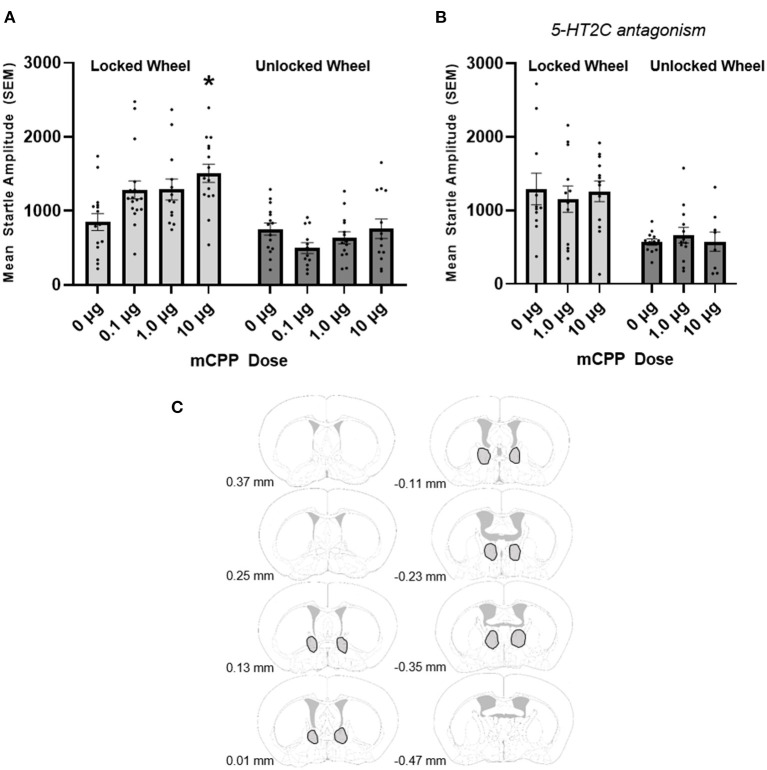
Introduction: Two weeks of voluntary exercise in group-housed mice produces a reduction in anxiety-like behaviors across a number of different measures, including a reduction in the anxiety levels typically produced by the anxiogenic serotonergic drug m-chlorophenylpiperazine (mCPP), an agonist at 5-HT2C/2b receptors. We have previously demonstrated that 2-weeks of voluntary exercise blunted the anxiogenic effects of systemic mCPP, and we have also shown that mCPP infused into the bed nucleus of the stria terminalis (BNST) is anxiogenic. Here we follow up on these reports.
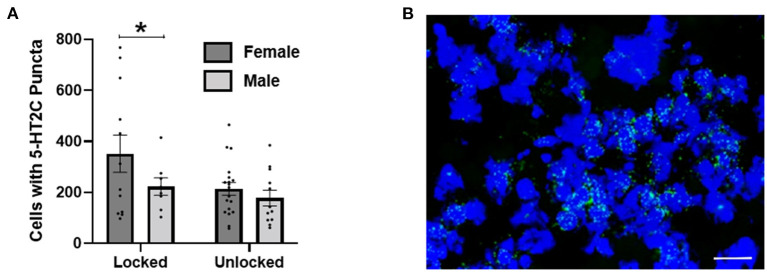
Methods: In Experiment 1 we infused several doses of mCPP into the BNST with or without the 5-HT2C antagonist SB242084. In Experiment 2, we administered mCPP into amygdala subregions and the dorsal hippocampus to investigate site specificity. In Experiment 4 we lesioned the BNST and subsequently infused mCPP systemically, and in Experiment 4 we used RNAscope® to assess BNST 5-HT2C transcripts following wheel running.
Results: BNST mCPP infusion increased acoustic startle responding, which was by 5-HT2C antagonism, while neither mCPP infused into the amygdala nor hippocampus was anxiogenic. Lesions of the BNST prevented the anxiogenic effect of systemically administered mCPP. Lastly, exercise reduced 5-HT2C transcripts in the BNST.
Discussion: These results suggest that the BNST is a critical site of action for the effects of exercise on mCPP. Together these data suggest that exercise may reduce 5-HT2C receptor function in the BNST, which may, in part, explain some of the anxiolytic effects associated with wheel running.
Keywords: anxiety; extended amygdala; serotonin; stress; wheel running.
Copyright © 2023 Fox, Boucher, Abedrabbo, Hare, Grimmig, Falls and Hammack.
Conflict of interest statement
The authors declare that the research was conducted in the absence of any commercial or financial relationships that could be construed as a potential conflict of interest.
Figures


References
-
- Bagdy G., Graf M., Anheuer Z. E., Modos E. A., Kantor S. (2001). Anxiety-like effects induced by acute fluoxetine, sertraline or m-CPP treatment are reversed by pretreatment with the 5-HT2C receptor antagonist SB-242084 but not the 5-HT1A receptor antagonist WAY-100635. Int. J. Neuropsychopharmacol. 4, 399–408. 10.1017/S1461145701002632 - DOI - PubMed
-
- Bristow L. J., O'Connor D., Watts R., Duxon M. S., Hutson P. H. (2000). Evidence for accelerated desensitisation of 5-HT(2C) receptors following combined treatment with fluoxetine and the 5-HT(1A) receptor antagonist, WAY 100,635, in the rat. Neuropharmacology 39, 1222–1236. 10.1016/S0028-3908(99)00191-4 - DOI - PubMed
Grants and funding
LinkOut - more resources
Full Text Sources
