


Duration of immunity to SARS-CoV-2 in children after natural infection or vaccination in the omicron and pre-omicron era: A systematic review of clinical and immunological studies
- PMID: 36713374
- PMCID: PMC9874918
- DOI: 10.3389/fimmu.2022.1024924
Duration of immunity to SARS-CoV-2 in children after natural infection or vaccination in the omicron and pre-omicron era: A systematic review of clinical and immunological studies
Abstract
Background: Duration of humoral and cellular memory in children previously infected SARS-CoV-2 or vaccinated and subsequent risk of reinfection is still not fully elucidated.
Methods: Systematic review of studies retrieved from medical databases and article reference lists.
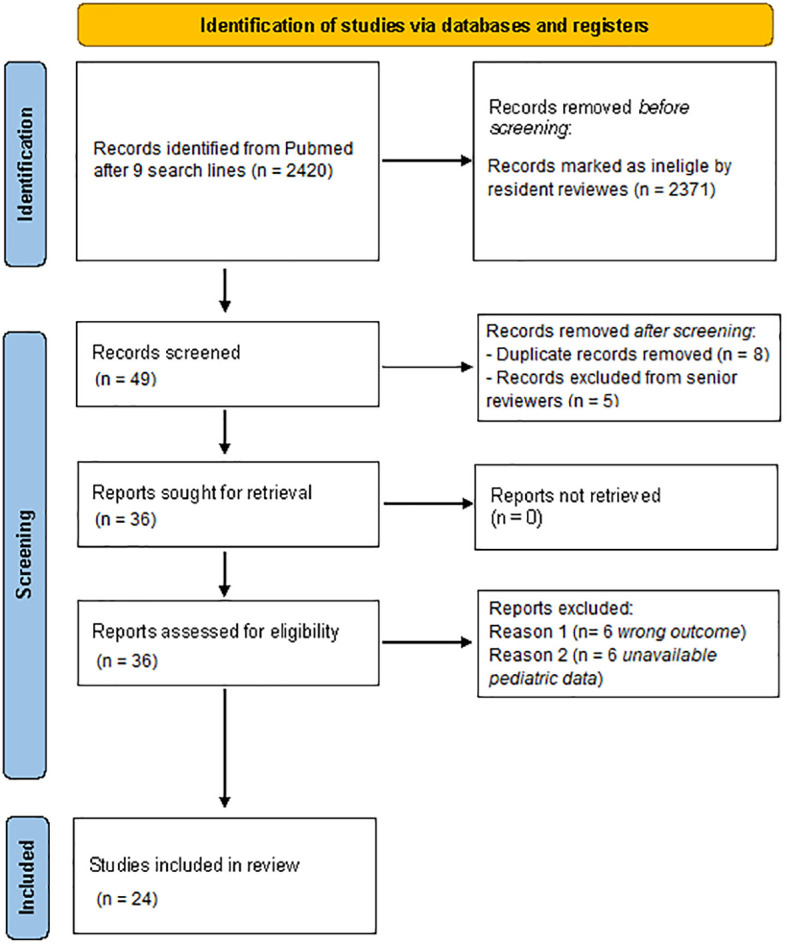
Results: From 2420 identified articles, 24 met the inclusion criteria. Children infected during the pre-omicron era developed long lasting (at least 10-12 months) humoral and cellular immunity against pre-Omicron SARS-CoV-2 variants, but have reduced in vitro cross-reactivity against Omicron. Conversely, although vaccination has a limited efficacy in preventing new infection with pre-Omicron and Omicron variants, in vitro studies suggested that vaccine-induced immunity provides better in vitro cross-neutralization against pre-Omicron and Omicron variants. Preprints published after the period of inclusion of our review suggested that overall risk of infection after Omicron infection is reduced, but children developed weak neutralizing responses in about half cases.
Conclusions: Available evidence, although limited, suggested a long-lasting but unperfect protection of previous infections or vaccination against pre-Omicron and Omicron variants. Based on our findings, it might be reasonable to offer families of children infected before Omicron a booster vaccination. A similar indication should be proposed also for those infected with Omicron, specifically for more fragile children at higher risk of COVID-19-related complications, based on better cross-variant neutralisation induced by vaccination.
Systematic review registration: PROSPERO, identifier ID 353189.
Keywords: COVID-19; SARS-CoV-2; children; immunity; vaccine.
Copyright © 2023 Buonsenso, Cusenza, Passadore, Bonanno, De Guido and Esposito.
Conflict of interest statement
DB participated at the ESPID2022 meeting discussing roles of Covid-19 in children, in a session sponsored by Pfizer. The remaining authors declare that the research was conducted in the absence of any commercial or financial relationships that could be construed as a potential conflict of interest.
Figures
References
-
- Viner RM, Mytton OT, Bonell C, Melendez-Torres GJ, Ward J, Hudson L, et al. Susceptibility to SARS-CoV-2 infection among children and adolescents compared with adults: A systematic review and meta-analysis. JAMA Pediatr (2021) 175(2):143–56. doi: 10.1001/jamapediatrics.2020.4573 - DOI - PMC - PubMed
-
- Available at: https://www.who.int/activities/tracking-SARS-CoV-2-variants (Accessed august 2022).
-
- Pazukhina E, Andreeva M, Spiridonova E, Bobkova P, Shikhaleva A, El-Taravi Y, et al. Prevalence and risk factors of post-COVID-19 condition in adults and children at 6 and 12 months after hospital discharge: a prospective, cohort study in Moscow (StopCOVID). BMC Med (2022) 20(1):244. doi: 10.1186/s12916-022-02448-4 - DOI - PMC - PubMed
-
- Available at: https://www.who.int/emergencies/diseases/novel-coronavirus-2019/covid-19... (Accessed May 7th, 2022).
Publication types
MeSH terms
Supplementary concepts
LinkOut - more resources
Full Text Sources
Medical
Miscellaneous
