


The photoplethysmography dictionary: practical guidance on signal interpretation and clinical scenarios from TeleCheck-AF
- PMID: 36713592
- PMCID: PMC9707923
- DOI: 10.1093/ehjdh/ztab050
The photoplethysmography dictionary: practical guidance on signal interpretation and clinical scenarios from TeleCheck-AF
Abstract
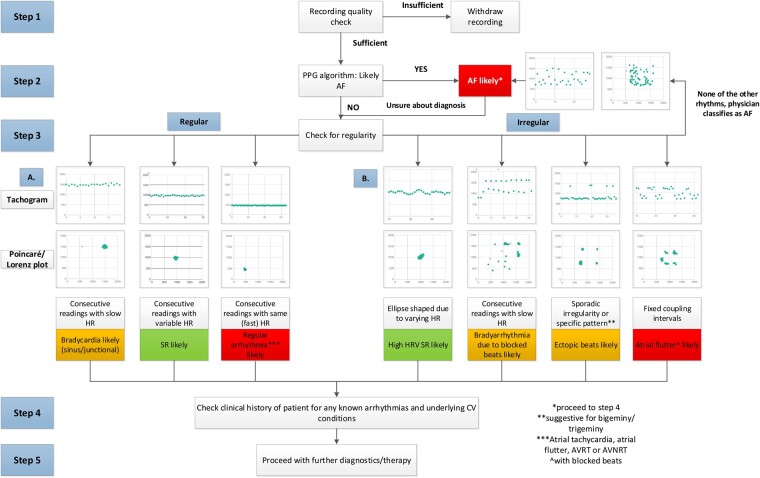
Aims: Within the TeleCheck-AF project, numerous centres in Europe used on-demand photoplethysmography (PPG) technology to remotely assess heart rate and rhythm in conjunction with teleconsultations. Based on the TeleCheck-AF investigator experiences, we aimed to develop an educational structured stepwise practical guide on how to interpret PPG signals and to introduce typical clinical scenarios how on-demand PPG was used.
Methods and results: During an online conference, the structured stepwise practical guide on how to interpret PPG signals was discussed and further refined during an internal review process. We provide the number of respective PPG recordings (FibriCheck®) and number of patients managed within a clinical scenario during the TeleCheck-AF project. To interpret PPG recordings, we introduce a structured stepwise practical guide and provide representative PPG recordings. In the TeleCheck-AF project, 2522 subjects collected 90 616 recordings in total. The majority of these recordings were classified by the PPG algorithm as sinus rhythm (57.6%), followed by AF (23.6%). In 9.7% of recordings, the quality was too low to interpret. The most frequent clinical scenarios where PPG technology was used in the TeleCheck-AF project was a follow-up after AF ablation (1110 patients) followed by heart rate and rhythm assessment around (tele)consultation (966 patients).
Conclusion: We introduce a newly developed structured stepwise practical guide on PPG signal interpretation developed based on presented experiences from TeleCheck-AF. The present clinical scenarios for the use of on-demand PPG technology derived from the TeleCheck-AF project will help to implement PPG technology in the management of AF patients.
Keywords: Atrial fibrillation; Heart rhythm disorders; Mobile health; Photoplethysmography; Structured stepwise approach.
© The Author(s) 2021. Published by Oxford University Press on behalf of the European Society of Cardiology.
Figures
References
-
- Varma N, Marrouche NF, Aguinaga L, Albert CM, Arbelo E, Choi J-I, Chung MK, Conte G, Dagher L, Epstein LM, Ghanbari H, Han JK, Heidbuchel H, Huang H, Lakkireddy DR, Ngarmukos T, Russo AM, Saad EB, Saenz Morales LC, Sandau KE, Sridhar ARM, Stecker EC, Varosy PD.. HRS/EHRA/APHRS/LAHRS/ACC/AHA worldwide practice update for telehealth and arrhythmia monitoring during and after a pandemic: developed in partnership with and endorsed by the American College of Cardiology (ACC), the American Heart Association (AHA), the Asia Pacific Heart Rhythm Society (APHRS), the European Heart Rhythm Association (EHRA), the Heart Rhythm Society (HRS), and the Latin American Heart Rhythm Society (LAHRS). Europace 2020;23:313.
-
- Hindricks G, Potpara T, Dagres N, Arbelo E, Bax JJ, Blomström-Lundqvist C, Boriani G, Castella M, Dan GA, Dilaveris PE, Fauchier L, Filippatos G, Kalman JM, La Meir M, Lane DA, Lebeau JP, Lettino M, Lip GYH, Pinto FJ, Thomas GN, Valgimigli M, Van Gelder IC, Van Putte BP, Watkins CL.. 2020 ESC Guidelines for the diagnosis and management of atrial fibrillation developed in collaboration with the European Association of Cardio-Thoracic Surgery (EACTS). Eur Heart J 2020. - PubMed
-
- Pluymaekers N, Hermans ANL, van der Velden RMJ, Gawałko M, den Uijl DW, Buskes S, Vernooy K, Crijns H, Hendriks JM, Linz D.. Implementation of an on-demand app-based heart rate and rhythm monitoring infrastructure for the management of atrial fibrillation through teleconsultation: TeleCheck-AF. Europace 2020. - PMC - PubMed
LinkOut - more resources
Full Text Sources