Review
. 2023 Jan 22:15:17-38.
doi: 10.2147/NSS.S201994. eCollection 2023.

Targeting Orexin Receptors for the Treatment of Insomnia: From Physiological Mechanisms to Current Clinical Evidence and Recommendations

Affiliations
Review

Targeting Orexin Receptors for the Treatment of Insomnia: From Physiological Mechanisms to Current Clinical Evidence and Recommendations

Maria P Mogavero et al. Nat Sci Sleep. .

Abstract

After a detailed description of orexins and their roles in sleep and other medical disorders, we discuss here the current clinical evidence on the effects of dual (DORAs) or selective (SORAs) orexin receptor antagonists on insomnia with the aim to provide recommendations for their further assessment in a context of personalized and precision medicine. In the last decade, many trials have been conducted with orexin receptor antagonists, which represent an innovative and valid therapeutic option based on the multiple mechanisms of action of orexins on different biological circuits, both centrally and peripherally, and their role in a wide range of medical conditions which are often associated with insomnia. A very interesting aspect of this new category of drugs is that they have limited abuse liability and their discontinuation does not seem associated with significant rebound effects. Further studies on the efficacy of DORAs are required, especially on children and adolescents and in particular conditions, such as menopause. Which DORA is most suitable for each patient, based on comorbidities and/or concomitant treatments, should be the focus of further careful research. On the contrary, studies on SORAs, some of which seem to be appropriate also in insomnia in patients with psychiatric diseases, are still at an early stage and, therefore, do not allow to draw definite conclusions.

Keywords: dual orexin receptor antagonists; hypocretin; insomnia; orexin; orexin receptor antagonist; selective orexin receptor antagonists.


Conflict of interest statement

Prof. Luigi Ferini-Strambi reports personal fees for lectures and advisory board work from Idorsia. Prof. Alessandro Silvani is an inventor in Italian patent application n. 102022000013894 related to a novel dual orexin receptor agonist. The other authors report no potential conflicts of interest in this work.

Figures
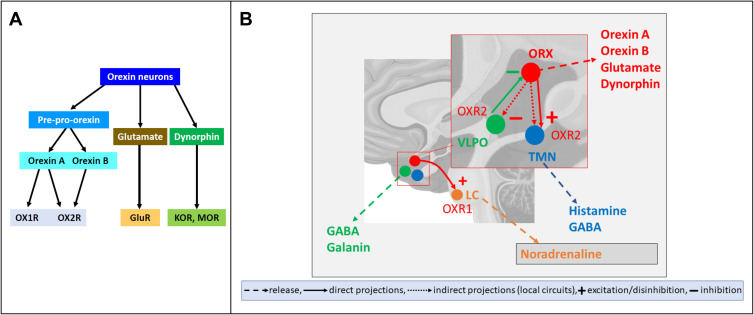
Figure 1
Figure 1
Neurochemistry and neuroanatomy of orexin neuron signaling. (A) summarizes the neurochemistry of orexin neuron signaling. Orexin neurons synthetize pre-pro-orexin, which is cleaved into the orexin (A and B) peptides (OXA and OXB, respectively). Orexin A acts by binding both orexin receptor 1 and (OXR1 and OXR2, respectively), whereas orexin B binds with high potency only OXR2. Orexin neurons may co-release glutamate, which binds its receptors (GluR), and dynorphin, which binds kappa opioid receptors (KOR) and mu opioid receptors (MOR). (B) illustrates three of the main projections of orexin neurons that are of particular relevance to wake-sleep control. Orexin (ORX) neurons indirectly inhibit neurons of the ventrolateral preoptic nucleus (VLPO) of the hypothalamus, which promote sleep, express gamma-aminobutyric acid (GABA) and galanin, and inhibit ORX neurons. In addition, ORX neurons directly excite and indirectly disinhibit neurons of the hypothalamic tuberomammillary nucleus (TMN), which co-release histamine and GABA to promote wakefulness. Finally, ORX neurons excite neurons of the locus coeruleus in the pons, which release noradrenaline and promote wakefulness. The effects of ORX neurons on the VLPO and TMN are mainly mediated by OX2R, whereas those on the LC are mainly mediated by OX1R. Other projections of ORX neurons as well as of VLPO, TMN, and LC neurons were omitted for clarity.

References

    1. Sakurai T, Amemiya A, Ishii M, et al. Orexins and orexin receptors: a family of hypothalamic neuropeptides and G protein-coupled receptors that regulate feeding behavior. Cell. 1998;92(4):573–585. doi:10.1016/S0092-8674(00)80949-6 - DOI - PubMed
    1. de Lecea L, Kilduff TS, Peyron C, et al. The hypocretins: hypothalamus-specific peptides with neuroexcitatory activity. Proc Natl Acad Sci U S A. 1998;95(1):322–327. doi:10.1073/pnas.95.1.322 - DOI - PMC - PubMed
    1. Siegel JM. Narcolepsy: a key role for hypocretins (orexins). Cell. 1999;98(4):409–412. doi:10.1016/S0092-8674(00)81969-8 - DOI - PMC - PubMed
    1. Ferini-Strambi L, Auer R, Bjorvatn B, et al. Insomnia disorder: clinical and research challenges for the 21st century. Eur j Neurol. 2021;28(7):2156–2167. doi:10.1111/ene.14784 - DOI - PubMed
    1. Riemann D, Benz F, Dressle RJ, et al. Insomnia disorder: state of the science and challenges for the future. J Sleep Res. 2022;31(4):e13604. doi:10.1111/jsr.13604 - DOI - PubMed
