. 2023 Mar;193(2):145-153.
doi: 10.1007/s00360-022-01471-4. Epub 2023 Jan 30.

Control of high-speed jumps: the rotation and energetics of the locust (Schistocerca gregaria)

Affiliations

Control of high-speed jumps: the rotation and energetics of the locust (Schistocerca gregaria)

C K Goode et al. J Comp Physiol B. 2023 Mar.

Abstract

Locusts (Schistocerca gregaria) jump using a latch mediated spring actuated system in the femur-tibia joint of their metathoracic legs. These jumps are exceptionally fast and display angular rotation immediately after take-off. In this study, we focus on the angular velocity, at take-off, of locusts ranging between 0.049 and 1.50 g to determine if and how rotation-rate scales with size. From 263 jumps recorded from 44 individuals, we found that angular velocity scales with mass-0.33, consistent with a hypothesis of locusts having a constant rotational kinetic energy density. Within the data from each locust, angular velocity increased proportionally with linear velocity, suggesting the two cannot be independently controlled and thus a fixed energy budget is formed at take-off. On average, the energy budget of a jump is distributed 98.7% to translational kinetic energy and gravitational potential energy, and 1.3% to rotational kinetic energy. The percentage of energy devoted to rotation was constant across all sizes of locusts and represents a very small proportion of the energy budget. This analysis suggests that smaller locusts find it harder to jump without body rotation.

Keywords: Biomechanics; Energy budget; Invertebrate; Jumping; LaMSA; Pitch.


Conflict of interest statement

The authors have no conflicts of interest.

Figures

Fig. 1
Fig. 1
Analysis of a locust (Schistocerca gregaria). a Tracking a locust jump from take-off T0 = 0 ms to T3 = 240 ms. The position of the blue triangle centre of mass (COM), red square Head were tracked using Tracker (Open Source Physics, 2020). These were used to calculate the angle of the body (q) for each frame. b The centre of mass of a locust is located above the coxa of the metathoracic leg (Bennet-Clark 1975). c The kinematic model of a locust represents the locust as a uniform rod that rotates about its middle, where the centre of mass is located
Fig. 2
Fig. 2
Linear velocity (v) (m/s) of a locust’s jump at take-off. Linear velocity does not vary with mass (p = 0.59, R2 = 6.86 × 10−3, Regression test). A line with a slope of y = 0x + c (shown in grey), is plotted to show the similarity in slope to our statistical trendline (blue)
Fig. 3
Fig. 3
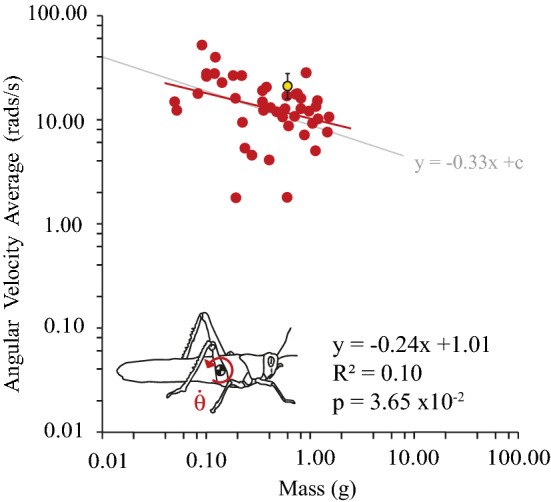
Angular velocity (θ˙) (rads/s) of a locust’s jump, at take-off. Average angular velocity decreases with mass−0.33 (p = 3.65 × 10−2, R2 = 0.10, regression test), thus the angular energy density remains constant as mass increases. A line with a slope of y =  − 0.33 × + c (shown in grey) is plotted to show the similarity in slope to our statistical trendline (red)
Fig. 4
Fig. 4
a Rotational kinetic energy (ER) and Translational kinetic energy (ET) of a locust’s jump, at take-off. Rotational kinetic energy (p = 1.35 × 10−7, R2 = 0.50) increases proportionally with translational kinetic energy (p = 1.58 × 10−12, R2 = 0.70). A line with a slope of y = 1x + c (shown in grey) is plotted to show the similarity in slope to our statistical trendlines (blue and red). b Energy budget of a locust’s jump, at take-off. On average, translational kinetic energy (including gravitational potential energy) accounts for 98.7% of the total energy and rotational kinetic energy accounts for 1.3% of the total energy budget, per jump
Fig. 5
Fig. 5
Intra-Individual variation a Linear velocity (m/s) of a locusts jump at take-off, over 61 consecutive jumps. Linear velocity does not vary with the number of consecutive jumps (p = 0.41, R2 = 0.01, Regression test). b Angular velocity (rads/s) and Linear velocity (m/s) of a locust’s jump at take-off, over 61 consecutive jumps. Angular velocity increases proportionally to linear velocity (p = 2.84 × 10−6, R2 = 0.31, Regression test). c Rotational kinetic energy (mJ) and Translational kinetic energy (mJ) of a locusts jump at take-off, over 61 consecutive jumps. Rotational kinetic energy increases proportionally to translational kinetic energy (p = 1.08 × 10−5, R2 = 0.28, Regression test). A line with the slope of y = 1 × + c (shown in Grey) is plotted to show the similarity in slope to that of our trendline (shown in black)

References

    1. Alexander RM. Elastic mechanisms in animal movement. Cambridge: Cambridge University Press; 1988.
    1. Baader A. The posture of the abdomen during locust flight: regulation by steering and ventilatory interneurones. J Exp Biol. 1990;151(1):109–131. doi: 10.1242/jeb.151.1.109. - DOI
    1. Baranowski L. Equations of motion of a spin-stabilized projectile for flight stability testing. J Theor Appl Mech. 2013;51(1):235–246.
    1. Bennet-Clark HC. The energetics of the jump of the locust Schistocerca gregaria. J Exp Biol. 1975;63(1):53–83. doi: 10.1242/jeb.63.1.53. - DOI - PubMed
    1. Burrows M, Picker MD. Jumping mechanisms and performance of pygmy mole crickets (Orthoptera, Tridactylidae) J Exp Biol. 2010;213(14):2386–2398. doi: 10.1242/jeb.042192. - DOI - PubMed

Publication types

LinkOut - more resources