. 2023 Feb 15;145(6):3276-3282.
doi: 10.1021/jacs.2c11450. Epub 2023 Jan 30.

Resolving Molecular Heterogeneity with Single-Molecule Centrifugation

Affiliations

Resolving Molecular Heterogeneity with Single-Molecule Centrifugation

Yi Luo et al. J Am Chem Soc. .

Abstract

For many classes of biomolecules, population-level heterogeneity is an essential aspect of biological function─from antibodies produced by the immune system to post-translationally modified proteins that regulate cellular processes. However, heterogeneity is difficult to fully characterize for multiple reasons: (i) single-molecule approaches are needed to avoid information lost by ensemble-level averaging, (ii) sufficient statistics must be gathered on both a per-molecule and per-population level, and (iii) a suitable analysis framework is required to make sense of a potentially limited number of intrinsically noisy measurements. Here, we introduce an approach that overcomes these difficulties by combining three techniques: a DNA nanoswitch construct to repeatedly interrogate the same molecule, a benchtop centrifuge force microscope (CFM) to obtain thousands of statistics in a highly parallel manner, and a Bayesian nonparametric (BNP) inference method to resolve separate subpopulations with distinct kinetics. We apply this approach to characterize commercially available antibodies and find that polyclonal antibody from rabbit serum is well-modeled by a mixture of three subpopulations. Our results show how combining a spatially and temporally multiplexed nanoswitch-CFM assay with BNP analysis can help resolve complex biomolecular interactions in heterogeneous samples.


Conflict of interest statement

The authors declare the following competing financial interest(s): D.Y. and W.P.W. are inventors on patent applications covering aspects of this work.

Figures
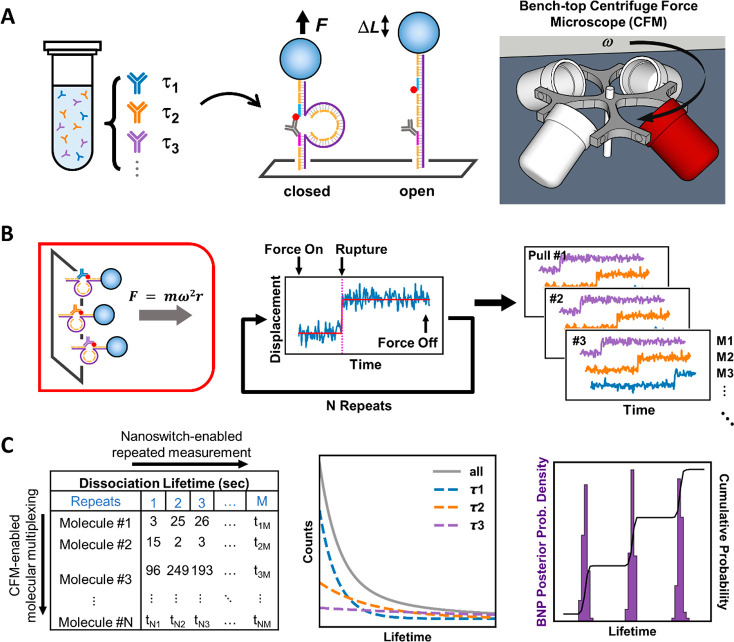
Figure 1
Figure 1
Schematic description of the assay. (A) Heterogeneous samples can contain multiple subpopulations with distinct unbinding kinetics (left). We mount pairs of antibody and antigen molecules into a DNA nanoswitch construct so that binding and unbinding can be seen by a change in DNA length (middle). The constructs are placed in a benchtop Centrifuge Force Microscope (CFM, right). (B) The CFM applies a centrifugal force on the antibody–antigen bond (left), leading to rupture events with a distinct signature (middle). By simultaneously tracking all the beads in the field of view, many pairs of molecules can be measured at once; with repeated pulls, multiple statistics can be collected per molecular pair (right). (C) Transition times are determined from bead trajectories and collated into a table (left). Collectively, the unbinding kinetics are multiexponential, but the individual subpopulations are single-exponential (middle). With Bayesian nonparametric analysis, the separate subpopulations can be resolved (right).
Figure 2
Figure 2
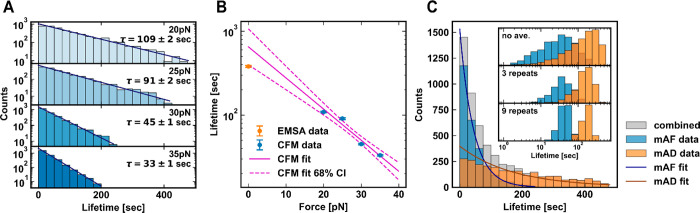
Validation of the CFM for homogeneous samples. (A) Unbinding lifetime distribution of the interaction between fluorescein and monoclonal antifluorescein (mAF), with y-axis on a log scale. The fit line and characteristic lifetime τ show results from a maximum likelihood estimation using a truncated exponential model. (B) Dependence of mAF unbinding lifetime on force as measured by CFM, with the best-fit line (magenta) based on the Bell–Evans model: τ ∝ exp (−F/F0). An independent zero force lifetime was measured by EMSA (orange). (C) Unbinding lifetime distribution of fluorescein and monoclonal antifluorescein (mAF), and DIG and monoclonal anti-DIG (mAD). Shown in gray is the combined data, representative of ensemble-averaged kinetics in a mixed sample. The inset shows the narrowing of the two distributions by taking per molecule averaged lifetimes (x-axis on log scale, y-axis normalized counts). The top panel contains the same data as in the main plot but with the x-axis on a log scale. The middle and lower panels show the average of a random subset of 3 and 9 data points per molecular pair, respectively, for all molecular pairs with at least that many statistics collected (the number of molecular pairs measured for the 3 repeat data was Nmolecular pairs = 288 and 319 for mAF and mAD, respectively; correspondingly, for 9 repeats, Nmolecular pairs = 171 and 106).
Figure 3
Figure 3
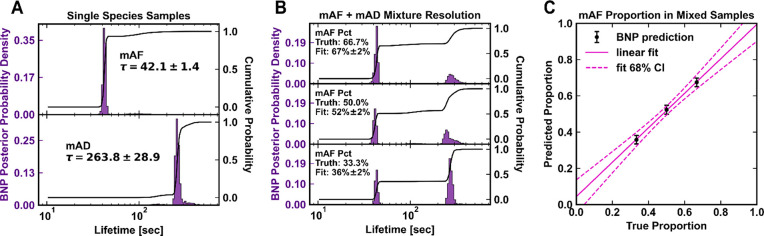
Validation of Bayesian Non-Parametric (BNP) inference with known samples of mAF and mAD for pure samples (A) and handmade binary mixtures (B). The inferred lifetime posterior is shown in dark purple. The distribution is a histogram of Monte Carlo samples of the lifetime [Figure S8, second row], weighted by the subpopulation fraction of that lifetime [Figure S8, first row] (see Section S2). The width of a peak represents its statistical uncertainty; the integrated area its population fraction. Solid line shows the cumulative probability; the inferred mAF proportion is the integrated area of the leftmost peak. (C) Correlation between true mAF proportion and inferred mAF proportion.
Figure 4
Figure 4
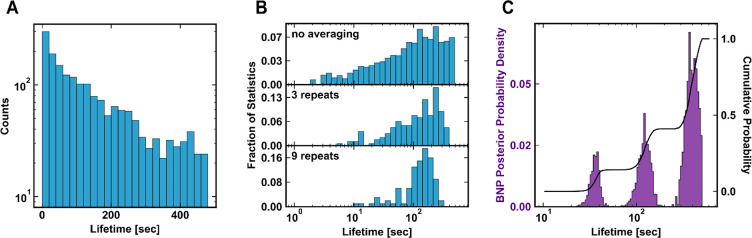
Demonstration of the CFM and BNP approach for an unknown polyclonal anti-FITC sample. (A) Population-level unbinding statistics of the polyclonal antibody. The nonexponential kinetics indicates heterogeneity. (B) Histogram of the per-molecule average lifetime. (C) Posterior distribution of lifetime inferred from Bayesian nonparametric analysis, as in Figure 3.

References

    1. Kabat E. A. Structure and Heterogeneity of Antibodies. Acta Haematol. 2004, 36 (3–4), 198–238. 10.1159/000209100. - DOI - PubMed
    1. Abbott W. M.; Snow M.; Eckersley S.; Renshaw J.; Davies G.; Norman R. A.; Ceuppens P.; Slootstra J.; Benschop J. J.; Hamuro Y.; Lee J. E.; Newham P. Characterization of the complex formed between a potent neutralizing ovine-derived polyclonal anti-TNFα Fab fragment and human TNFα. Biosci. Rep. 2013, 33 (4), e0006010.1042/BSR20130044. - DOI - PMC - PubMed
    1. Wine Y.; Boutz D. R.; Lavinder J. J.; Miklos A. E.; Hughes R. A.; Hoi K. H.; Jung S. T.; Horton A. P.; Murrin E. M.; Ellington A. D.; Marcotte E. M.; Georgiou G. Molecular deconvolution of the monoclonal antibodies that comprise the polyclonal serum response. Proc. Natl. Acad. Sci. U. S. A. 2013, 110 (8), 2993–2998. 10.1073/pnas.1213737110. - DOI - PMC - PubMed
    1. Bustamante C.; Cheng W.; Mejia Y. X. Revisiting the Central Dogma One Molecule at a Time. Cell 2011, 144 (4), 480–497. 10.1016/j.cell.2011.01.033. - DOI - PMC - PubMed
    1. Greenleaf W. J.; Woodside M. T.; Block S. M. High-resolution, single-molecule measurements of biomolecular motion. Annu. Rev. Biophys. Biomol. Struct. 2007, 36, 171–190. 10.1146/annurev.biophys.36.101106.101451. - DOI - PMC - PubMed

Publication types