


Tinetti balance performance is associated with mortality in older adults with late-onset Parkinson's disease: a longitudinal study
- PMID: 36717787
- PMCID: PMC9887890
- DOI: 10.1186/s12877-023-03776-7
Tinetti balance performance is associated with mortality in older adults with late-onset Parkinson's disease: a longitudinal study
Abstract
Background: Parkinson's disease (PD) is associated with a 3-fold mortality risk, which is closely related to advancing age. Evidence is lacking regarding the factors associated with the risks of mortality or nursing-home (NH) admission, in elderly patients with PD. We aimed at identifying the clinical characteristics associated with these outcomes, in older community-dwelling patients with late-onset PD.
Methods: Retrospective, observational analysis of data from geriatric day hospital patients. Motor assessment included Unified Parkinson Disease Rating Scale (UPDRS) part III score, Tinetti Performance Oriented Mobility Assessment (POMA) balance and gait tests, and gait speed. Levodopa equivalent dose, comorbidity, cognitive performance, Activities of Daily Living performance were examined. Cox proportional hazards models were performed to identify the factors associated with mortality and NH admission rate (maximum follow-up time = 5 years).
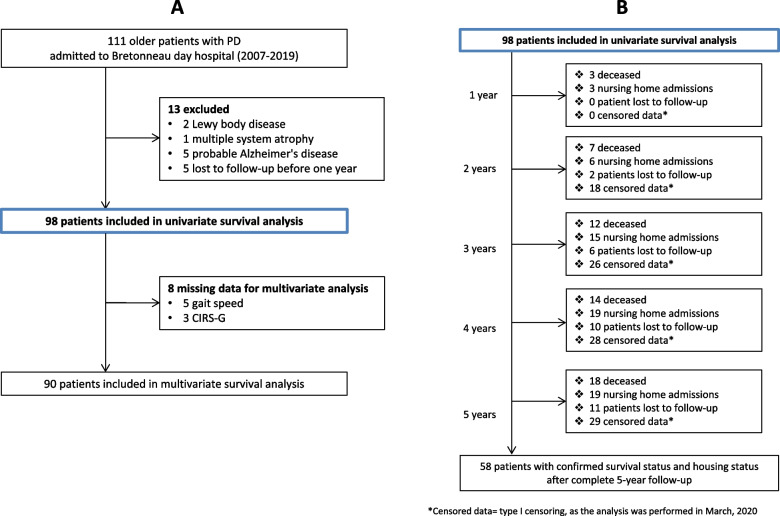
Results: We included 98 patients, mean age 79.4 (SD = 5.3) of whom 18 (18.3%) died and 19 (19.4%) were admitted into NH, over a median follow-up of 4 years. In multivariate Cox models, poor balance on the Tinetti POMA scale (HR = 0.82 95%CI (0.66-0.96), p = .023) and older age (HR = 1.12 95%CI (1.01-1.25), p = .044) were the only variables significantly associated with increased mortality risk. A Tinetti balance score below 11/16 was associated with a 6.7 hazard for mortality (p = .006). No specific factor was associated with NH admissions.
Conclusions: Age and the Tinetti POMA score were the only factors independently associated with mortality. The Tinetti POMA scale should be considered for balance assessment and as a screening tool for the most at-risk individuals, in this population.
Keywords: Balance; Older adults; Parkinson’s disease; Tinetti.
© 2023. The Author(s).
Conflict of interest statement
The authors declare that they have no competing interests.
Figures

References
-
- Elbaz A, Carcaillon L, Kab S, Moisan F. Epidemiology of Parkinson’s disease. Rev Neurol (Paris) 2016;172(1):14–26. - PubMed
-
- Dorsey ER, Constantinescu R, Thompson JP, et al. Projected number of people with Parkinson disease in the most populous nations, 2005 through 2030. Neurology. 2007;68(5):384–386. - PubMed
-
- Santos-García D, Suárez-Castro E, Ernandez J, et al. Predictors of mortality in nondemented patients with Parkinson disease: motor symptoms versus nonmotor symptoms. J Geriatr Psychiatry Neurol. 2018;31(1):19–26. - PubMed
-
- Leibson CL, Maraganore DM, Bower JH, Ransom JE, O’brien PC, Rocca WA. Comorbid conditions associated with Parkinson’s disease: a population-based study. Mov Disord Off J Mov Disord Soc. 2006;21(4):446–455. - PubMed
-
- Marras C, McDermott MP, Rochon PA, et al. Survival in Parkinson disease: thirteen-year follow-up of the DATATOP cohort. Neurology. 2005;64(1):87–93. - PubMed
Publication types
MeSH terms
Substances
LinkOut - more resources
Full Text Sources
Medical
