


Microbial cell factories based on filamentous bacteria, yeasts, and fungi
- PMID: 36717860
- PMCID: PMC9885587
- DOI: 10.1186/s12934-023-02025-1
Microbial cell factories based on filamentous bacteria, yeasts, and fungi
Abstract
Background: Advanced DNA synthesis, biosensor assembly, and genetic circuit development in synthetic biology and metabolic engineering have reinforced the application of filamentous bacteria, yeasts, and fungi as promising chassis cells for chemical production, but their industrial application remains a major challenge that needs to be solved.
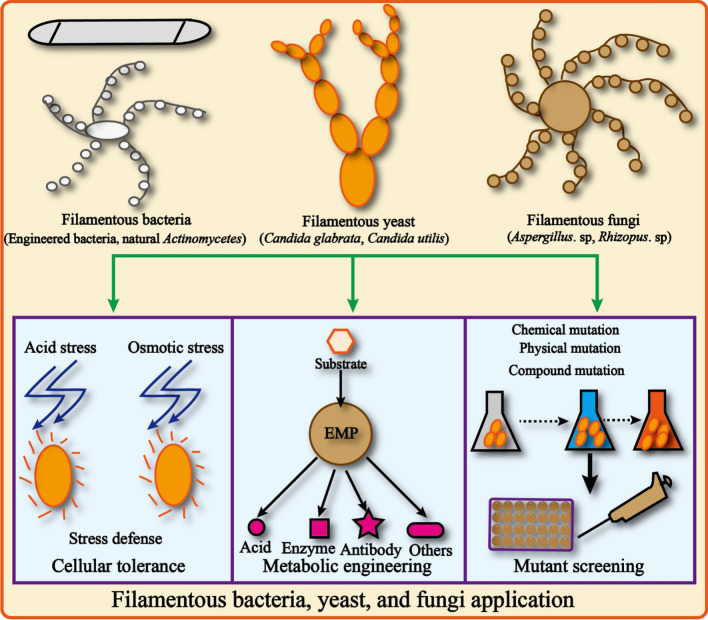
Results: As important chassis strains, filamentous microorganisms can synthesize important enzymes, chemicals, and niche pharmaceutical products through microbial fermentation. With the aid of metabolic engineering and synthetic biology, filamentous bacteria, yeasts, and fungi can be developed into efficient microbial cell factories through genome engineering, pathway engineering, tolerance engineering, and microbial engineering. Mutant screening and metabolic engineering can be used in filamentous bacteria, filamentous yeasts (Candida glabrata, Candida utilis), and filamentous fungi (Aspergillus sp., Rhizopus sp.) to greatly increase their capacity for chemical production. This review highlights the potential of using biotechnology to further develop filamentous bacteria, yeasts, and fungi as alternative chassis strains.
Conclusions: In this review, we recapitulate the recent progress in the application of filamentous bacteria, yeasts, and fungi as microbial cell factories. Furthermore, emphasis on metabolic engineering strategies involved in cellular tolerance, metabolic engineering, and screening are discussed. Finally, we offer an outlook on advanced techniques for the engineering of filamentous bacteria, yeasts, and fungi.
Keywords: Cellular tolerance; Filamentous microorganisms; Metabolic engineering; Microbial cell factories; Screening.
© 2023. The Author(s).
Conflict of interest statement
The authors hereby declare that they have no conflict of interest.
Figures

References
-
- Li W, Shen X, Wang J, Sun X, Yuan Q. Engineering microorganisms for the biosynthesis of dicarboxylic acids. Biotechnol Adv. 2021;48:107710. - PubMed
-
- Choi KR, Jang WD, Yang D, Cho JS, Park D, Lee SY. Systems metabolic engineering strategies: integrating systems and synthetic biology with metabolic engineering. Trends Biotechnol. 2019;37:817–837. - PubMed
-
- Burk MJ, Van Dien S. Biotechnology for chemical production: Challenges and opportunities. Trends Biotechnol. 2016;34:187–190. - PubMed
-
- Li C, Zhou J, Du G, Chen J, Takahashi S, Liu S. Developing Aspergillus niger as a cell factory for food enzyme production. Biotechnol Adv. 2020;44:107630. - PubMed
-
- Huang X, Men P, Tang S, Lu X. Aspergillus terreus as an industrial filamentous fungus for pharmaceutical biotechnology. Curr Opin Biotechnol. 2021;69:273–280. - PubMed
Publication types
MeSH terms
Grants and funding
LinkOut - more resources
Full Text Sources
Medical
Research Materials
