Review
. 2023 Jan 30;22(1):20.
doi: 10.1186/s12943-023-01723-z.

CAR-cell therapy in the era of solid tumor treatment: current challenges and emerging therapeutic advances

Affiliations
Review

CAR-cell therapy in the era of solid tumor treatment: current challenges and emerging therapeutic advances

Karama Makni Maalej et al. Mol Cancer. .

Abstract

In the last decade, Chimeric Antigen Receptor (CAR)-T cell therapy has emerged as a promising immunotherapeutic approach to fight cancers. This approach consists of genetically engineered immune cells expressing a surface receptor, called CAR, that specifically targets antigens expressed on the surface of tumor cells. In hematological malignancies like leukemias, myeloma, and non-Hodgkin B-cell lymphomas, adoptive CAR-T cell therapy has shown efficacy in treating chemotherapy refractory patients. However, the value of this therapy remains inconclusive in the context of solid tumors and is restrained by several obstacles including limited tumor trafficking and infiltration, the presence of an immunosuppressive tumor microenvironment, as well as adverse events associated with such therapy. Recently, CAR-Natural Killer (CAR-NK) and CAR-macrophages (CAR-M) were introduced as a complement/alternative to CAR-T cell therapy for solid tumors. CAR-NK cells could be a favorable substitute for CAR-T cells since they do not require HLA compatibility and have limited toxicity. Additionally, CAR-NK cells might be generated in large scale from several sources which would suggest them as promising off-the-shelf product. CAR-M immunotherapy with its capabilities of phagocytosis, tumor-antigen presentation, and broad tumor infiltration, is currently being investigated. Here, we discuss the emerging role of CAR-T, CAR-NK, and CAR-M cells in solid tumors. We also highlight the advantages and drawbacks of CAR-NK and CAR-M cells compared to CAR-T cells. Finally, we suggest prospective solutions such as potential combination therapies to enhance the efficacy of CAR-cells immunotherapy.

Keywords: CAR-M; CAR-NK; CAR-T; Cellular immunotherapy; Combined therapies; Solid tumors.


Conflict of interest statement

The authors declare that they have no competing interest.

Figures
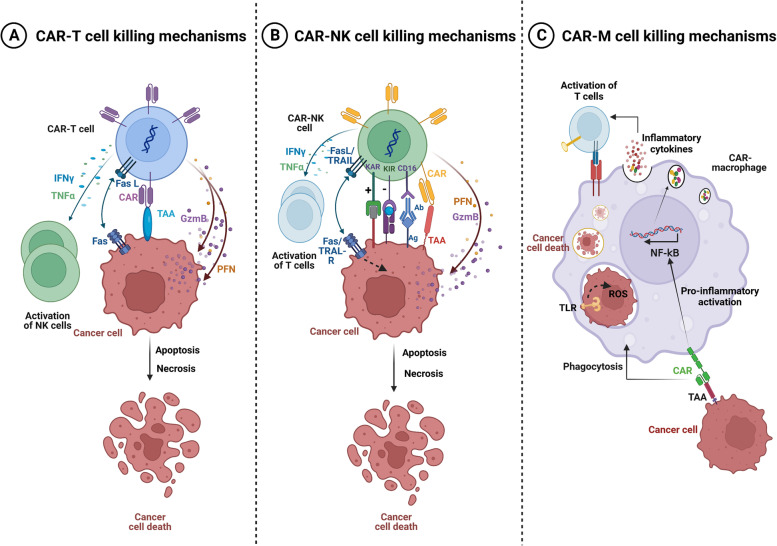
Fig. 1
Fig. 1
Killing mechanisms of CAR-T, CAR-NK, and CAR-M cells. A Tumor killing mechanisms of CAR-T cells. Activated CAR-T cells can specifically recognize the tumor associated antigen (TAA). Cytotoxic activity of Chimeric Antigen Receptor (CAR)-T cells is mediated by perforin (PFN) and granzyme (GzmB) granules secretion, and by activation of death receptor pathways such as Fas/Fas-L leading to cancer cells apoptosis and necrosis. Activated CAR-T cells also secrete Interferon-gamma (IFN-γ) and tumor necrosis factor-alpha (TNFα) which can promote Natural Killer (NK) cell anti-tumor cytotoxic activity. B Tumor killing mechanisms of CAR-NK cells. The activity of CAR-NK cells is regulated by the signal of activating (KAR) and inhibitory receptors (KIR) expressed on NK cells. Activated CAR-NK cells secrete the cytotoxic proteins perforin and granzyme B which synergize to induce cancer cell necrosis and apoptosis. NK cells also express the death ligands FasL and TRAIL which will bind to Fas and TRAIL-R on cancer cells and induce apoptosis. Moreover, CAR-NK cells trigger ADCC through the CD16 Fc receptor which recognize antibody-opsonized cancer cells. In addition, CAR-NK cells secrete IFN-γ and TNFα which promote their activation and stimulate other T-lymphocytes leading to increased anti-tumor immune response. NK: cell-Natural killer cells; IFN-γ: Interferon-gamma; TNFα: Tumor necrosis factor-alpha; TRAIL-R: TNF-related apoptosis-inducing ligand, KIR: Killer Inhibitory Receptors, KAR: Killer Activation Receptor, ADCC: Antibody-dependent cellular cytotoxicity, (PFN) perforin and (GzmB) granzyme. C Tumor killing mechanisms of CAR-M. The binding of a specific tumor associated antigen (TAA) with CAR receptor on the surface of CAR-M generates activation signals that mediate tumor phagocytosis, activation of transcription factors such as NF-kB and subsequent release of pro-inflammatory cytokines, which in turn can activate T cell-mediated immunity against the tumor
Fig. 2
Fig. 2
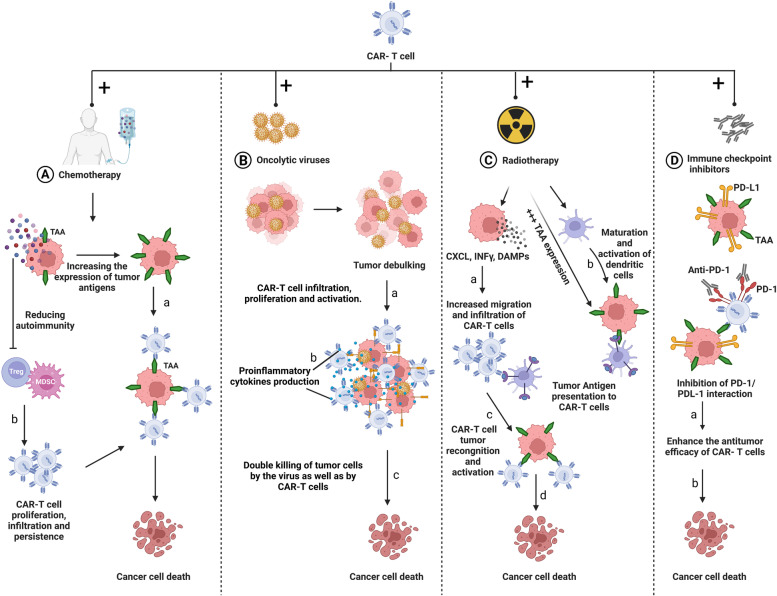
Possible combination therapies for CAR-T cells. A Combination of CAR-T cells with chemotherapy: Chemotherapy is known to increase the expression of tumor associated antigen (TAA) on cancer cells. This effect will help in (a) enhancing CAR-T cells interaction with cancer cells. Moreover, by downregulating regulatory T cells (Treg) and myeloid-derived suppressor cells (MDSCs), chemotherapy (b) promotes CAR-T cells proliferation, infiltration and extend their persistence in the TME. These mechanisms strongly support the use of CAR-T cells with chemotherapy for a more potent anti-tumor effect. B Combination of CAR-T cells with oncolytic viruses: Oncolytic viruses promote tumor debulking which (a) enhance CAR-T cells infiltration, proliferation, and activation (b) induce proinflammatory cytokines production, and (c) increase tumor cell death through a double mechanism: direct effect of the virus and enhanced CAR-T cells activity. C Combination of CAR-T cells with radiotherapy: Radiotherapy induces chemokines (CXCLs), interferon-gamma (INF-γ), damage-associated molecular patterns (DAMPs) release by tumor cells leading to (a) increased migration and infiltration of CAR-T cells. Radiotherapy also upregulates TAA expression on tumor cells allowing (b) maturation and activation of dendritic cells associated with better TAA presentation to T cells followed by (c) enhanced CAR-T cells tumor recognition and activation and leading to (d) increased cancer cells death. D Combination of CAR-T cells with immune checkpoint inhibitors (ICIs): ICIs targeting PD1/PDL-1 interaction unleash CAR-T cells inhibition by this repressive pathway. This effect will (a) enhance CAR-T cells cytotoxic activity and consequently (b) promote cancer cell death
Fig. 3
Fig. 3
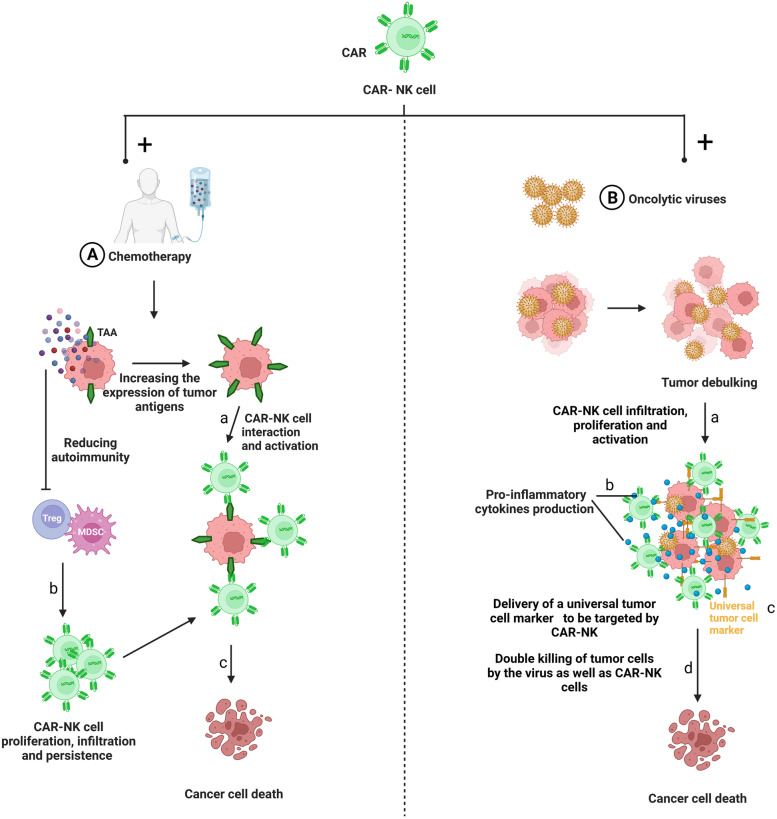
Possible combination therapies for CAR-NK cells. A Combination of CAR-NK cells with chemotherapy: The upregulation of tumor associated antigen (TAA) on cancer cells (a) enhances CAR-NK cells interaction with cancer cells and promotes their cytotoxic activity. Moreover, by decreasing Treg and MDSCs, chemotherapy (b) promotes CAR-NK cells proliferation, infiltration and prolongates their survival in the TME. Therefore, combination of CAR-NK cells with chemotherapy would (c) enhance tumor cell death. B Combination of CAR-NK cells with oncolytic viruses: The tumor debulking induced by oncolytic viruses (a) enhances CAR-NK cells infiltration, proliferation, and activation and (b) proinflammatory cytokines production. Chemotherapy can (c) deliver a universal tumor cell marker to be targeted by CAR-NK cells. Combination of CAR-NK cells with oncolytic viruses will (d) induce double killing of tumor cells by the virus and the CAR-NK cells
Fig. 4
Fig. 4
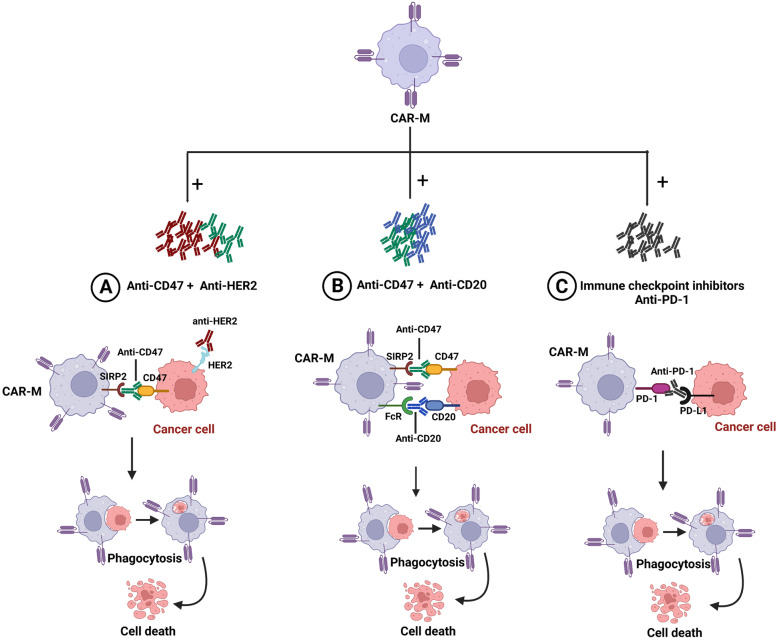
Possible combination therapies for CAR-M. CAR-M activation requires cancer cell recognition and interaction. Immune cell inhibitory mechanisms such as CD47/SIRPα or FcR/CD20 can limit CAR-M activity. CAR-M therapy demonstrated enhanced phagocytosis when combined with anti-CD47 and anti-HER2 (Trastuzumab) (A), with anti-CD47 and anti-CD20 (Rituximab) (B), as well as with anti-PD-1 (C). HER2; human epidermal growth factor receptor 2; PD-1; programmed cell death protein, SIRPα; signal regulatory protein α
Fig. 5
Fig. 5
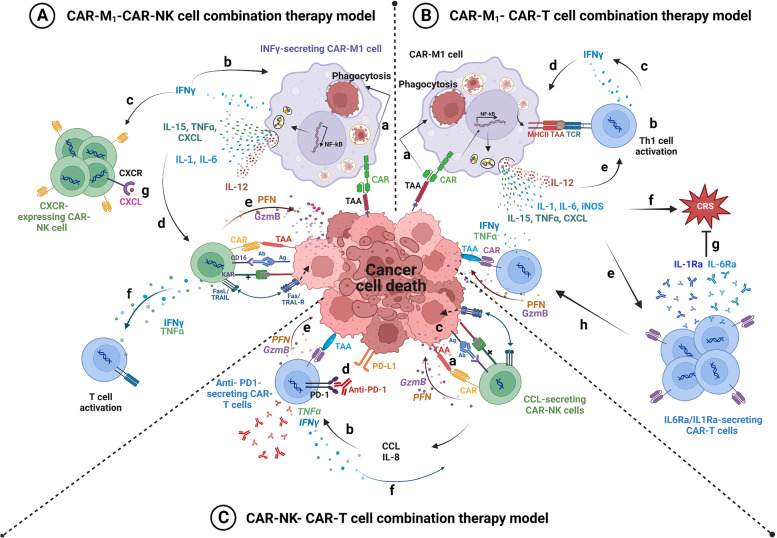
Combined CAR cells therapies would improve their efficacy. A CAR-M1/CAR-NK cell combination therapy model. (a) CAR-M1 genetically modified to secrete INF-γ recognize the TAA through the CAR and phagocyte the tumor. (b) The continuous secretion of INF-γ by these CAR-M maintains them in M1 phenotype and (c) induces the recruitment of CAR-NK cells genetically modified to express CXCR. Additionally, CAR-M1 secrete IL-1, IL-12 and IL-15 which (d) induce the upregulation of CAR-NK KAR), CXCR, FASL and CD16. The upregulation of activated CAR-NK cells (e) enhanced cytotoxicity against tumor cells. Additionally, activated CAR-NK cells secrete IFN-γ and TNFα which (f) stimulate endogenous cytotoxic T cells. Moreover, (g) CXCR-expressing CAR-NK cells have a higher potential to migrate and infiltrate the CXCL secreting TME. B CAR-M1/CAR-T cell combination therapy model. (a) CAR-M1 recognize TAA with CAR and phagocyte the tumor. TAA presentation by CAR-M1 induces (b) the activation of Th1 immune responses. The interaction between CAR-M1-MHC-TAA and Th1 induces (c) IFN-γ production by Th1. (d) IFN-γ maintains CAR-M in M1 phenotype. (e) Activated CAR-M1 cells produces pro-inflammatory cytokines and chemokines, ROS and TNF-α involved in the activation of Th1 and the recruitment of CAR-T cells into the tumor site. (f) CAR-M1 are also able to produce NO which contributes with IL-1 and IL-6 to the generation of CRS. (g) IL-1Ra-expressing-genetically modified CAR-T cells inhibit the CRC mediated by IL-1 and IL-6. (h) Recruited CAR-T cells recognize TAA and induce tumor cytotoxicity. C CAR-NK/CAR-T cell combination therapy model. (a) CAR-NK cells recognize TAA by CAR and ligands expressed on tumor cells. (b) CCL-secreting CAR-NK cells recruit CAR-T cells by releasing IL-8, CCL3, and CCL5. CAR-NK expressing chemokines are better recruited to cancer cells and (c) kill them directly by apoptosis. (d) CAR-T cells secrete PD-1 blocking antibodies and inhibits this interaction with PDL-1. (e) CAR-T cells induce cancer cells killing by releasing granzyme and perforin. (f) CAR-T cell recruit CAR-NK

References

    1. World Health Organization (WHO) Cancer [https://www.who.int/news-room/fact-sheets/detail/cancer].
    1. GlobalSurg C. National Institute for Health Research Global Health Research Unit on Global S: Global variation in postoperative mortality and complications after cancer surgery: a multicentre, prospective cohort study in 82 countries. Lancet. 2021;397:387–397. - PMC - PubMed
    1. Albano D, Benenati M, Bruno A, Bruno F, Calandri M, Caruso D, Cozzi D, De Robertis R, Gentili F, Grazzini I, et al. Imaging side effects and complications of chemotherapy and radiation therapy: a pictorial review from head to toe. Insights Imaging. 2021;12:76. - PMC - PubMed
    1. Orzetti S, Tommasi F, Bertola A, Bortolin G, Caccin E, Cecco S, Ferrarin E, Giacomin E, Baldo P. Genetic Therapy and Molecular Targeted Therapy in Oncology: Safety, Pharmacovigilance, and Perspectives for Research and Clinical Practice. Int J Mol Sci. 2022;23:3012. - PMC - PubMed
    1. Papaioannou NE, Beniata OV, Vitsos P, Tsitsilonis O, Samara P. Harnessing the immune system to improve cancer therapy. Ann Transl Med. 2016;4:261. - PMC - PubMed

Publication types

Substances