Global, Regional, and National Burden of CKD due to Glomerulonephritis from 1990 to 2019: A Systematic Analysis from the Global Burden of Disease Study 2019
- PMID: 36719159
- PMCID: PMC10101559
- DOI: 10.2215/CJN.0000000000000017
Global, Regional, and National Burden of CKD due to Glomerulonephritis from 1990 to 2019: A Systematic Analysis from the Global Burden of Disease Study 2019
Abstract
Background: CKD is becoming a major human health concern. Limited quantitative assessments of the burden of CKD due to glomerulonephritis have been performed. We performed a comprehensive analysis of the disease burden to update the epidemiology of this disease.
Methods: Incidence, prevalence, deaths, and disability-adjusted life-years (DALYs) data and percent changes in these indicators were extracted from Global Burden of Disease Study 2019 to analyze the burden of CKD due to glomerulonephritis.
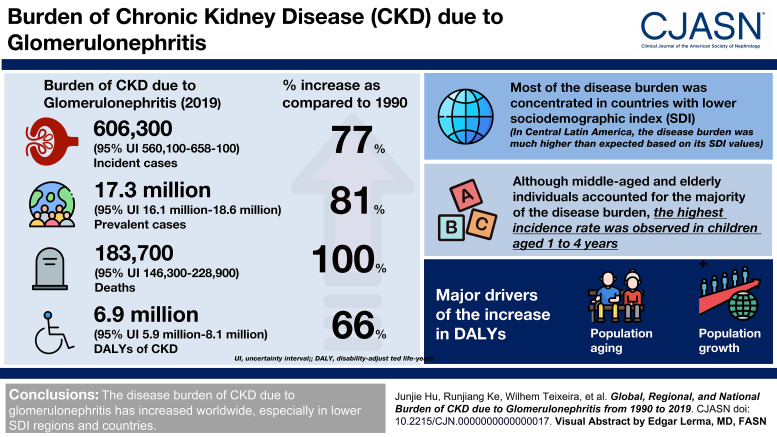
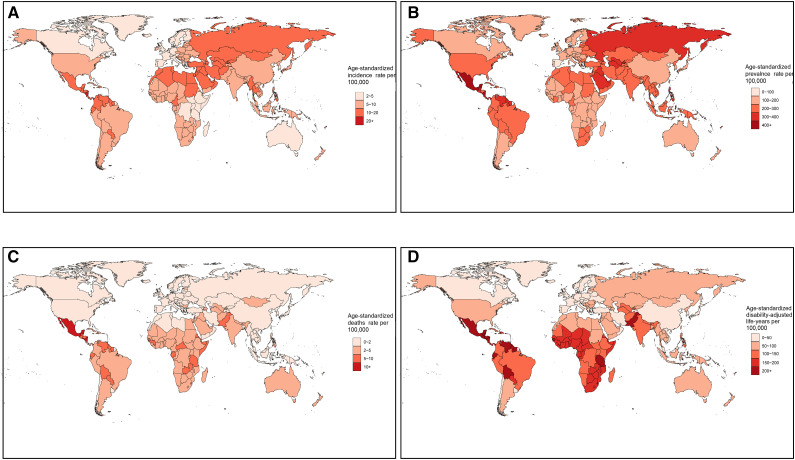
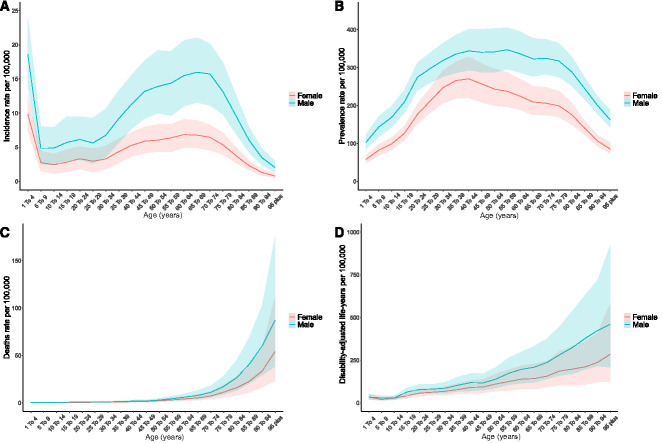
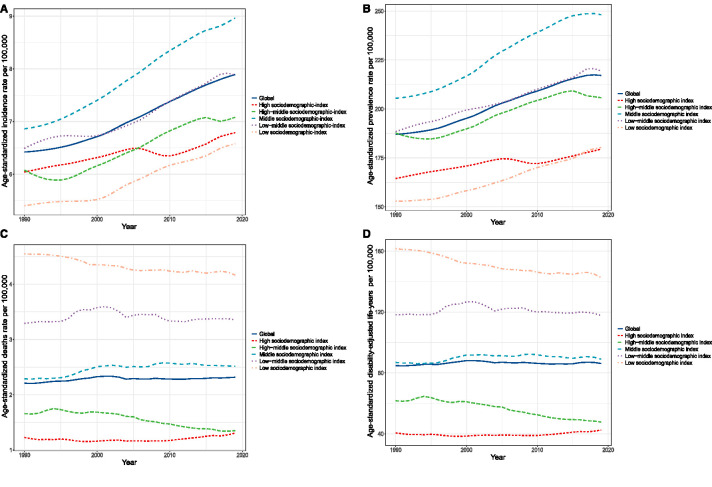
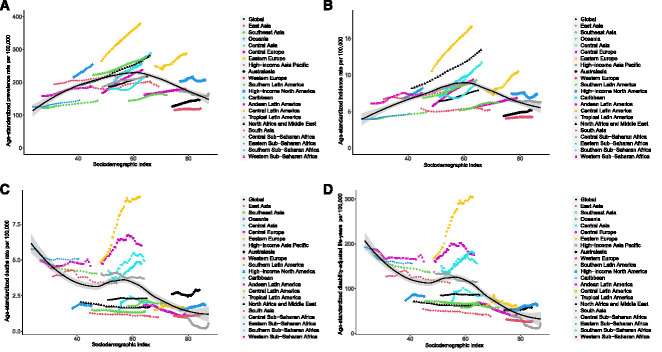
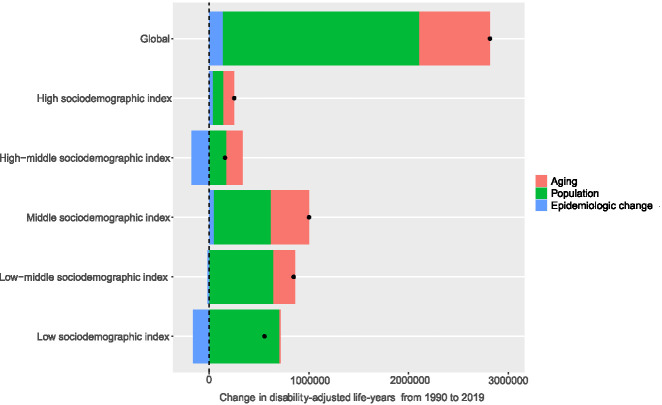
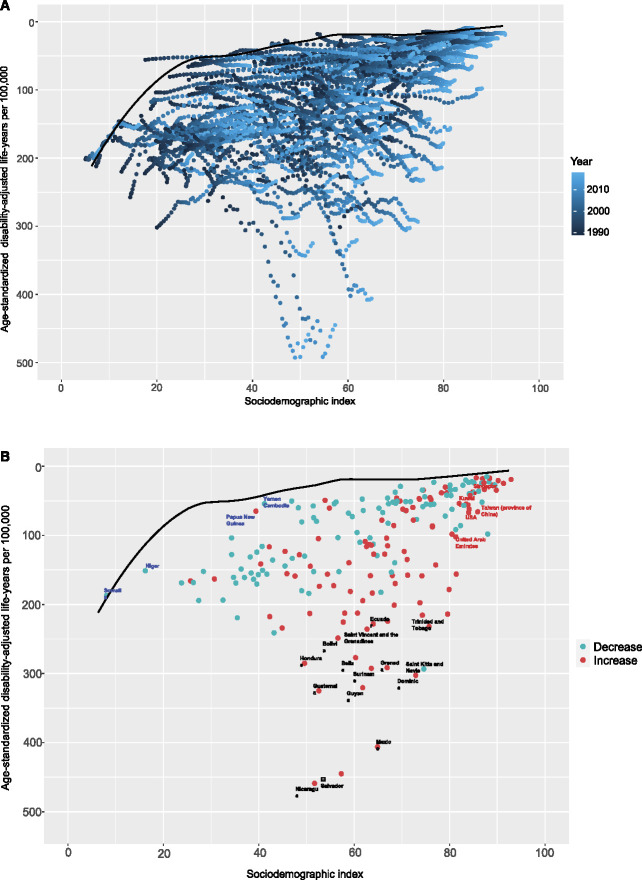
Results: Globally, there were 606,300 (95% uncertainty interval [UI], 560,100 to 658,100) incident patients, 17,300,000 (95% UI, 16,100,000 to 18,600,000) prevalent patients, 183,700 (95% UI, 146,300 to 228,900) deaths, and 6,900,000 (95% UI, 5,900,000 to 8,100,000) DALYs of CKD due to glomerulonephritis in 2019. Compared with those in 1990, the numbers of incident patients, prevalent patients, deaths, and DALYs increased by 77%, 81%, 100%, and 66%, respectively. Most of the disease burden was concentrated in countries with lower sociodemographic index. In Central Latin America, the disease burden was much higher than expected on the basis of its sociodemographic index. Decomposition analysis showed that population aging and growth were the two major drivers of the increase in DALYs. Frontier analysis revealed considerable opportunities to reduce the age-standardized DALYs in the middle of the sociodemographic-index spectrum. Although middle-aged and elderly individuals accounted for the majority of the disease burden, the highest incidence rate was observed in children aged 1-4 years.
Conclusions: The disease burden of CKD due to glomerulonephritis has increased worldwide, especially in regions and countries with lower sociodemographic indexes.
Copyright © 2023 The Author(s). Published by Wolters Kluwer Health, Inc. on behalf of the American Society of Nephrology.
Conflict of interest statement
All authors have nothing to disclose.
Figures
Comment in
-
Trends in the Global Burden of Glomerulonephritis.Clin J Am Soc Nephrol. 2023 Jan 1;18(1):14-16. doi: 10.2215/CJN.0000000000000029. Clin J Am Soc Nephrol. 2023. PMID: 36719156 Free PMC article. No abstract available.
References
-
- Chronic Kidney Disease Prognosis Consortium, Matsushita K van der Velde M, et al. Association of estimated glomerular filtration rate and albuminuria with all-cause and cardiovascular mortality in general population cohorts: a collaborative meta-analysis. Lancet. 2010;375:2073-2081. doi: 10.1016/S0140-6736(10)60674-5 - DOI - PMC - PubMed
-
- Foreman KJ Marquez N Dolgert A, et al. Forecasting life expectancy, years of life lost, and all-cause and cause-specific mortality for 250 causes of death: reference and alternative scenarios for 2016-40 for 195 countries and territories. Lancet. 2018;392:2052-2090. doi: 10.1016/S0140-6736(18)31694-5 - DOI - PMC - PubMed
MeSH terms
LinkOut - more resources
Full Text Sources
Medical