Development and Validation of a Deep Learning-Based Synthetic Bone-Suppressed Model for Pulmonary Nodule Detection in Chest Radiographs
- PMID: 36719681
- PMCID: PMC9890286
- DOI: 10.1001/jamanetworkopen.2022.53820
Development and Validation of a Deep Learning-Based Synthetic Bone-Suppressed Model for Pulmonary Nodule Detection in Chest Radiographs
Abstract
Importance: Dual-energy chest radiography exhibits better sensitivity than single-energy chest radiography, partly due to its ability to remove overlying anatomical structures.
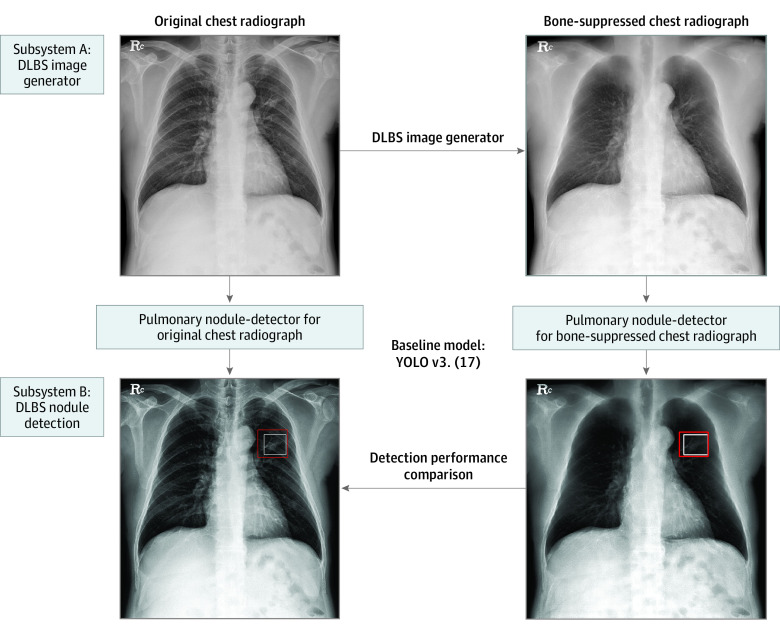
Objectives: To develop and validate a deep learning-based synthetic bone-suppressed (DLBS) nodule-detection algorithm for pulmonary nodule detection on chest radiographs.
Design, setting, and participants: This decision analytical modeling study used data from 3 centers between November 2015 and July 2019 from 1449 patients. The DLBS nodule-detection algorithm was trained using single-center data (institute 1) of 998 chest radiographs. The DLBS algorithm was validated using 2 external data sets (institute 2, 246 patients; and institute 3, 205 patients). Statistical analysis was performed from March to December 2021.
Exposures: DLBS nodule-detection algorithm.
Main outcomes and measures: The nodule-detection performance of DLBS model was compared with the convolution neural network nodule-detection algorithm (original model). Reader performance testing was conducted by 3 thoracic radiologists assisted by the DLBS algorithm or not. Sensitivity and false-positive markings per image (FPPI) were compared.
Results: Training data consisted of 998 patients (539 men [54.0%]; mean [SD] age, 54.2 [9.82] years), and 2 external validation data sets consisted of 246 patients (133 men [54.1%]; mean [SD] age, 55.3 [8.7] years) and 205 patients (105 men [51.2%]; mean [SD] age, 51.8 [9.1] years). Using the external validation data set of institute 2, the bone-suppressed model showed higher sensitivity compared with that of the original model for nodule detection (91.5% [109 of 119] vs 79.8% [95 of 119]; P < .001). The overall mean of FPPI with the bone-suppressed model was reduced compared with the original model (0.07 [17 of 246] vs 0.09 [23 of 246]; P < .001). For the observer performance testing with the data of institute 3, the mean sensitivity of 3 radiologists was 77.5% (95% [CI], 69.9%-85.2%), whereas that of radiologists assisted by DLBS modeling was 92.1% (95% CI, 86.3%-97.3%; P < .001). The 3 radiologists had a reduced number of FPPI when assisted by the DLBS model (0.071 [95% CI, 0.041-0.111] vs 0.151 [95% CI, 0.111-0.210]; P < .001).
Conclusions and relevance: This decision analytical modeling study found that the DLBS model was more sensitive to detecting pulmonary nodules on chest radiographs compared with the original model. These findings suggest that the DLBS model could be beneficial to radiologists in the detection of lung nodules in chest radiographs without need of the specialized equipment or increase of radiation dose.
Conflict of interest statement
Figures