. 2023 Jan 31;19(1):e1011117.
doi: 10.1371/journal.ppat.1011117. eCollection 2023 Jan.

Developing Wolbachia-based disease interventions for an extreme environment

Affiliations

Developing Wolbachia-based disease interventions for an extreme environment

Perran A Ross et al. PLoS Pathog. .

Abstract

Aedes aegypti mosquitoes carrying self-spreading, virus-blocking Wolbachia bacteria are being deployed to suppress dengue transmission. However, there are challenges in applying this technology in extreme environments. We introduced two Wolbachia strains into Ae. aegypti from Saudi Arabia for a release program in the hot coastal city of Jeddah. Wolbachia reduced infection and dissemination of dengue virus (DENV2) in Saudi Arabian mosquitoes and showed complete maternal transmission and cytoplasmic incompatibility. Wolbachia reduced egg hatch under a range of environmental conditions, with the Wolbachia strains showing differential thermal stability. Wolbachia effects were similar across mosquito genetic backgrounds but we found evidence of local adaptation, with Saudi Arabian mosquitoes having lower egg viability but higher adult desiccation tolerance than Australian mosquitoes. Genetic background effects will influence Wolbachia invasion dynamics, reinforcing the need to use local genotypes for mosquito release programs, particularly in extreme environments like Jeddah. Our comprehensive characterization of Wolbachia strains provides a foundation for Wolbachia-based disease interventions in harsh climates.


Conflict of interest statement

The authors have declared that no competing interests exist.

Figures
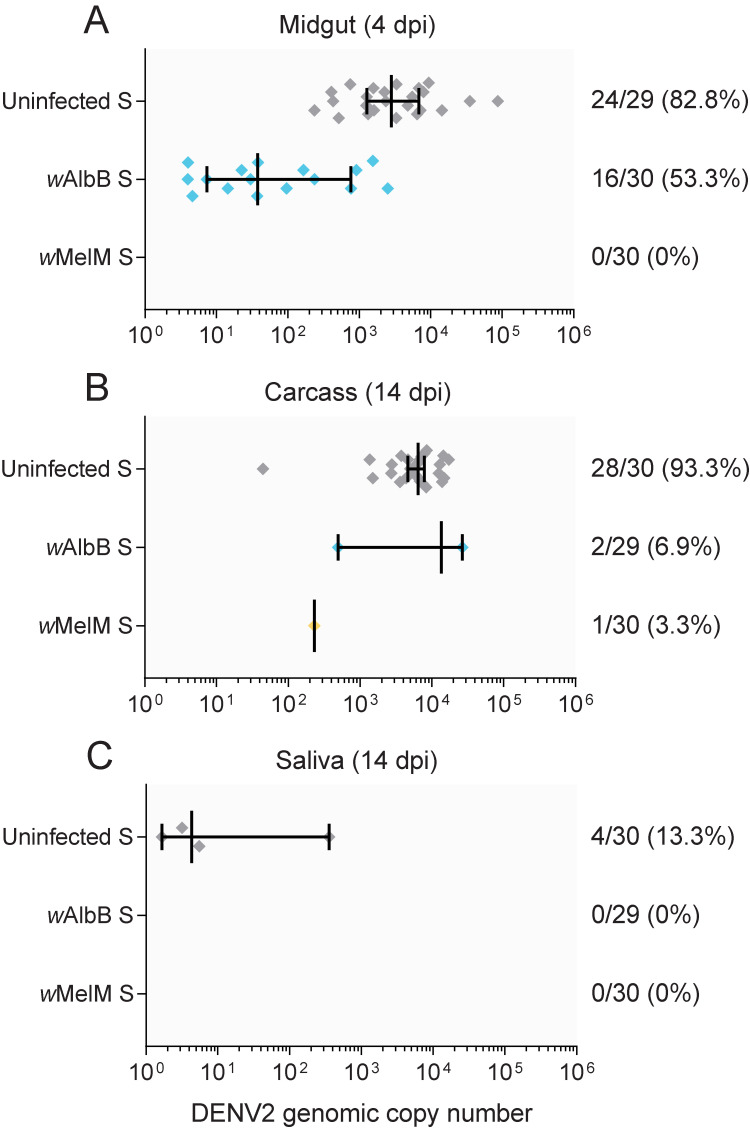
Fig 1
Fig 1. Comparison of DENV2 infection frequencies and copy numbers in uninfected, wAlbB-infected and wMelM-infected Ae. aegypti with a Saudi Arabian background.
We fed females human blood spiked with DENV2 via membrane feeders. We then measured (A) midgut infection at 4 dpi, (B) dissemination to the carcass at 14 dpi and (C) saliva infection at 14 dpi as a proxy for transmission. Each symbol shows data from a single DENV2-positive sample (negative samples were excluded), while vertical lines and error bars represent medians and 95% confidence intervals. Numbers to the right of indicate the number of individuals positive for DENV2 out of the total number tested, followed by the percent positive.
Fig 2
Fig 2. Cross-generational effects of egg storage on Wolbachia-infected and uninfected Ae. aegypti from Australian and Saudi Arabian backgrounds.
(A) Egg hatch proportions of eggs stored for 1 to 11 weeks. Females hatching from eggs stored for different periods were then reared to adulthood and measured for their fertility in panels B-D. (B) Proportion of females hatching from stored eggs that were infertile (with no eggs laid) following a blood meal. (C) Number of eggs laid by fertile females hatching from stored eggs in the previous generation. (D) Egg hatch proportions of fertile females hatching from stored eggs in the previous generation. (E-F) Egg hatch proportions of stored eggs (E) and female infertility (F) measured in a repeat experiment which included the wMelM S population. Symbols show medians, while error bars are 95% confidence intervals. Error bars in panels B and F are not shown as data are binomial. Data points within each time point have been offset to avoid overlap.
Fig 3
Fig 3. Survival of wAlbB-infected and uninfected Aedes aegypti adults from Australian and Saudi Arabian backgrounds under low (A-B) and high (C-D) relative humidity.
Data are presented separately for females (A, C) and males (B, D). Lines show data from 48 (A-B) or 64 (C-D) adults per population. Error bars represent 95% confidence intervals.
Fig 4
Fig 4. Effects of high cyclical temperatures on egg hatch and Wolbachia density in Wolbachia-infected and uninfected Ae. aegypti from Australian and Saudi Arabian backgrounds.
Eggs were placed in thermocyclers set to 26°C (control) or daily cycling temperatures for one week before hatching. Egg hatch proportions are presented separately for Australian (A) and Saudi Arabian (B) populations, with Wolbachia density presented separately for (C) females and (D) males. Symbols show medians, while error bars are 95% confidence intervals. Data points within each temperature cycle have been offset to avoid overlap.

References

    1. Kraemer MU, Sinka ME, Duda KA, Mylne AQ, Shearer FM, Barker CM, et al.. The global distribution of the arbovirus vectors Aedes aegypti and Ae. albopictus. eLife. 2015;4. doi: 10.7554/eLife.08347 . - DOI - PMC - PubMed
    1. Diniz DFA, de Albuquerque CMR, Oliva LO, de Melo-Santos MAV, Ayres CFJ. Diapause and quiescence: dormancy mechanisms that contribute to the geographical expansion of mosquitoes and their evolutionary success. Parasites & vectors. 2017;10(1):310. Epub 2017/06/28. doi: 10.1186/s13071-017-2235-0 - DOI - PMC - PubMed
    1. Rose NH, Sylla M, Badolo A, Lutomiah J, Ayala D, Aribodor OB, et al.. Climate and urbanization drive mosquito preference for humans. Curr Biol. 2020;30(18):3570–9 e6. Epub 2020/07/25. doi: 10.1016/j.cub.2020.06.092 - DOI - PMC - PubMed
    1. Bargielowski I, Lounibos LP. Rapid evolution of reduced receptivity to interspecific mating in the dengue vector Aedes aegypti in response to satyrization by invasive Aedes albopictus. Evol Ecol. 2014;28(1):193–203. Epub 2014/02/25. doi: 10.1007/s10682-013-9669-4 - DOI - PMC - PubMed
    1. Baltzegar J, Vella M, Gunning C, Vasquez G, Astete H, Stell F, et al.. Rapid evolution of knockdown resistance haplotypes in response to pyrethroid selection in Aedes aegypti. Evol Appl. 2021;14(8):2098. - PMC - PubMed

Publication types